
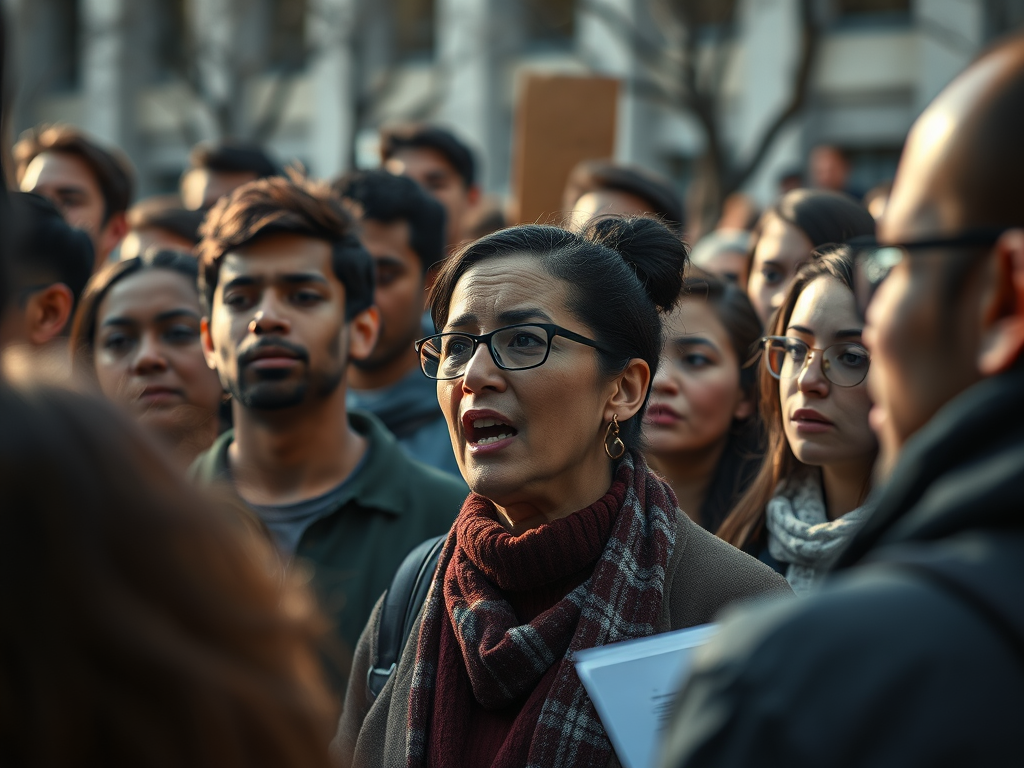

As protests erupted across numerous college campuses last spring, it wasn’t just students who faced repercussions for their involvement. Faculty members also encountered consequences for supporting the protests or for expressing opinions that were interpreted as antisemitic, or less frequently, for pro-Israel activism.
The intensification of the Israeli-Palestinian conflict has, in the eyes of many educators and their supporters, contributed to a growing threat against the principle of academic freedom, which is highly valued by most American colleges and universities.
Non-tenured positions, including visiting scholars and adjuncts, saw their contracts either canceled or not renewed. Some had classes unexpectedly halted. Faculty members reported experiencing public criticism that damaged their reputations and careers.

This trend has affected more than a dozen prominent universities, as indicated by informal records kept by faculty union advocates.
Disciplinary actions against scholars have surged, rising to 145 cases in 2022 from just four in 2000, as education has become increasingly polarized, according to the Foundation for Individual Rights and Expression, an organization dedicated to monitoring free speech violations.
“There’s a chilling atmosphere,” noted Peter Lake, a law professor and director of the Center for Excellence in Higher Education Law and Policy at Stetson University in Florida.
These disciplinary measures have emerged alongside efforts to create a safe environment for students on campus. In the past year, numerous Jewish students reported that protests and discussions about the war have undermined their sense of safety, making them hesitant to express their opinions and anxious about revealing their Jewish identities.
Academic freedom, however, is not limitless. It does not safeguard the “promotion of misguided ideas” in teaching or research, according to Nadine Strossen, a former president of the American Civil Liberties Union. It does not exempt faculty from legal accountability or campus regulations intended to ensure that protests—regardless of their stance—do not interfere with educational activities.
That said, academics are generally granted the First Amendment right to express their opinions or to speak outside their areas of expertise, including on social media.
Yet, it is precisely here that many faculty members are facing challenges, according to Ms. Strossen.
Professors have been accused of creating unwelcoming classroom environments and silencing dissenting student voices, assuming activist roles rather than teaching. Some argue that certain faculty members are expressing views that may necessitate universities to protect students from discrimination.
Much of the pressure to discipline faculty is coming from external sources such as alumni, lawmakers, advocacy groups, and donors.
“External pressures are something any president keen on retaining their position must heed,” said Alison Byerly, president of Carleton College in Minnesota.
During hearings on campus antisemitism last academic year, several congressional Republicans targeted specific professors, urging universities to discipline or dismiss them over speech or writings deemed hateful.
When Columbia’s president, Nemat Shafik, testified, Representative Elise Stefanik from New York highlighted Mohamed Abdou, a visiting assistant professor, citing his Facebook posts supporting Hamas, Hezbollah, and Islamic Jihad shortly after the Hamas attack on Israel.
“What will the consequences be in this case?” Ms. Stefanik inquired.
“He will never work at Columbia again,” Dr. Shafik responded.

Dr. Abdou’s contract was not renewed, and he has since filed a lawsuit against Dr. Shafik and the university for defamation and infringement on his academic freedom, among other claims. He argues that he was misquoted, asserting his post stated he supported Hamas and its affiliates “to a point—given fundamental disagreements regarding our ethical political commitments.”
By condemning him, Dr. Shafik “blacklisted me globally and tarnished my scholarship,” Dr. Abdou stated in an interview.
(Dr. Shafik resigned over the summer after losing the support of numerous faculty members, who expressed their discontent through a no-confidence vote, accusing her of disregarding “our statutes and our norms of academic freedom and shared governance.”)
Columbia has declined to comment on Dr. Abdou’s case, citing ongoing litigation.
Recently, the university also prohibited a vocal pro-Israel assistant professor in its business school, Shai Davidai, from campus, alleging he harassed and intimidated university staff. The professor contends the university hasn’t done enough to curb pro-Palestinian activism, which he believes crosses into antisemitism.
Dr. Finkelstein claims that if any antisemitism was present in her situation, it originated from Muhlenberg College, not her.
“Once the administration summoned me for meetings, I realized that I had assumed being Jewish would protect me, but it didn’t,” Dr. Finkelstein recalled. “I was told there are good Jews and bad Jews, Jews who count and Jews who don’t, which is fundamentally antisemitic.”
She was dismissed on May 30 and is currently appealing her termination.
In a separate investigation, the Education Department’s civil rights division reached a resolution with Muhlenberg in September regarding complaints, including allegations that Dr. Finkelstein fostered a hostile environment for Jewish individuals—contrary to civil rights law—and that the college had failed to take adequate corrective measures. A spokesperson for the college, Todd Lineburger, stated that it is “steadfastly devoted to principles of academic freedom, tenure, and due process.”
Dr. Finkelstein, who chaired the sociology and anthropology department, is the only tenured professor known to have been dismissed for speech or conduct related to the Gaza conflict, according to Anita Levy, a senior program officer for academic freedom at the American Association of University Professors, which plans to investigate her case.
The most vulnerable faculty members are those without tenure.
At the University of California, Los Angeles, another hotspot during last spring’s protests, several faculty, including two tenured professors, two on the tenure track, eight lecturers, and one adjunct, faced criminal charges and internal disciplinary actions for their involvement in campus protests, according to involved faculty members.
Graeme Blair, an associate professor of political science who was arrested during the UCLA encampment, believes that his support for students during a violent confrontation with police cost him a promotion to full professor.

“I think they are sending a message,” Dr. Blair remarked.
UCLA stated it supports academic freedom but cannot comment on individual conduct cases.
Fewer incidents have involved pro-Israel faculty and instructors.
However, the pressure to control faculty speech has highlighted the persistent influence of the tenure system.
Raz Segal, an associate professor of Holocaust and genocide studies, believes he lost a job offer to lead a Holocaust and genocide center at the University of Minnesota due to lobbying from a pro-Israel group against him for labeling Israel’s military actions “a textbook case of genocide.”
Dr. Segal continues to hold his tenured position at Stockton University, a public institution in southern New Jersey.
Annelise Orleck, a history professor at Dartmouth, was arrested while filming a student protest and was subsequently barred from central campus areas, including the president’s residence.

For weeks, she navigated through backyards to attend class to avoid the block near the president’s house, she recounted. Although the charges against her have been dropped and the ban lifted, she still avoids the Green, where her arrest occurred.
Justin Anderson, a spokesperson for Dartmouth, asserted that the university maintains an “unwavering commitment” to academic freedom.
Dr. Orleck expressed gratitude for her situation compared to her colleagues elsewhere. “Many of my colleagues this fall seem to be caught up in a new wave of repression, while I have not,” she noted.
A correction was made on October 23, 2024: An earlier version of this article inaccurately described the employment discussions involving Raz Segal at the University of Minnesota based on information from the university. The administration only supported him receiving a faculty job offer but did not make him an offer.




Leave a Reply