
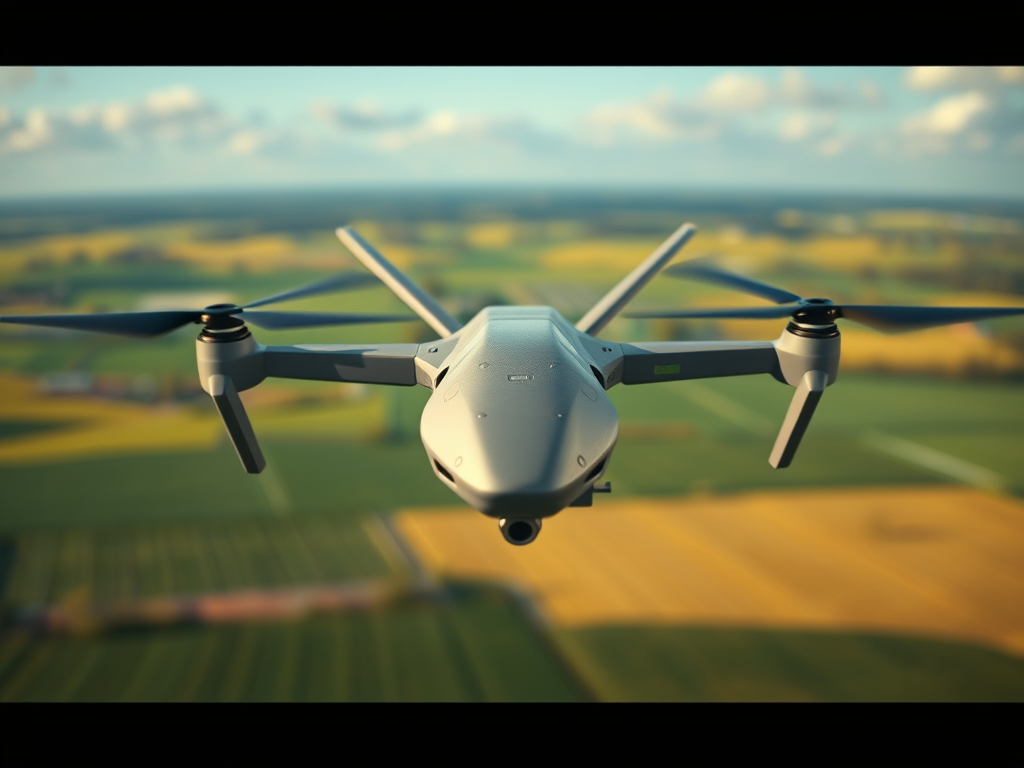

The United States has committed $800 million in military assistance to Ukraine, aimed at producing long-range drones for use against Russian forces, as stated by Ukraine’s president on Monday. This marks a significant step towards fulfilling Ukraine’s long-standing objective of having Washington procure arms from local manufacturers rather than predominantly from U.S. sources.
A Pentagon official, who requested anonymity due to the sensitive nature of the situation, confirmed this development. It reflects a shift in U.S. policy towards bolstering Ukraine’s capacity to conduct the war using its own weapons and strategies.
During a press briefing on Monday, President Volodymyr Zelensky highlighted that this funding represents the initial tranche of U.S. support for Kyiv’s domestic weapons manufacturing and long-range capabilities.
The decision to support the production of long-range drones in Ukraine may serve as a consolation for Mr. Zelensky, who, despite persistent appeals, has been unsuccessful in persuading Western allies to lift restrictions on their long-range missiles for strikes deep within Russia.
This decision also signifies a tactical evolution for Western support.
Since Russia’s full-scale invasion began in February 2022, the U.S. has provided over $61 billion in security aid to Ukraine. Historically, however, it has been reluctant to allocate funds directly for Ukrainian weapon production, opting instead to frame its assistance as a means to support American companies while minimizing corruption risks. Recently, U.S. military aid packages have decreased due to concerns about diminishing Pentagon inventories.
In April, Denmark became the first nation to participate in a Ukrainian initiative known as Manufacturing Freedom, which aims to raise $10 billion for the production of Ukrainian weaponry. The Danish government pledged around $28.5 million to purchase arms from Ukrainian producers, with Canada and the Netherlands joining in later.
With more than two and a half years of conflict behind him, Mr. Zelensky is actively seeking to bolster Western support in any possible way. Despite suffering significant troop casualties, Russia continues to advance in eastern Ukraine, controlling about 20 percent of the territory.
For weeks, Mr. Zelensky has been advocating for what he terms a “victory plan,” traveling to the U.S. and Europe to urge Western leaders to supply additional arms and empower Ukraine to negotiate with Russia from a stronger position.
However, no countries have yet embraced this plan, which heavily relies on enhanced Western backing. Mr. Zelensky’s diplomatic efforts have been overshadowed by events in the Middle East, Hurricane Milton, and the upcoming U.S. elections.
On Monday, he informed reporters that U.S. officials were reviewing his proposal, but he did not anticipate any conclusions until after the Nov. 5 elections. He also mentioned that most NATO allies were keen to formally invite Ukraine to join the alliance, although some, including the U.S. and Germany, are more hesitant, especially given Russia’s strong opposition to Ukraine’s NATO membership.
Drones have played a vital role in enhancing Ukraine’s long-range attack capabilities, particularly as the country awaits approval for long-range missiles from the West.
Ukraine’s defense minister, Rustem Umerov, announced on Monday that Ukraine had invested over $4 billion into its defense sector. At a joint appearance with U.S. Defense Secretary Lloyd J. Austin III in Kyiv, he noted that these long-range drones could strike targets over 1,000 miles away and had already destroyed more than 200 military sites in Russia.
“Our drones have become a significant threat to the enemy,” Umerov remarked, though he emphasized that further investment from international partners was essential.
Western officials have recently commended Ukraine’s drone strikes against ammunition depots near Toropets in western Russia in late September, citing them as prime examples of successful operations targeting Russian supply lines.
They reported that Ukrainian one-way attack drones had effectively targeted several depots holding Russian munitions, including those acquired from North Korea. The first strike on Sept. 18 was substantial enough to create an explosion registering 2.7 on the Richter scale, igniting fires over nearly four miles.
In total, the strikes across several days resulted in the destruction of approximately 100,000 tons of ammunition—the largest loss of Russian and North Korean-supplied munitions since the war began, according to the officials.
During a recent statement in Brussels, Mr. Austin confirmed that the Ukrainians had utilized their long-range drones to neutralize several key ammunition supply points, significantly affecting the battlefield dynamics. He added that Ukraine could produce these drones in large quantities at a fraction of the cost of precision-guided missiles, highlighting their effectiveness and accuracy.




Leave a Reply