
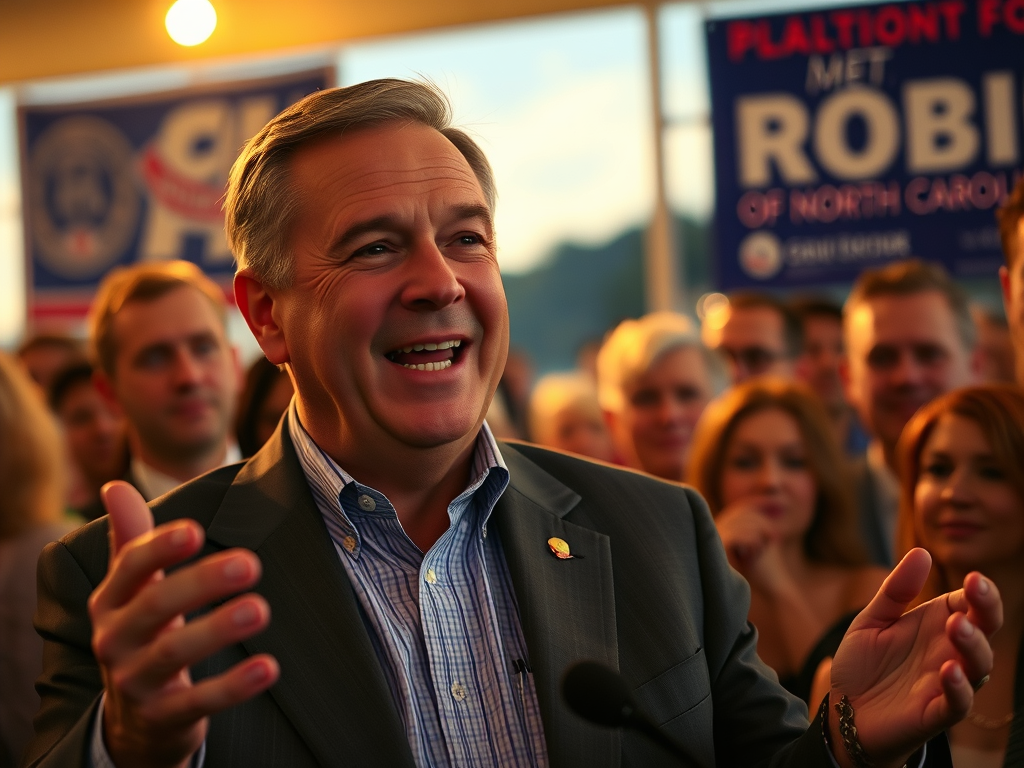
In late 2007, Mark Robinson, now the Republican nominee for governor of North Carolina, made a choice that would drastically alter his future: he created a Facebook account.
At that time, Robinson was 39 years old, running a home daycare with his wife, and said he initially joined Facebook just to talk about pro wrestling. However, his posts soon took a political turn, reflecting his views as a Black conservative with hard-right opinions. He quickly discovered he had a talent for stirring controversy online.
“I wanted people to challenge me,” he wrote in his memoir, published in 2022. “I aimed to be as bold as possible. I wanted people to read my posts and think, ‘Did he actually say that?’ And that’s exactly what happened.”
Robinson’s knack for provocation, combined with a socially conservative Christian worldview and a talent for public speaking, propelled him from obscurity to the political spotlight in North Carolina, where he currently serves as lieutenant governor at age 56.
However, Robinson’s campaign for governor has faced significant challenges, especially after a CNN report linked him to explicit and offensive comments anonymously posted on a pornography site between 2008 and 2012—around the same time he became more active as a provocateur on Facebook. While Robinson has filed a defamation lawsuit against CNN, he has yet to provide evidence to support his claim that the report was “recklessly false.”
Even before the CNN story, Robinson’s polling numbers had started to decline, with his Democratic opponent, Josh Stein, the state’s attorney general, highlighting Robinson’s controversial statements over the years, including derogatory remarks about women who seek abortions. Additionally, Robinson has been criticized for making comments perceived as racist, antisemitic, and transphobic.

Robinson’s political ascent exemplifies the influence of a media landscape where unfiltered voices can gain substantial reach. Yet, his story may also serve as a cautionary tale for a Republican Party increasingly shaped by Trumpism, highlighting the potential pitfalls of promoting candidates whose strength lies in online edginess.
“You look at his résumé and wonder, how did he become lieutenant governor?” said Allen Johnson, editorial page editor of Greensboro’s News & Record, where Robinson is from.
Robinson had agreed to an interview for this article but ended the conversation abruptly when asked about the porn site allegations and his past offensive comments. His consultant, Matt Hurley, ended the call, saying, “Let us know when you’re ready to do a proper profile on the race.”
Before his political career, Robinson worked in pizza shops and as an upholsterer in a furniture factory. He had a high school diploma, a big personality, and a passion for wrestling on TV. In his 30s, he and his wife went bankrupt, admitting in court that they had only $40 in cash.
Some of Robinson’s longtime friends recall that he always had strong opinions and loved stirring the pot. One friend, Anthony Spearman, noted that Robinson often said things “for shock value” just to see how people would react.
Darius Burwell, who also grew up with Robinson in Greensboro, described him as the “life of the party” and someone who could light up a room.
Born in 1968 in Greensboro, Robinson grew up in poverty with many siblings. His father, an alcoholic who abused his mother, passed away when Robinson was in fifth grade. His family received government food assistance, and Robinson spent some time in foster care. His mother, proud of her independence, worked as a custodian at North Carolina A&T State University after her husband’s death, refusing to rely on welfare.
Greensboro thrived during the 20th century, driven by the textile and tobacco industries, but both sectors started to decline in the 1970s and ’80s, when Robinson was growing up.

Robinson’s exposure to both the struggles and successes of Black residents shaped his view of race. He rejected what he saw as victimhood narratives, finding it offensive when people reduced Black stories to tales of oppression and hardship. He also criticized school busing plans in Greensboro, which he felt disrupted his education.
In high school during the Reagan era, Robinson was drawn to patriotism, joining the Junior Reserve Officers’ Training Corps and dreaming of a military career inspired by the “Rambo” movies. However, after graduation, he struggled to find his path. He considered college and active military service but neither felt right for him, though he did serve in the Army Reserves for a few years.
By the mid-1990s, Robinson identified as a conservative, influenced by Rush Limbaugh’s book The Way Things Ought to Be. Initially, Robinson bought the book to criticize its content, but he soon found himself agreeing with Limbaugh’s views, realizing, “Rush Limbaugh is not a racist. Rush Limbaugh is me.”
Financial troubles continued to follow Robinson and his family. Bankruptcy records revealed he hadn’t filed federal taxes for five consecutive years, and by 2003, he and his wife were more than $1.1 million in debt with only $70 in savings. Their home was foreclosed in 2004, and the family bounced between rental properties.

In 2006, state inspectors found multiple violations at the daycare Robinson and his wife operated, leading to its closure the following year. Robinson would later use this experience to criticize government overregulation of small businesses.
Robinson’s financial struggles and bold online persona characterized much of his life, and he and his wife declared bankruptcy three times in total. They faced accusations of writing bad checks and saw multiple businesses fail under regulatory scrutiny.
Despite these setbacks, Robinson’s provocative online presence continued to gain attention, especially among conservatives, as he criticized mainstream Black perspectives and figures such as the Rev. Dr. Martin Luther King Jr. By 2018, Robinson viewed himself as a truth-teller shaped by years of online debate.
That April, he delivered a passionate pro-gun speech at a Greensboro City Council meeting, which quickly went viral and propelled him into national conservative circles. His remarks resonated with conservatives, not least because of his race, and he soon became a rising star within the Republican Party.

In 2019, Robinson announced his run for lieutenant governor and won both the Republican primary and the general election. However, scandals have continued to follow him, including investigations into his wife’s nonprofit and his ties to questionable business practices.
Since the CNN report, many of Robinson’s campaign staff have resigned, and support from high-profile Republicans, including Donald Trump, has waned.
A few years ago, Robinson mused about possibly running for national office, saying, “It might sound odd, but I would leave it up to God — and social media.”




Leave a Reply