
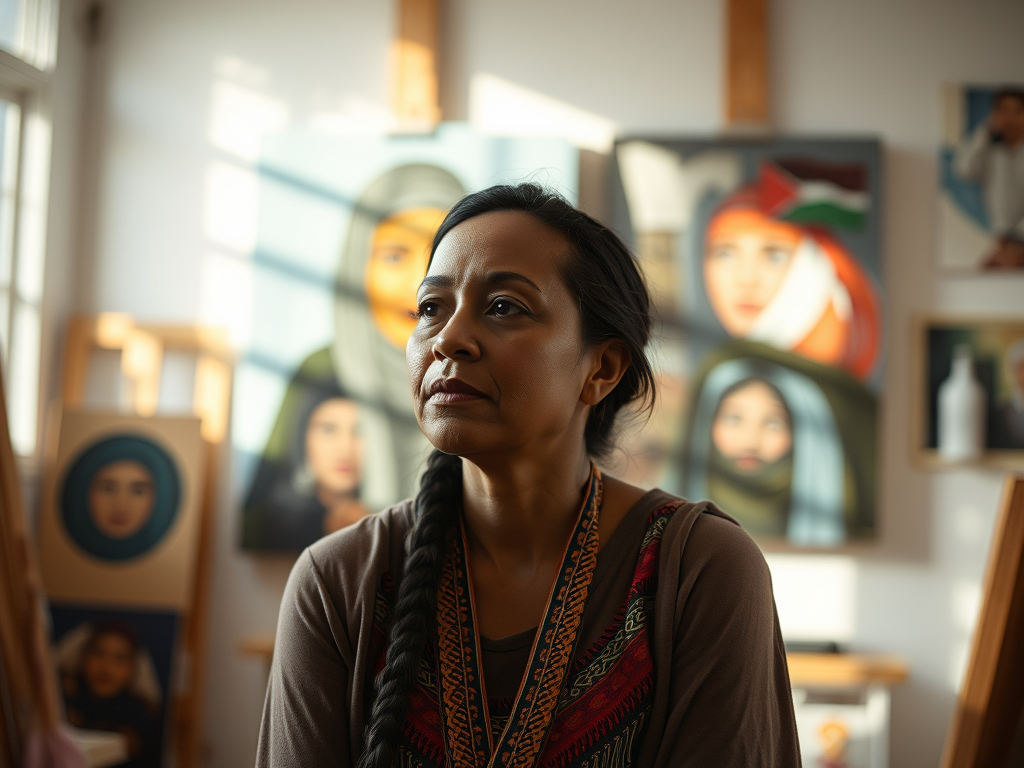

The American Civil Liberties Union (ACLU) of Colorado has filed a lawsuit against the town of Vail on behalf of Native American artist Danielle SeeWalker, asserting that the town violated her First Amendment rights by canceling her artist residency. The residency was revoked after she posted a painting on social media about her views on the Gaza war.
SeeWalker’s painting depicted a woman wearing a Palestinian kaffiyeh and a feather, titled “G is for Genocide.” In March, she shared it on Instagram, expressing her grief and guilt over living in privilege while people in Gaza suffered. Two months later, Vail officials informed SeeWalker, 41, that her planned 10-day residency through the town’s Art in Public Places program, during which she was to complete a mural, had been terminated. The cancellation was reportedly due to outrage from some members of the local Jewish community over her painting.
The lawsuit, filed last week in federal court, highlights a larger debate in the art world over freedom of expression and criticism of Israel, as several artists, writers, and other public figures face backlash for their views on the Gaza conflict. The war began on October 7, 2023, with a Hamas attack on Israel that killed 1,200 people, followed by Israeli military operations that local health authorities say have killed over 42,000 people in Gaza, many of them civilians. Israel denies targeting civilians, claiming Hamas fighters hide among the population.
A spokeswoman for Vail, a town about 90 miles from Denver known for its ski resorts, declined to comment on the lawsuit. However, in May, the town issued a statement saying the residency was canceled due to concerns about politicizing the public art program, noting that the program’s mission was to provide a diverse public art experience without using public funds to take a stance on divisive geopolitical issues.
The lawsuit claims the decision was influenced by complaints from Rabbi Joel Newman of the B’nai Vail Congregation, who emailed town officials in early May, condemning the painting’s suggestion that Israel was committing genocide. The town canceled the residency shortly after receiving these emails. SeeWalker, a citizen of the Standing Rock Sioux Tribe, said her painting was intended to draw comparisons between the historical struggles of Native Americans and the current situation in Gaza and was unrelated to the mural she had planned in Vail.
SeeWalker expressed disappointment over the cancellation, saying Indigenous voices have been silenced for generations and that this kind of censorship must end. She noted the cancellation disrupted her schedule and caused her to turn down other opportunities.
ACLU attorney Laura Moraff stated that both the U.S. and state constitutions prohibit viewpoint-based discrimination, and they would fight to protect the rights of Coloradans to express their opinions without fear of government retaliation. The ACLU emphasized that while Vail was not required to create an artist residency program, it could not impose viewpoint restrictions once the program was established.
David Pozen, a constitutional law expert at Columbia Law School, said the lawsuit appears strong, noting that while governments can limit the speech of those they fund, such restrictions must align with the purpose of the program. He suggested the reason for SeeWalker’s removal was unrelated to the residency’s goals, which could pose a significant issue for the town in court.




Leave a Reply