
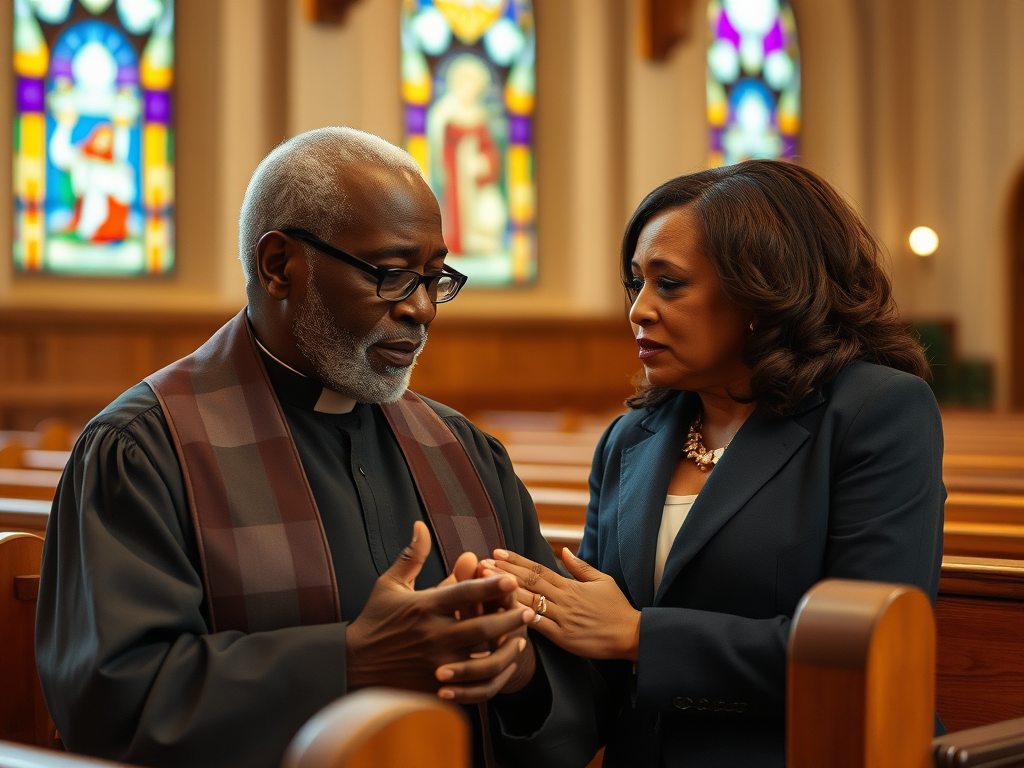

The Rev. Dr. Amos Brown was enjoying his typical Sunday afternoon nap in late July when he received a call from a long-time member of his congregation, Vice President Kamala Harris.
“Pastor, I need you to pray for Doug, for me, and for our nation,” Dr. Brown recalls her saying. “I’ve made the decision to run for president.”
Just hours earlier, President Biden had announced he would not seek re-election and quickly endorsed Ms. Harris.
The prayer Dr. Brown, 83, offered was inspired by a Bible verse frequently quoted by Ms. Harris: “What does the Lord require of you but to do justly, to love mercy, and to walk humbly with your God?”
This intimate moment provides a rare insight into Ms. Harris’s private spiritual life, reflecting the diverse and increasingly secular America she aspires to lead. Born to a Hindu mother and a Christian father, she later married a Jewish man in a ceremony that blended both Indian and Jewish traditions. Reports from that time noted that in 2021, the couple affixed a mezuzah—a small scroll in a decorative case indicating a Jewish household—on the doorpost of the vice-presidential residence, a historic first.
Rev. Paul Brandeis Raushenbush, who leads Interfaith Alliance, remarked that Ms. Harris has experienced the essence of living in a multifaith democracy throughout her life.
In the final weeks of the election campaign, Ms. Harris visited several churches. On her 60th birthday, she attended two services in Georgia, aligning with the campaign’s “Souls to the Polls” initiative aimed at mobilizing Black churchgoers.
Polls indicate that many Americans do not perceive either Ms. Harris or Mr. Trump as especially religious. A September survey by The Associated Press-NORC Center for Public Affairs found that 43 percent of respondents considered Ms. Harris “religious,” while 35 percent felt the same about Trump.
This perception may not be an issue for a large portion of Ms. Harris’s supporters. As religious affiliation declines across the U.S., the decrease has been more pronounced among Democrats. According to Gallup, in 1999, approximately 60 percent of both Democrats and Republicans identified as “religious.” By 2023, the figure for Republicans remained stable, but only 37 percent of Democrats described themselves in that way.
Ms. Harris has stated that she grew up attending both a church, the Twenty-Third Avenue Church of God in Oakland, and an unnamed Hindu temple. Throughout her adult life, she has maintained connections to the Black church and its tradition of political engagement. While she often references scripture in speeches and interviews, she rarely discusses her faith in personal terms that resonate with evangelicals, nor does she attend church as frequently as President Biden, who regularly participates in Mass.
In contrast, Donald J. Trump, who was baptized as a Presbyterian, claimed in 2020 to identify as a nondenominational Christian, a broad category that includes many evangelicals. He has shown limited knowledge of the Bible or fundamental Christian theology.

Nonetheless, Mr. Trump has positioned himself as a defender of conservative Christian values, making unfounded allegations that Ms. Harris has presided over a “wave of anti-Christian bigotry” and aims to marginalize Christians. Trump’s supporters have also questioned her ties to the Black church.
The Harris campaign did not respond to inquiries about her faith and spiritual life. In a recent interview with radio host Charlamagne Tha God, Ms. Harris defended herself against accusations of not engaging enough with Black churches, asserting that such attacks are part of Mr. Trump’s attempts to undermine her racial identity.
“They are trying to disconnect me from the people I’ve worked with—and who I am,” she stated, adding, “I grew up in the Black church.”
She suggested it is Mr. Trump whose values conflict with the teachings of justice, mercy, and kindness, referencing Micah 6:8, the Bible verse Dr. Brown mentioned when seeking prayers for her candidacy.
“God is good,” Charlamagne said.
“Everyday, all the time,” Ms. Harris replied, echoing a common call-and-response from Black churches.
When addressing Black religious audiences, Ms. Harris often incorporates Bible verses. At a recent event in a North Carolina church, she concluded with Psalm 30:5—“Though weeping may endure for a night, joy cometh in the morning”—prompting applause and shouts of recognition from the congregation.
Ms. Harris has been a member of Dr. Brown’s church for around 20 years, a congregation founded before the Civil War where Martin Luther King Jr. once preached. Their initial connection was political rather than spiritual; Ms. Harris was introduced to Dr. Brown by Willie Brown, the then-mayor of San Francisco, and later advised him on his successful campaign for a city board position in the 1990s.
Although Ms. Harris has since relocated from the Bay Area and built a network of faith advisors from predominantly Black churches nationwide, Dr. Brown asserts that Third Baptist remains her spiritual home. She is not widely known to attend services regularly in Washington or Los Angeles, where she moved after marrying Doug Emhoff. Dr. Brown noted that evangelist Billy Graham was a member of a Southern Baptist church in Dallas for decades, even though he never resided there.
In a recent interview, Dr. Brown described Ms. Harris as a Christian—“a follower of Jesus of Nazareth”—whose faith manifests more in action than in words. He cited a pilot program she initiated in 2005 aimed at reducing recidivism among young nonviolent drug offenders as an example of her compassion and recognition of human dignity.
“Her faith is an active faith, a walking faith,” he remarked. “She’s a doer of the word.” He contrasted this with a more ostentatious approach that he criticized as “a whole lot of hallelujah but not much do-aloojah.”
In her 2019 memoir, “The Truths We Hold,” Ms. Harris articulated her Christian faith similarly: “‘Faith’ is a verb,” she wrote. “I believe we must live our faith and demonstrate faith in action.”
Some of Ms. Harris’s supporters feel she should be more vocal about her Christian beliefs during the campaign.
“I believe she needs to continue discussing her faith, to show the world that she is a proud Christian and a devoted prayer warrior,” said Rev. Dr. Kevin Johnson, senior pastor of Abyssinian Baptist Church in Harlem, who met Ms. Harris years ago in Pennsylvania.
During a recent visit to New Birth Missionary Baptist Church, a prominent Atlanta-area megachurch that has hosted many politicians, including former President George W. Bush, Ms. Harris used the parable of the Good Samaritan from the Gospel of Luke to intertwine themes of faith, action, and power.
At the end of the service, Rev. Jamal Bryant invited the congregation to reach out to Ms. Harris with their hands. The candidate stood in the front pew, head bowed, eyes closed, and hands clasped, as they prayed for her.




Leave a Reply