
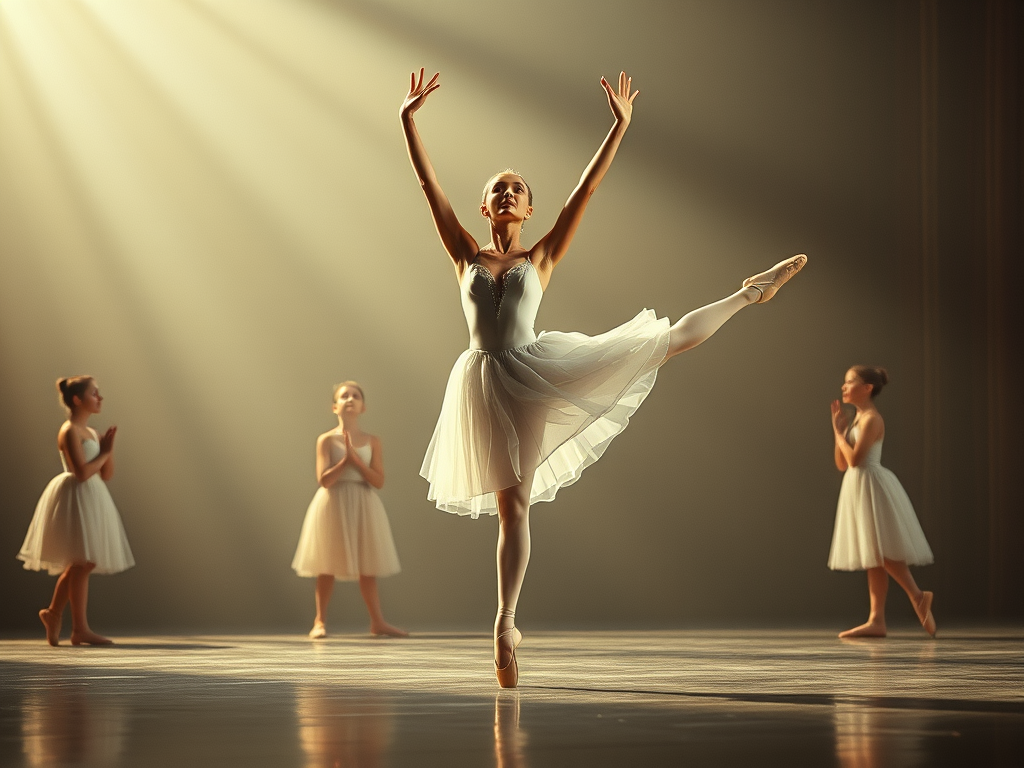

There is a time to dance, and a time to applaud. While these moments can occasionally overlap, it’s not ideal. George Balanchine, the founding choreographer of the New York City Ballet, once likened the theater to a church. As he famously said in a book about the making of his final major work, Mozartiana, “You wouldn’t clap in the middle of a sermon or hymn.”
This sentiment applies to the beginning of Mozartiana, which was created for the 1981 Tchaikovsky Festival (Balanchine passed away two years later). The ballet, set to Suite No. 4—Tchaikovsky’s arrangement of several short Mozart pieces—opens with a soulful prayer, or “preghiera.” The delicate and reverent quality of this moment makes it feel like a dance hymn, with the dancer even lifting her arms in prayer.
At the start of the ballet, the female lead, originally Suzanne Farrell, is flanked by four young dancers who resemble smaller versions of herself. This arrangement immediately brings a sense of stillness to the stage. As Balanchine described it, “Like a picture—still, as in a church.”
Mozartiana, which returned to the City Ballet’s repertory this fall as part of the season’s highlight program, “Balanchine + Ratmansky,” glowed with a sense of beauty, melancholy, and vibrancy. In the ballet’s opening sequence, the lead dancer rises en pointe, performing intricate bourrée steps, giving the impression of floating as she glides across the stage, almost as if she’s dancing on air.
By featuring both professional dancers and students, Mozartiana serves as a poignant reminder that ballet is passed down through generations—not via technology but through the dedication of dancers and rigorous training. Through years of hard work, dancers learn to make what once seemed impossible appear natural. Mira Nadon, in her debut as the lead, embodied this perfectly. She danced with a natural elegance, staying true to her age and personal interpretation of Mozartiana.
Coached by Farrell, Nadon’s performance was stunning. Her open and innocent prayer was breathtaking, and throughout her variations, she displayed a mix of assertiveness and simplicity, quickening her footwork as the music built and moving her arms with bold grace. Early in the performance, she pushed a balance so far that she collapsed onto the floor, only to spring up immediately, unphased. It was as if a cloud had lifted.
Her partner, Peter Walker, slightly redeemed his shaky earlier-season performance. Though he is still searching for refinement in classical roles, a softer approach may benefit him. In the gigue, Sebastián Villarini-Vélez brought buoyancy to the choreography without turning it into an acrobatic display. His presence carried a haunting quality, almost as if he were channeling the spirit of a jester.

Balanchine’s works Monumentum pro Gesualdo and Movements for Piano and Orchestra served as a cool and crisp centerpiece for the program. Nadon danced both with Adrian Danchig-Waring one evening, but casting was varied across performances. On another night, Miriam Miller, who showed some restraint, danced Monumentum with Aarón Sanz, while in Movements, Dominika Afanasenkov and Davide Riccardo formed a powerful and steely duo, switching between sharp precision and a more relaxed, flowing style.
The finale, Alexei Ratmansky’s lively Concerto DSCH set to Shostakovich, reinforced how well his choreography suits the City Ballet dancers. Emma Von Enck dazzled with her sharp jumps, and another cast featuring Indiana Woodward, KJ Takahashi, and Victor Abreu delivered an energetic and joyful performance that elevated DSCH even further.
This program highlighted the connection between Balanchine and Ratmansky, the company’s artist-in-residence. While their styles aren’t identical, they share a similar intent: blending precision with attack, finesse with emotion, and musicality with heart. Their works don’t just create ballets; they conjure dreamlike worlds filled with magic.

The season also marked Justin Peck’s 10th anniversary as the company’s resident choreographer, celebrated with an “All Peck” program. Though the collection of four dances and a film tribute was a bit uneven and lengthy, Peck’s earlier works, In Creases (2012) and Everywhere We Go (2014), stood out as promising examples of his early creativity and youthful energy. These works were born during a time when Peck, a former dancer, was experimenting alongside friends.
In a film that introduced the program, Peck discussed his aim, similar to Balanchine, to expand his range by creating different types of ballets. However, building a lasting repertoire requires more than a shift in scenery or a fashionable collaborator, and lately, his works seem to recycle ideas rather than evolve from one another. Peck’s preference for creating onstage communities makes him feel more akin to Jerome Robbins than Balanchine.
Peck’s Solo, originally developed as a digital work during the 2021 pandemic and set to Barber’s Adagio for Strings, is most successful when performed by Sara Mearns. Her calm, unsentimental execution brings substance to the piece. Without her, it risks becoming just another competition dance. Naomi Corti, debuting in the solo, commanded the stage but leaned a bit too heavily into emotion.
Partita (2022), set to Caroline Shaw’s music, hasn’t improved with time. The sneaker ballet, set against a backdrop of silky, colorful fabric by Eva LeWitt, feels more decorative than substantive. It also now seems like a precursor to Peck’s Broadway show, Illinoise, based on a Stevens album—though not in a good way.
This fall season, coinciding with the 90th anniversary of the School of American Ballet, featured a special performance of Serenade by students, some of whom are now apprentices. The dance was split between multiple principal performers to allow more students to participate, which slightly disrupted the flow of the piece, though the students’ dancing was better than it had been at their June workshop. A standout was Kylie Vernia as one of the Dark Angels, displaying confidence and a fresh approach.

Following the celebration of City Ballet’s 75th anniversary, this fall season felt like a return to basics, with dancers reprising roles from previous years. Though there wasn’t a new Swanilda in Coppélia, it did provide Megan Fairchild with another opportunity to shine in a role she first took on as a 19-year-old in 2003. With her humor and depth of performance, Fairchild continued to charm as Swanilda. At the fall gala, when Wendy Whelan, City Ballet’s associate artistic director, referenced the “spirit of ’76,” Fairchild immediately came to mind—leading the way all season with a radiant smile.




Leave a Reply