
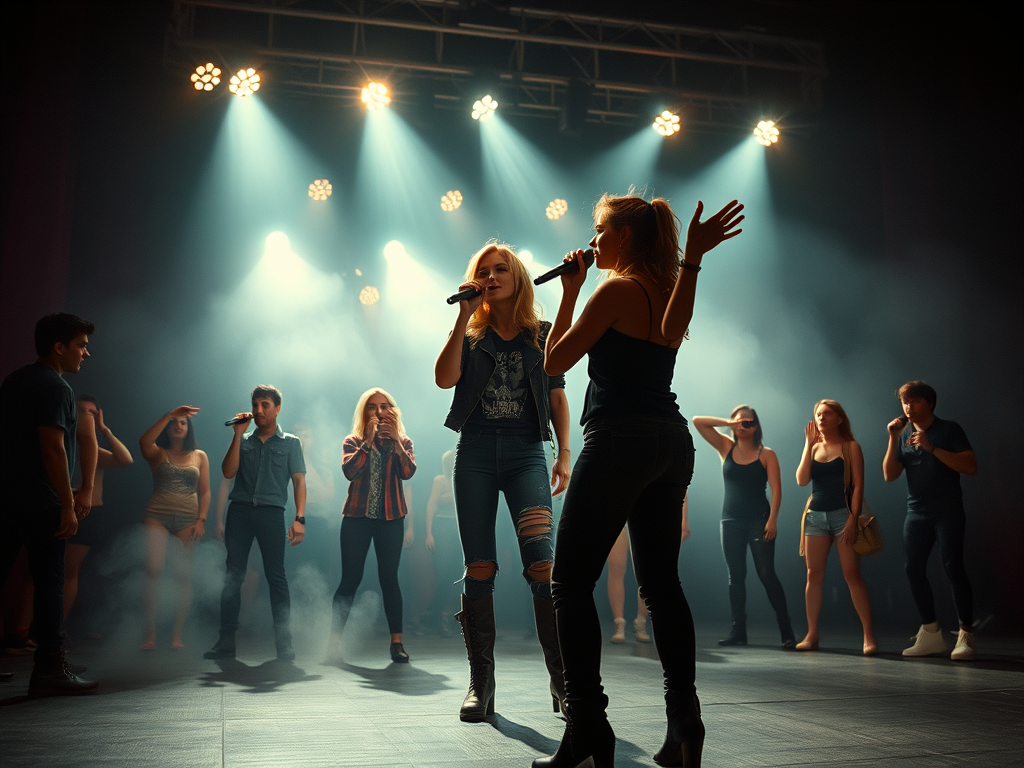
Inside the Mark Taper Forum in downtown Los Angeles, the atmosphere was thick with stage fog and the nervous energy that comes before a big show. It was just a few hours before the first performance of a revival of Green Day’s “American Idiot.” The choreographer, Jennifer Weber, was giving the cast some final pointers. Dressed in their costumes—combat boots, eyeliner, and ripped jeans straight out of Hot Topic—they rehearsed their dance moves on stage. Holding a microphone, Weber sang “Homecoming” while demonstrating choreography:
“What the hell’s your name?/What’s your pleasure, what is your pain?”
Nearby, Maria Cardoza, the American Sign Language (ASL) interpreter, was translating Weber’s instructions for the cast. As stage fog swirled and the lights dimmed, Colin Analco, the show’s ASL choreographer, used a flashlight to help highlight Cardoza’s signing. Weber continued singing and counting out the beats:
“‘Blew his brains out’ … one! … two! … three!”
All around the theater, a mix of spoken English and sign language conversations filled the space as the cast and crew prepped for the show. This version of “American Idiot” adds another layer to its legacy. It’s more than just an album that dominated 2004’s alternative radio or a nostalgic playlist favorite. The musical, which premiered on Broadway in 2010, has now transformed into a vibrant display of the countless ways to express defiance through body language, particularly the middle finger.
Running from October 9 to November 16, this production is a collaboration between Center Theater Group and Deaf West Theater, a Tony Award-winning company that masterfully combines ASL with spoken English. The cast includes both Deaf and hearing actors, with some lead roles shared between two performers—one Deaf, who primarily signs, and one hearing, who sings and speaks. Deaf West has honed this method for years, but the fast-paced, foul-mouthed punk rock musical presented unique challenges.
“American Idiot” is not your typical stage musical. It’s built around rock songs like “Boulevard of Broken Dreams,” “Wake Me Up When September Ends,” and the title track, all of which were never intended for theater. The story follows three teenage outcasts—Johnny, Will, and Tunny—as they navigate their lives, largely told through music.
When DJ Kurs, Deaf West’s artistic director, was approached by Snehal Desai, the director of this production, to collaborate on a sung-signed revival, his initial reaction was fear. Kurs worried that the characters’ angry punk energy might perpetuate stereotypes about Deaf people being constantly angry at the hearing world. At the same time, the project offered a chance to counteract some of the flat, one-dimensional portrayals of Deaf characters in mainstream media.
One of the cast members, Daniel Durant, who starred in the 2022 film “CODA” and played Johnny in this production, described his character as “the most rebellious and anti-establishment” role he’s ever taken on. Unlike many portrayals of Deaf characters, these roles don’t ask for pity.
Jennifer Weber, the show’s choreographer, worked with the team to explore what it means to be “physically loud” in a way that’s visually powerful, especially since ASL isn’t sound-based. They used synchronized movements and repetition to create impactful moments on stage. On top of this, bold captions were added, with words projected on the set to match the intensity of the music, giving the lyrics a visually explosive flair.
The cast also had to deal with technical challenges. Analco, the ASL choreographer, led the effort to translate Green Day’s lyrics into sign language. In songs like “Holiday,” he found creative ways to capture the sarcastic tone by blending opposing signs to mirror the biting delivery of the lyrics.
To keep everything in sync, the production uses an elaborate system of colored lights that act as cues for the actors, both hearing and Deaf. These lights, hidden from the audience, let the performers know when to deliver lines or hit a specific dance move. During rehearsals, crew member Abby Peterson explained how the lights were controlled from a panel offstage, each switch triggering a light assigned to a different performer.
For Daniel Durant, the music in the show is more about rhythm than melody. As a profoundly Deaf person, he explained that he doesn’t experience music in the same way as hearing people, but he deeply connects with rhythm. “I love a pounding bass. It could be a heartbeat, a ticking clock—those are the beats in our lives,” he said.
As the audience trickled in for the evening performance, they would have noticed something unusual—there was no preshow music. Instead, the speakers emitted the rhythmic thud of a beating heart, setting the stage for a visceral and immersive experience.




Leave a Reply