
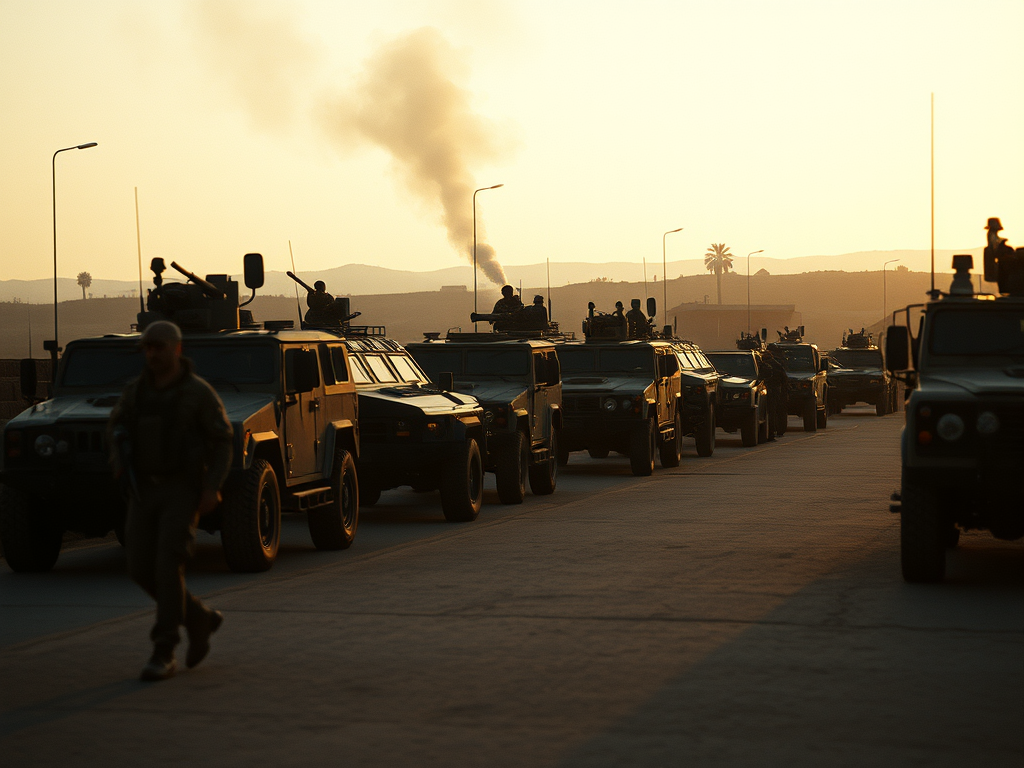

A Hezbollah drone strike on a military base in northern Israel killed four soldiers and injured dozens more, the Israeli military reported on Sunday.
The attack targeted a base in Binyamina, a town in the Haifa district. Israeli officials viewed this incident not only as a demonstration of Hezbollah’s strength but also as highlighting a concerning gap in Israel’s air defense systems. Hezbollah claimed responsibility, stating it had launched a “swarm of attack drones” across the border into Israel.
“We are analyzing and investigating how a drone managed to breach our defenses without detection and strike the base,” said Rear Adm. Daniel Hagari, an Israeli military spokesperson. “We need to improve our defenses.”
Over the past week, Israel has ramped up its military offensive against Hezbollah in Lebanon, carrying out heavy bombings around Beirut, southern Lebanon, and other areas. The Lebanese government reported that at least 23 people were killed in the last 24 hours. However, the airstrikes and ground offensive, which began two weeks ago, have not yet achieved their objective of stopping Hezbollah’s cross-border attacks.
On Sunday, air raid sirens warned of incoming rockets throughout northern Israel, with Israeli forces reporting that Hezbollah had fired around 115 rockets or missiles by 3 p.m. local time.
Fears of further attacks, especially as Israel is also engaged in conflict with Hamas in Gaza, led the United States to announce on Sunday that it was sending an advanced missile defense system to Israel, along with 100 troops to operate it. This move places American personnel even closer to the conflict in the Middle East.
The Institute for the Study of War, a Washington-based research organization, said in a new report that Hezbollah’s continued rocket attacks were intended to erode Israeli public support for the invasion of Lebanon, which followed a year of rocket exchanges.
Hezbollah’s rocket fire began over a year ago in solidarity with Hamas, shortly after Hamas’s October 7 attacks on Israel. Both groups receive backing from Iran.

As Israeli troops advanced into southern Lebanon this week, they encountered tensions with United Nations peacekeepers, who are there to help maintain a buffer zone.
In a new development on Sunday, Israeli tanks entered a U.N. peacekeeping base, drawing a formal protest from the U.N. mission, which said that its soldiers’ lives were put at risk.
The tank entry followed days of criticism directed at Israel for attacks that injured at least four peacekeepers in Lebanon.
The U.N. peacekeeping force, known as UNIFIL, has been stationed in southern Lebanon for over four decades, tasked with keeping the border area free of military forces and weapons.
Early Sunday morning, the U.N. said, Israeli battle tanks arrived at one of its bases.
“While peacekeepers were in shelters, two IDF Merkava tanks destroyed the main gate and entered the base by force,” the mission said in a statement. Israeli soldiers repeatedly asked the base to turn off its lights.

Although no peacekeepers were injured, Israel’s entry into a U.N. base risked compromising the mission’s neutrality and potentially making it a target for Hezbollah. The tanks reportedly left 45 minutes later, following a formal protest by the U.N.
The Israeli military explained that its forces were evacuating soldiers under Hezbollah missile fire at the time. A military spokesperson, Nadav Shoshani, said that the tank’s entry was not an intentional breach.
Israel claims that the peacekeeping force, which is largely observational, has failed to prevent Hezbollah from building up its military presence near the border and accused militants of operating close to the peacekeeping bases.
Recently, Israeli officials have called for the mission to withdraw. On Sunday, Prime Minister Benjamin Netanyahu reiterated this stance in a message to U.N. Secretary-General António Guterres, stating, “Your refusal to evacuate UNIFIL soldiers is making them hostages of Hezbollah, endangering both their lives and those of our soldiers.”
Netanyahu expressed regret over the injured peacekeepers, emphasizing that Israel is doing everything possible to avoid further harm. “The simplest way to ensure their safety,” he said, “is to pull them out of the danger zone.”
The U.N. force has rejected Israel’s demands to leave its positions in southern Lebanon, citing its mandate from the U.N. Security Council. Secretary-General Guterres does not have direct control over UNIFIL.
U.S. Defense Secretary Lloyd J. Austin III said on Saturday that he had spoken with Israel’s defense minister, Yoav Gallant, and stressed the importance of ensuring the safety of peacekeepers and Lebanese forces.
Gallant confirmed on Sunday that Israel was investigating the incident involving UNIFIL troops and would continue efforts to avoid harm to peacekeeping personnel and bases.
On Sunday, the Israeli military reported that its air force had targeted approximately “200 Hezbollah sites across Lebanon” over the previous day, as ground clashes continued between Israeli troops and Hezbollah fighters in southern Lebanon.
The Lebanese Red Cross responded overnight to what it called a “major strike” in the southern city of Nabatieh, sharing an image online of flames and debris. Lebanese civil defense later confirmed that one person was killed and four were injured. Lebanese authorities said that at least 23 people had been killed in the past 24 hours.
Philippe Lazzarini, head of the United Nations agency aiding Palestinians, said on Sunday that he had recently visited Lebanon, where his teams were assisting Lebanese, Palestinians, and Syrians affected by the conflict. “The escalation into Lebanon is diverting efforts from achieving a ceasefire, which is urgently needed for civilians across the region,” he said on social media.
Around a dozen Israeli troops have died in the current campaign. On Sunday, Israel announced that two more soldiers had been seriously wounded in combat. Additionally, Israeli forces captured a Hezbollah fighter during a tunnel raid in southern Lebanon.




Leave a Reply