
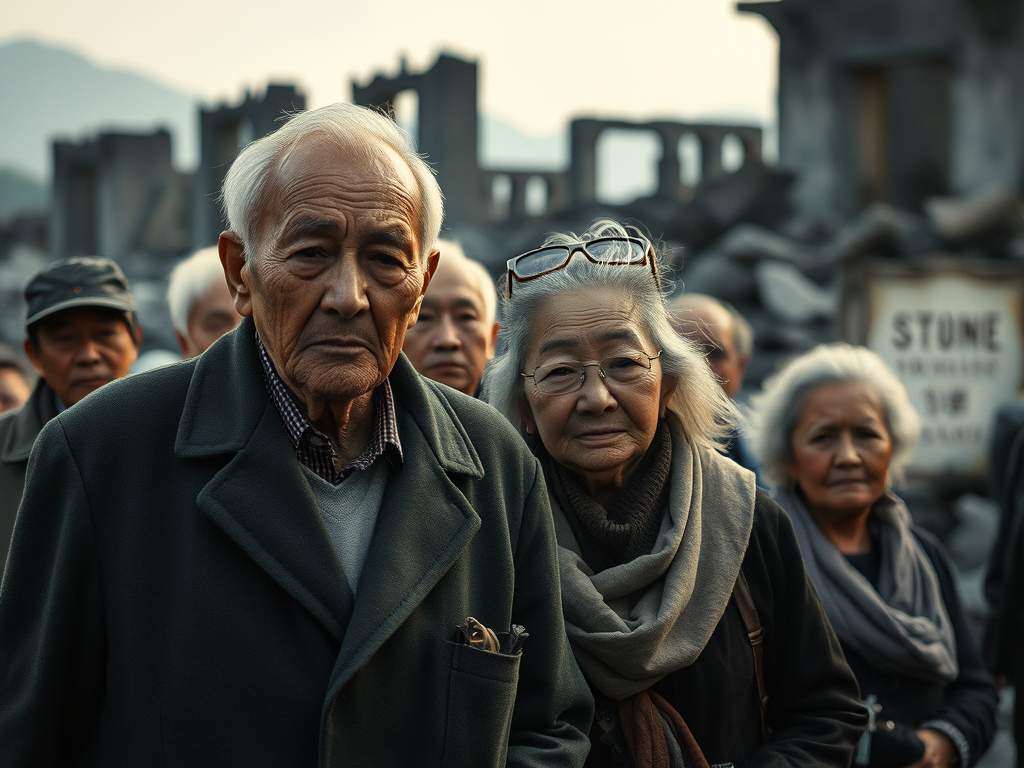
Cities reduced to rubble, charred bodies, and scorched skin. Radiation swept through the air, unseen but deadly, leaving behind the haunting image of a mushroom cloud.

When the United States dropped atomic bombs on Hiroshima and Nagasaki, it gave the world a glimpse of what total destruction looked like. Tens of thousands perished instantly.
They were bombed, then shunned. Now, at last, nuclear survivors are being acknowledged.

Emerging from the ruins of two atomic blasts, their skin burned, their bodies exposed to radiation, and their loved ones wiped out by the mushroom clouds, the survivors were left to rebuild their lives in isolation.
Toshiyuki Mimaki was just 3 years old when the flash of light from the Hiroshima explosion took nearly 100,000 lives in 1945. Nearly 80 years later, now a leader in Nihon Hidankyo, an organization for atomic bomb survivors recently honored with the Nobel Peace Prize, he reiterated his call for the abolition of nuclear weapons.

“We don’t have much time left,” said Mr. Mimaki, now 82. “I’m not sure if I’ll live to see another year.”
Other Nobel Peace Prize recipients before them have also fought against nuclear weapons.
It’s not the first time the Norwegian Nobel Committee has awarded the Peace Prize to those working to prevent the use of nuclear weapons.

As committee chairman Jorgen Watne Frydnes noted in his announcement of the 2024 prize, the decision to recognize Nihon Hidankyo is “deeply rooted in Alfred Nobel’s will.”
This prize to Japan’s atomic bomb survivors comes at a time of rising concern about the use of nuclear weapons, particularly regarding tensions in Ukraine and nuclear proliferation in the Middle East and Asia.

The Norwegian Nobel Committee expressed concern that the “taboo” against nuclear weapons use might be weakening, though they did not single out specific nations.
Here’s how the Peace Prize nomination process unfolds.
Predicting who will win the Nobel Peace Prize is always challenging, partly because hundreds of nominees are considered each year.
Since the Nobel Committee doesn’t reveal the finalists, speculation is rife, and the names of potential winners often come from those who nominated them.
The survivors were called ‘bomb-affected people.’
Around 200,000 people were killed when the U.S. dropped atomic bombs on Hiroshima and Nagasaki in 1945, wiping out large parts of the cities. However, many survived—some with lifelong physical injuries, others burdened with deep emotional scars from the devastation they witnessed.
These survivors came to be known as “hibakusha,” or “bomb-affected people.”

Japan initially recognized approximately 650,000 survivors, but with time, that number has dwindled as many have passed away. Today, around 114,000 hibakusha remain, according to Nihon Hidankyo, the grassroots organization recently awarded the Nobel Peace Prize.
For many survivors, their lives have been dedicated to sharing their stories of profound loss and suffering. Their powerful testimonies have helped to broaden the world’s understanding of the catastrophic impact of nuclear war. The New York Times recently highlighted their experiences in its Opinion section.
Nihon Hidankyo, founded 11 years after World War II ended, was created to represent the survivors of the atomic bombings, who not only continued to suffer from the physical effects of radiation but also faced social discrimination.
Nihon Hidankyo is the only nationwide organization of atomic bomb survivors in Japan, with members in all 47 prefectures. Over the decades, the group has sent survivors around the world to share their experiences of living with radiation exposure from the atomic bomb.
“Humanity must never again endure the sacrifice and torment we have suffered,” the group declared in its founding statement in 1956.
During the 2005 Nobel Peace Prize ceremony, when the award was given to the International Atomic Energy Agency for its role in monitoring nuclear weapons, the Nobel committee also acknowledged Nihon Hidankyo and the hibakusha for their relentless work in advocating against nuclear war.




Leave a Reply