
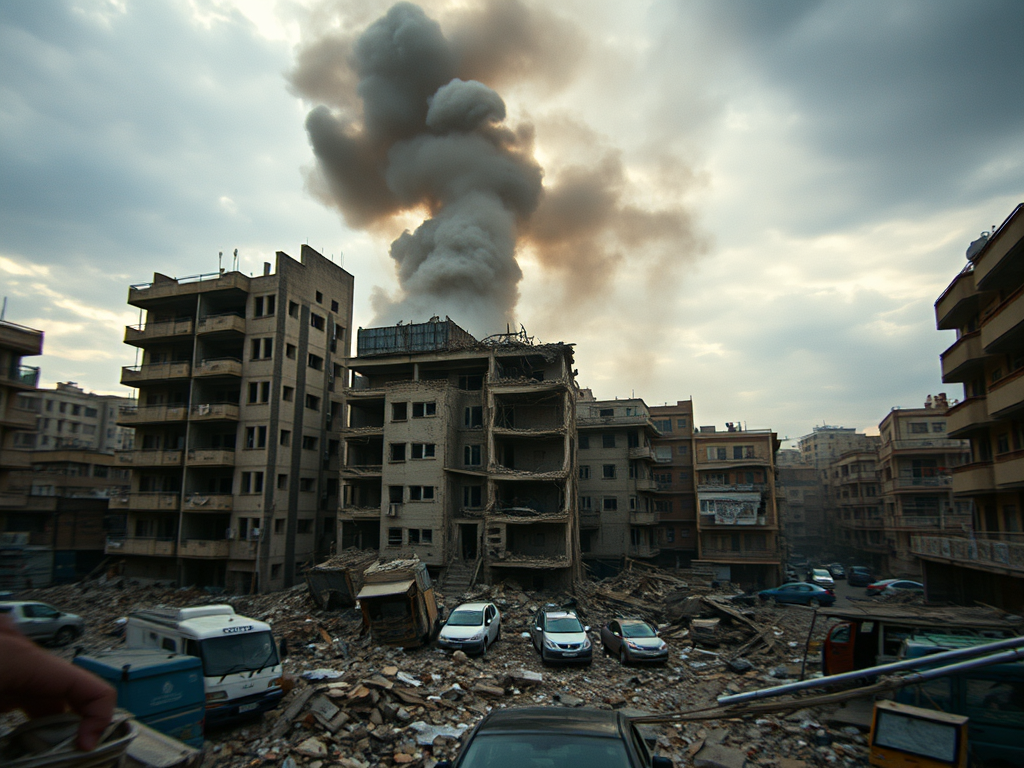
Israeli airstrikes on Thursday hit two buildings in a densely populated part of central Beirut, according to Lebanese officials, marking what seemed to be the deadliest attack in the capital in over a year of ongoing conflict between Israel and Hezbollah.
The strikes resulted in at least 22 deaths and left over 117 injured, as reported by Lebanese authorities.
Lebanon’s state news agency noted that one of the airstrikes struck an eight-story building in the Ras el-Nabaa area, while another leveled a four-story structure in the Basta neighborhood. Verified footage from The New York Times confirmed the complete destruction of the Basta building and damage to neighboring structures. Two thick plumes of smoke could be seen rising above the city skyline.

The Israeli military did not immediately provide a comment regarding the attacks. However, Israel has been systematically targeting Hezbollah leaders and locations through a heavy bombardment campaign in Beirut and surrounding areas, alongside a ground offensive in southern Lebanon.
These strikes occurred just hours after U.N. officials reported that Israeli forces had attacked U.N. peacekeepers in southern Lebanon, injuring two soldiers and drawing widespread international criticism of Israel’s military actions against Hezbollah, a militant group backed by Iran.
The United Nations Interim Force in Lebanon (UNIFIL) confirmed that two Indonesian peacekeepers were injured when an Israeli tank shell hit a watchtower at UNIFIL’s headquarters in Naqoura. In a separate incident nearby, Israeli forces fired on a bunker where peacekeepers had taken shelter, damaging vehicles and communications equipment.
UNIFIL condemned the attack, stating that “any deliberate targeting of peacekeepers is a serious violation of international humanitarian law.”

In response, the Israeli military said its troops operating in the Naqoura region had instructed U.N. forces to move to “protected areas” before they opened fire, claiming Hezbollah operates within civilian areas, including near UNIFIL positions.
Linda Thomas-Greenfield, the U.S. ambassador to the U.N., urged Israeli forces to ensure the safety of U.N. peacekeepers, stressing that UNIFIL must be able to operate without interference.
Hezbollah has launched numerous attacks on Israel from southern Lebanon since October 7, 2023, following an initial offensive by Hamas on southern Israel. In retaliation, Israel has escalated its military operations, targeting Hezbollah leaders and infrastructure, resulting in heavy casualties, including civilians. Israeli ground forces have also engaged Hezbollah fighters in fierce combat in southern Lebanon.

Since 1978, UNIFIL, a peacekeeping mission with over 10,000 personnel from 50 countries, has been tasked with maintaining peace along the Blue Line, the de facto border between Israel and Lebanon. Although the peacekeepers are armed, their mission is primarily observational, and they only use force when their or civilians’ safety is directly threatened.
Israel and the U.S. have criticized UNIFIL for its inability to prevent Hezbollah from amassing weapons and launching attacks on Israel. On Thursday, Hezbollah fired 190 more rockets into Israel, according to the Israeli military.
The escalation of violence has led to increasing attacks on U.N. peacekeepers, U.N. officials report, including machine gun fire and tank shelling by Israeli forces.
Several nations contributing troops to UNIFIL, such as France, Italy, and Spain, condemned the attacks on peacekeepers. Italy’s defense minister, Guido Crosetto, labeled the incidents “serious violations of international law,” while France expressed concern, demanding explanations from Israel.
Danny Danon, Israel’s ambassador to the U.N., urged peacekeepers to move five kilometers north to avoid danger as fighting intensifies, noting that Hezbollah’s aggression continues to make the situation along the Blue Line volatile.
The conflict in Lebanon has paralleled intensified Israeli military actions in Gaza, raising concerns among U.N. officials about the worsening humanitarian crisis in the area. The death toll in Gaza has surpassed 42,000, according to Gaza’s health ministry.
In Gaza, an airstrike on a school housing civilians seeking medical treatment killed several women and children, UNICEF reported.
Israel has expanded its military operations across the region, including recent airstrikes on an Iranian Red Crescent field hospital on the Lebanon-Syria border. Amid speculation about an Israeli response to an Iranian missile attack, Israel’s security cabinet met to authorize further military action, with Israeli officials promising a precise and unexpected retaliation against Iran.
President Biden has advised Israel to avoid targeting Iran’s nuclear and energy infrastructure to prevent a cycle of escalating violence between the two nations.d Eve Sampson.




Leave a Reply