
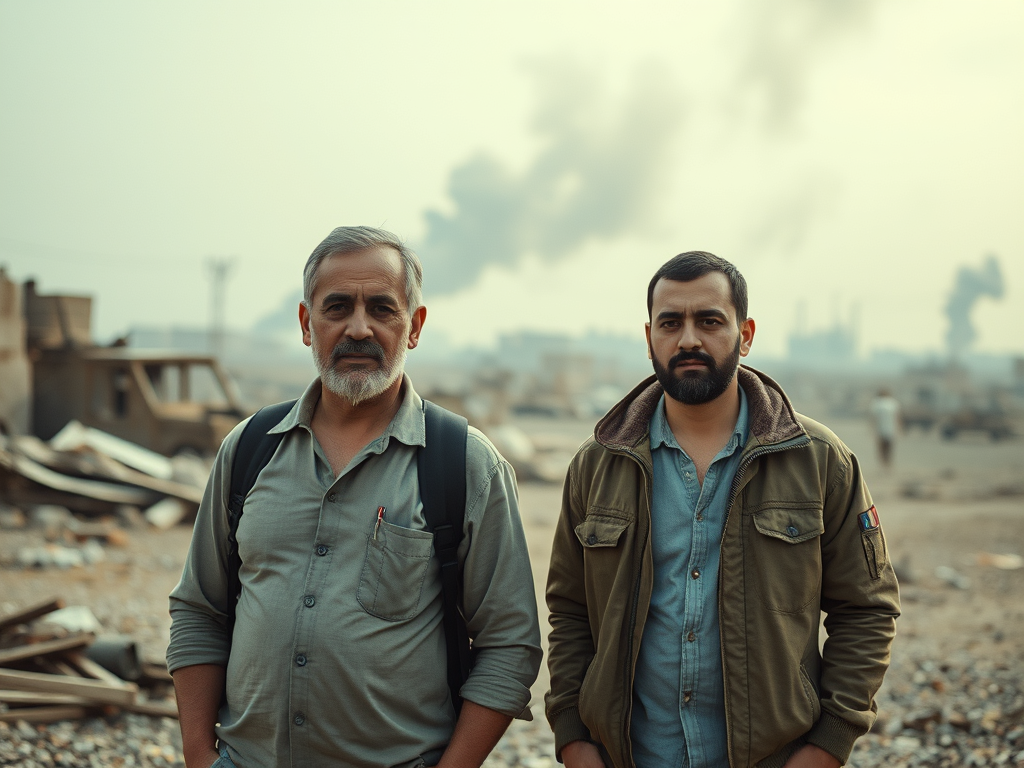
Yaniv Hegyi, an Israeli community organizer, fled his home last Oct. 7, after terrorists from Gaza overran his village in southern Israel. “I was sure that by January we would go back,” Mr. Hegyi said.
Mohammed Shakib Hassan, a Palestinian civil servant, fled his home on Oct. 12, after the Israeli Air Force responded by striking his city in northern Gaza. “We thought it would be two months — at most,” Mr. Hassan said.
Instead, the war in Gaza has dragged on for a year, with no end in sight.

It is the longest war between Israelis and Arabs since the end of the conflict that set the boundaries of the Israeli state in 1949. It is also by far the deadliest. More than 1,500 Israelis have been killed, mostly during Hamas’s attack on Oct. 7, and roughly 250 others were abducted. More than 40,000 Palestinians have been killed in Israel’s counterattack, which began with one of the most intense bombardments ever recorded in modern warfare.
A wider, multifront war between Israel and Hamas’s regional allies is now unfolding — most recently with Israel’s invasion of Lebanon and Iran’s bombardment of Israel — but the core of the conflict remains the original battle between Hamas and Israel, and the almost Sisyphean challenge of ending it.

Inside a deeply traumatized Israel, that conflict has magnified long-running social schisms and set off bitter debate about whether to prioritize Hamas’s destruction or a deal to free the hostages. Outside Israel, it has spurred horror at the Israeli military response to Hamas’s atrocities, accusations of genocide and war crimes, and widespread protests in the United States and beyond.
The war in Gaza has also highlighted the limits of American influence, with the Biden administration unable or unwilling to exert the pressure needed to broker a truce. And on the ground, it has displaced millions of people, mostly in Gaza but also in Israel.
Mr. Hegyi is living in a stranger’s house, 100 miles from his hometown, wary of returning to his half-ruined village while fighting flares nearby. Mr. Hassan is living in a tent in central Gaza, his third makeshift shelter since fleeing his now destroyed apartment nearly a year ago.

“We were optimistic that it would end by Ramadan. Then Eid. Then Eid al-Adha,” Mr. Hassan said, listing three important events in the Muslim calendar that fell in the first half of the year. Instead, he said, “Twelve months have passed in front of our eyes.”
By most military metrics, Israel has crushed Hamas, killing most of its leadership and many fighters, capturing most of its territory at one stage or another, seizing or destroying much of its arsenal and blocking the routes by which it might smuggle in new weapons.
Yet the war rumbles on, for several reasons but chiefly this: Israel’s government, led by Prime Minister Benjamin Netanyahu, has set itself an almost unreachable threshold for victory, while Hamas’s conception of winning revolves mainly around survival.
Israel wants to destroy Hamas’s leadership as well as free the roughly 100 hostages still held by the group. The first goal essentially precludes the second: Hamas’s surviving commanders in Gaza, led by Yahya Sinwar, are believed to be hiding alongside hostages, making it hard for Israeli soldiers to capture or kill them without harming their own citizens.
Hamas seeks mainly to survive the war as a movement, a modest goal that allows it to weather a level of destruction that might have caused others to surrender. In World War II, Japan surrendered after suffering widespread devastation while France did so to avoid such harm. Hamas has done neither, as its leaders attempt to set off a regional conflict that endangers Israel’s long-term future.
The war also continues because of the way each side is waging it. Hamas is fighting as a guerrilla force, hiding in a vast network of tunnels, making it hard for Israel to deal a decisive blow. And when Israel has seized parts of Gaza, it has in most cases given up those gains by refusing to hold the ground.
The two men driving many of these dynamics are Mr. Netanyahu and Mr. Sinwar.
In Israel, Mr. Netanyahu’s grip on power relies on several far-right lawmakers who have threatened to collapse his fragile coalition government if he ends the war without destroying Hamas. At least in part, that dependency has prevented Mr. Netanyahu from agreeing to a hostage-release deal.
In Gaza, it was Mr. Sinwar who oversaw plans for the raid that started the war. It is his tolerance for the ensuing destruction and large civilian death toll that has allowed Hamas to fight on even as much of Gaza lies in ruins and his top military commanders are dead. And it is his insistence on a permanent cease-fire, coupled with Mr. Netanyahu’s on a temporary one, that has prevented any truce.Both sides appear to have decided that they will not go back to how things were before Oct. 7. Hamas’s leaders have said the prewar dynamic of endless Israeli occupation must be disrupted regardless of the human cost. Israel feels far more vulnerable after the deadliest day in its history and has decided it can no longer tolerate groups dedicated to its destruction on its borders.

“This war won’t end because nobody is willing to blink,” said Thomas R. Nides, the United States ambassador to Israel until shortly before the Oct. 7 attack. “In the meantime, everyone is losing — hostages and their families, innocent Palestinians, Israelis displaced from northern Israel, Lebanese civilians. And it’s truly tragic.”
The first sign that Israel might struggle to achieve a conventional military victory came in the hours after its forces invaded Gaza on Oct. 27.
Israel sent more than 20,000 troops to capture Gaza City and its hinterland, accompanied by hundreds of tanks, after Israeli warplanes had spent nearly three weeks pounding Gaza with one of the deadliest aerial campaigns of the 21st century. In a traditional encounter on the battlefield, Israel’s invasion force would have swiftly devastated Hamas’s military wing.
Instead, Hamas’s fighters were nowhere to be seen. Their commanders appeared to have made a strategic decision to avoid giving Israel the chance to deliver a knockout blow.
Eitan Laub, an Israeli officer tasked with capturing a cluster of buildings close to the border, imagined that his battalion would face fierce resistance. To the soldiers’ astonishment, they captured the site at around dawn on Oct. 28 without encountering a single Hamas fighter.

“The entire battalion looked at those buildings, just leaned on their backpacks, pulled out cigarettes, and smoked,” Mr. Laub told an Israeli podcast. “It was obvious that no one was left.”
“We know they’re here,” he remembered thinking. “But where are they?”
Gradually, it became clear. Hamas’s gunmen were largely hiding in a tunnel network, hundreds of miles long, that extended under homes, schools, hospitals and United Nations facilities. Wearing ordinary clothes that made it hard to distinguish them from civilians, the fighters would emerge suddenly from those tunnels to shoot at Israeli soldiers and attach mines to their tanks.




Leave a Reply