
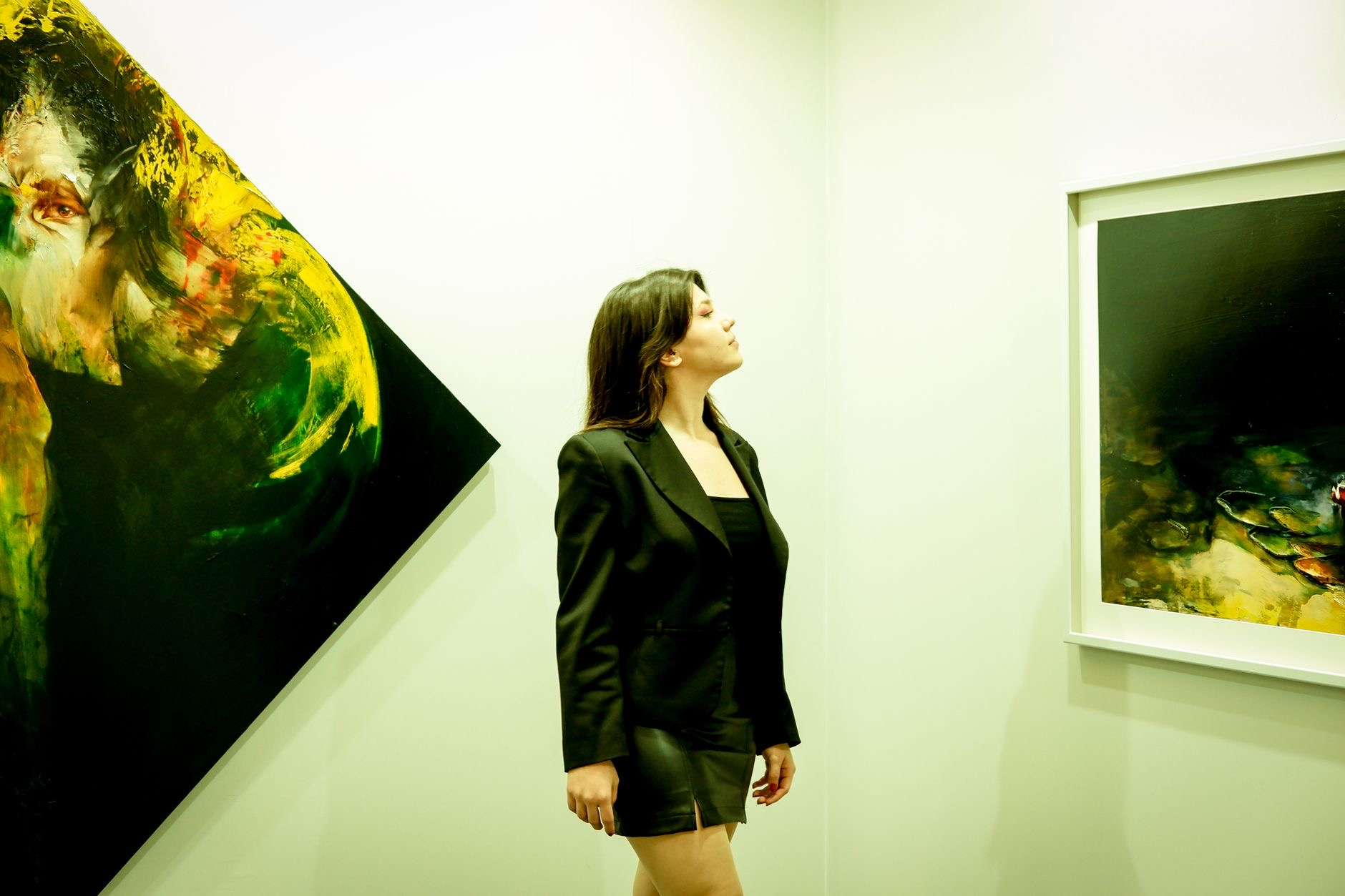
“Let Us Gather in a Flourishing Way,” closing this weekend at the Buffalo AKG Art Museum, has emerged as a pointed challenge to assumptions about what contemporary Latinx painting is supposed to look like. Curated by Andrea Alvarez, the exhibition gathers 58 artists whose work ranges from recognizable canvas painting to pieces made with textiles, architectural materials, adobe and other unconventional surfaces, presenting Latinx painting not as a unified style but as a field defined by difference.
The exhibition opened March 6 and runs through Sept. 6 in the museum’s Jeffrey E. Gundlach Building. Its title comes from a 2008 poem by Juan Felipe Herrera, the former U.S. Poet Laureate whose writing moves fluidly between English and Spanish. The museum describes the exhibition as a celebration of abundance, complexity and the diversity of a diaspora whose artists have often been marginalized within conventional narratives of American and contemporary art.
Rather than organize the show chronologically or attempt a comprehensive history, Alvarez divided it into seven thematic groupings: “(New) Histories,” “Bodies & Figures,” “Identity/Place,” “Land/tierra,” “Community,” “Pinturx” and “Abstractions.” The structure allows very different practices to sit beside one another without suggesting that any single work can stand in for Latinx experience. It also enables artists to engage with traditional painting genres while questioning the historical boundaries around them.
That strategy is particularly visible in the exhibition’s treatment of materials. Alvarez told ARTnews that she deliberately included works that challenge the expectation that painting must mean oil or acrylic applied to canvas or linen. Moises Salazar Tlatenchi’s work incorporates crochet; Manuela Gonzalez uses painted textiles; and Nery Gabriel Lemus has presented painted floor mats as part of his practice. Such choices move the discussion beyond imagery and toward the physical assumptions that museums, collectors and viewers bring to the word “painting.”
The exhibition also resists another set of expectations: the idea that Latinx painting should be readily identifiable through bright color, figurative imagery or folkloric references. Alvarez said some visitors may enter with those assumptions and encounter a much broader field. The point is not that artists are collectively reacting against a stereotype, but that many of them are already working beyond the obligation to answer it. Their practices move through abstraction, art history, domestic life, politics, memory and material experimentation without requiring a common visual language.

Karla Diaz’s “Uncle’s Crossing” offers one example of how personal history complicates easy interpretation. The 2022 painting depicts two Latino men, one carrying the other on his shoulders, and draws on the story of Diaz’s late uncle, who worked as a coyote helping people cross into the United States. The image combines family memory with a subject that carries conflicting meanings within immigrant communities, where coyotes may be understood as both facilitators of migration and potential sources of exploitation.
Elsewhere, familiar painting categories are deliberately rearranged. Eamon Ore-Giron’s abstraction appears within a section concerned with histories, while Kristopher Raos transforms a close-up of a commercial detergent logo into an investigation of abstraction. Salomón Huerta’s still lifes pair a firearm with domestic objects and food, images that Alvarez has described as portraits rooted in memories of the artist’s father. The works demonstrate how a genre such as still life can carry biographical and emotional information without showing a human figure.
Family and community recur throughout the exhibition without becoming a single sentimental theme. Artists including Aliza Nisenbaum, David Antonio Cruz and Shizu Saldamando appear in the “Community” section, where relationships of blood, friendship and chosen family become ways of thinking about how marginalized communities sustain themselves. Larry Madrigal’s large-scale painting of family members bouncing on a trampoline combines the disorder of everyday domestic life with references to European art history, collapsing the distance between canonical painting and ordinary American experience.
Other works engage migration more directly. Guadalupe Maravilla, who migrated from El Salvador to the United States as a child during the Salvadoran civil war, draws on memories of displacement and assimilation. The exhibition also includes a commissioned work by rafa esparza that connects historical violence against Indigenous people with more recent images of immigration enforcement. Sarah Zapata and Justin Favela are among the other artists commissioned to create works for the exhibition.

The emphasis on painting is significant because the medium carries its own institutional history. Alvarez has described painting as particularly “loaded,” not only because of its central place in Western art museums but also because European painting traditions traveled alongside colonial power in the Americas. By working within, around and against those traditions, the artists in “Let Us Gather” treat painting as something that can be inherited, disrupted and remade rather than simply preserved.
The project has also had consequences for the Buffalo AKG’s permanent collection. In connection with the exhibition, the museum has acquired works by several participating artists, including Patrick Martinez, Guadalupe Maravilla, Ilana Savdie and Eamon Ore-Giron. More recently, works by Felipe Baeza, Yvette Mayorga, Salomón Huerta and Alfonso Gonzalez Jr. have also entered the collection, according to ARTnews. That collecting activity gives the exhibition a longer institutional footprint than its six-month run in Buffalo.
The show will not end with Buffalo. The Des Moines Art Center is scheduled to present “Let Us Gather in a Flourishing Way: Contemporary Latinx Painting” from Oct. 24, 2026, through Jan. 24, 2027. The exhibition is also slated to continue to Phoenix Art Museum and the Frye Art Museum in Seattle; Buffalo AKG has additionally listed the Museum of Contemporary Art Denver among tour venues. The Des Moines presentation describes the artists as expanding painting through new forms, materials and subjects while contributing to both American art and global contemporary art.
As the Buffalo presentation enters its final days, its most durable argument may be its refusal to substitute one definition of Latinx painting for another. Instead, the exhibition treats the category as an active network of artists whose differences are precisely the point. By placing abstraction beside family portraiture, textiles beside canvas and intimate memories beside migration histories, “Let Us Gather in a Flourishing Way” makes the case that Latinx painting does not need a recognizable look to have a meaningful place in the story of American art.
Leave a Reply