
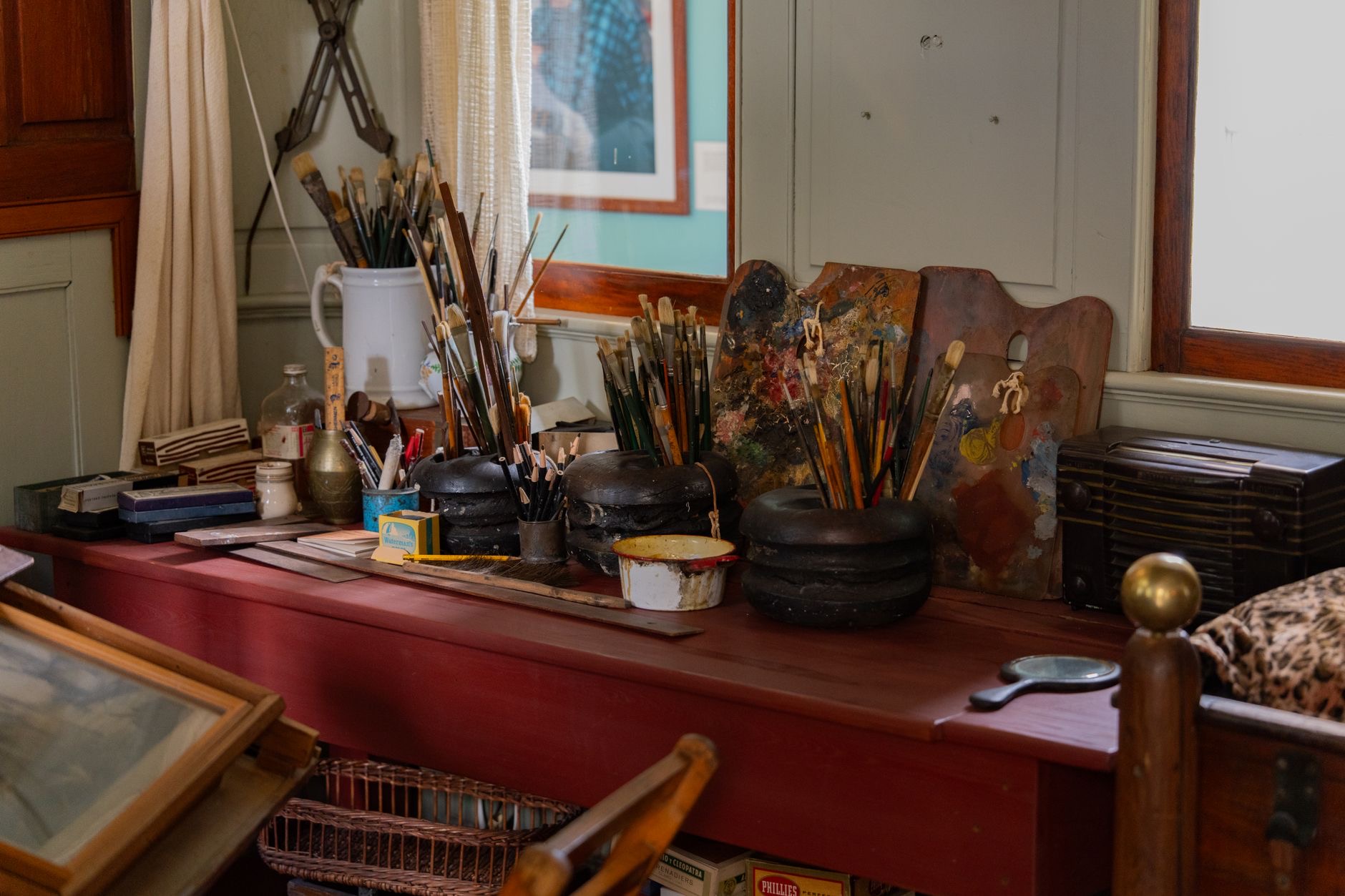
New Haven is becoming an increasingly practical alternative to New York for working artists, as high studio and housing costs push some creators to reconsider whether living inside the country’s dominant art-market center is still necessary. Recent reporting centered on artist and sculptor Chiffon Thomas illustrates the calculation: New York offered access and prestige, but New Haven offered enough affordable space to make ambitious work while keeping Manhattan within reach by train.
Thomas, who had previously attended the Yale School of Art, moved to New York after spending several years in Los Angeles. His sculpture practice required more than a desk and a clean white room. He needed enough space to maneuver long pieces of metal, ventilation for welding and somewhere to keep a van. In New York, those requirements quickly became expensive.
According to reporting published Aug. 27, Thomas eventually paid about $4,000 a month for roughly 800 square feet of studio space in New York, separate from the cost of his Brooklyn housing. By contrast, he said an approximately 800-square-foot studio in New Haven costs $550 a month and an apartment roughly $1,400. Together, his living and working expenses in Connecticut came to less than $2,000 a month. Thomas began dividing his time between the two cities in January.
The gap matters because studio rent is not simply another household expense for artists. It is effectively a production cost. Money spent securing workspace cannot be spent on materials, fabrication, assistants or experimentation. For sculptors and installation artists in particular, the amount and configuration of available space can determine whether a project is feasible at all. Thomas described his partial move as a business decision that allowed more income to flow back into his practice.
Painter Dominic Chambers offers another example of how New Haven can shift from temporary stop to long-term base. Chambers arrived in 2017 to attend Yale’s MFA program and initially assumed that New York would eventually follow. Instead, he remained in Connecticut. He told the recent report that his first New Haven studio was about 1,200 square feet for $1,000 a month. His current studio is approximately 1,700 square feet and costs between $1,500 and $1,800 depending on utilities.
Cost was initially central to Chambers’ decision, but community and lifestyle became increasingly important. He has said that more artists have moved into the area and that Connecticut feels less isolated than when he arrived. New Haven also changed the environment surrounding his practice: he wanted outdoor space, dogs and access to hiking, and elements of the regional landscape have gradually entered his paintings.

That evolution highlights what makes New Haven different from a purely inexpensive satellite city. It already has artistic infrastructure. Yale has brought generations of artists, designers and curators into the city, even though many historically departed after graduation. The newer pattern is that more artists appear willing to remain, while others arrive through different institutions and professional networks.
NXTHVN has become one of the most visible additions to that ecosystem. Founded by artist Titus Kaphar and Jason Price, the nonprofit operates a fellowship program that brings artists and curators to New Haven for an intensive residency. NXTHVN says fellows receive a living stipend, dedicated studio or office space and subsidized housing, along with mentorship and professional development. Its Cohort 08 announcement this month said curatorial and studio fellows receive a $45,000 stipend for the fellowship year as well as 24-hour access to dedicated workspace and on-site housing.
The fellowship is significant not only because it brings artists into New Haven but because some decide to remain. Recent reporting cited NXTHVN officials as saying roughly 15 alumni were living in the city. Sculptor Kristy Hughes, who came through the program without a Yale connection, stayed after her fellowship and established two studios, separating fabrication from painting. Access to warehouse-scale space allowed her to pursue larger projects, including outdoor sculpture.
New Haven also retains an industrial studio infrastructure increasingly difficult to find at comparable prices in New York. Erector Square, a former A.C. Gilbert toy factory in the Fair Haven neighborhood, has been converted into one of the region’s largest creative complexes. Its official website says the property contains more than 175 studios across eight buildings, with more than 150 used by artists. The complex also houses architects, musicians, designers and performing-arts organizations.
The city’s appeal is reinforced by a broader Connecticut institutional network. The Aldrich Contemporary Art Museum in Ridgefield is currently presenting “The Aldrich Decennial: I am what is around me,” its first recurring survey devoted to artists who live and work in Connecticut. The museum says curators Amy Smith-Stewart and Caitlin Monachino conducted more than 100 studio visits while preparing the exhibition. Forty artists were ultimately selected, including Chambers and Hughes.

The Aldrich has explicitly linked the project to artists choosing to work outside major art centers. Its exhibition materials note that Connecticut has long provided an alternative to the pressure and expense of places such as New York and Boston and say rising rents have accelerated that pattern. The survey gives artists based outside New York something particularly important: institutional visibility without requiring relocation into the city.
Still, New Haven does not eliminate New York from the equation. Its value partly comes from proximity to it. Artists can travel to exhibitions, meet dealers, maintain gallery relationships and host visiting curators while keeping their primary production spaces in Connecticut. Thomas still maintains a foothold in Brooklyn, in part because some New York grants and residency programs impose local-residency requirements.
That points to one of the unresolved tensions in the migration. Art-world opportunities remain heavily concentrated in New York even as the economics of living there become harder for many artists to sustain. Moving away can preserve a practice financially while potentially making informal networking and last-minute studio visits less frequent.
New Haven’s growing appeal therefore does not signal the replacement of New York as America’s art capital. It suggests something subtler: artists may no longer believe they must choose between complete immersion in New York and complete separation from it. A smaller city with affordable workspace, universities, museums, fellowships, fabrication resources and direct transportation to Manhattan can occupy the middle ground.
For New Haven, that shift could become self-reinforcing. Each artist who stays contributes another studio, professional relationship and reason for curators or collectors to visit. Each institution that showcases Connecticut artists gives the community more visibility. What began for some artists as a decision about rent is increasingly becoming a decision about where a sustainable artistic career can actually be built.
Leave a Reply