
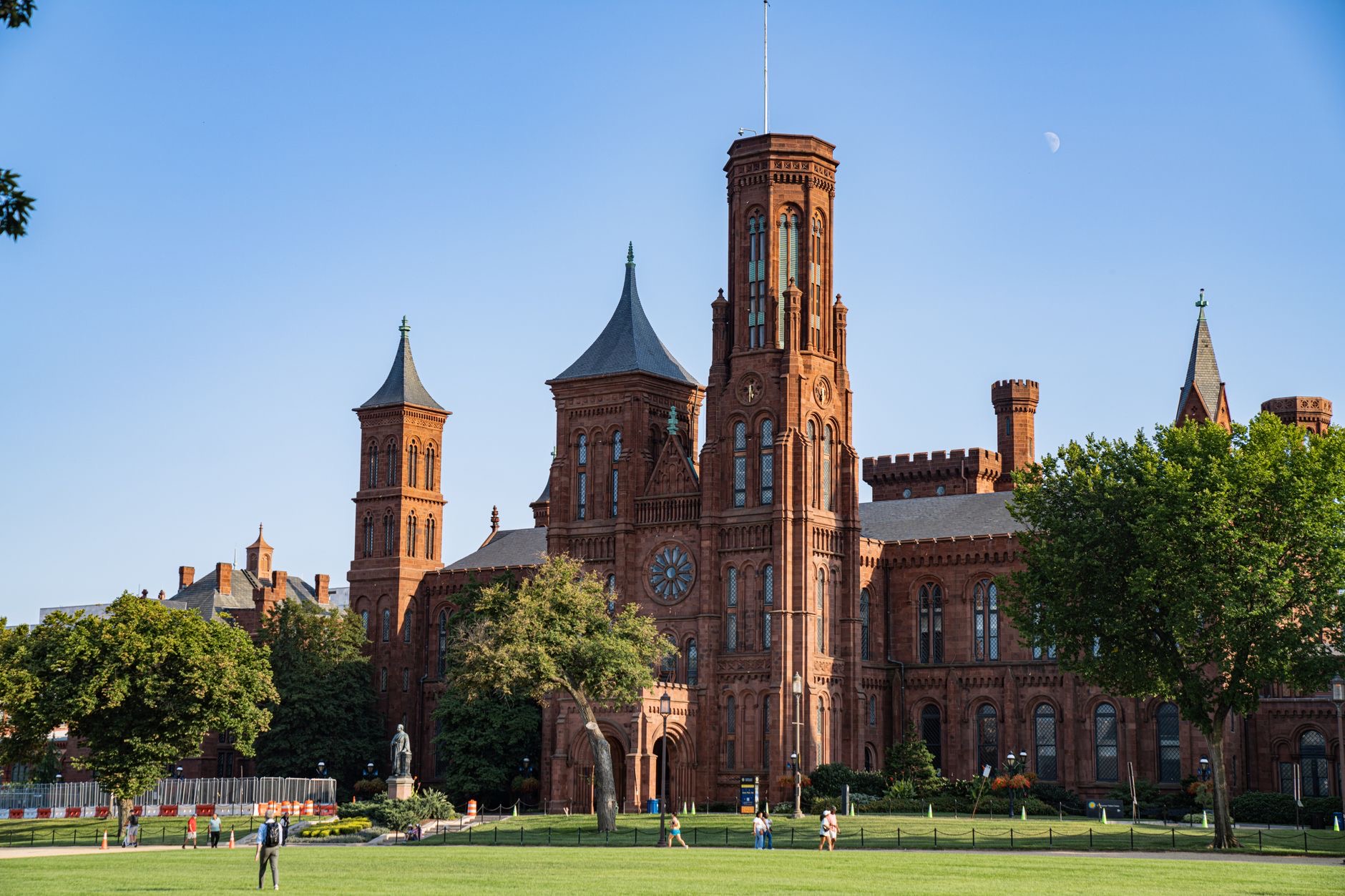
President Donald Trump has directed federal agencies to install temporary signs outside the Smithsonian’s National Museum of American History warning visitors about what his administration describes as ideological bias and inaccurate presentations of the nation’s past.
The July 24 executive order instructs the secretary of the interior, acting through the National Park Service, to place signage along sidewalks and walkways used by the public to enter the museum in Washington. Those exterior areas are maintained by the Park Service, giving the administration a mechanism to display its message without ordering the Smithsonian to alter the exhibits inside.
According to the order, the signs must inform visitors about the findings of a White House Domestic Policy Council report and state that museum exhibits should be renovated in accordance with those findings. They must also direct visitors toward locations and resources that the administration considers sources of accurate information about American history.
The order does not specify the signs’ final wording, dimensions, number or installation schedule. It also does not identify which outside historical resources visitors would be directed to consult. Implementation is subject to federal law and the availability of appropriated funds, leaving several practical details to the Interior Department, National Park Service and White House domestic policy staff.
A separate provision directs the Interior Department to install temporary outdoor exhibits or additional signs that the administration says would correct inaccurate information presented inside the museum. The order links that requirement to the 250th anniversary of American independence and asserts that the museum has not appropriately honored the 56 signers of the Declaration of Independence.
The action follows the July 4 release of “Saving America’s Story,” a 162-page report prepared by the Domestic Policy Council. The report accuses the National Museum of American History and Smithsonian leadership of treating history as a vehicle for social transformation rather than as a shared national inheritance. It argues that the museum gives insufficient prominence to the country’s founders, constitutional government and national achievements while emphasizing injustice and political conflict.
The report itself recommended a much more pointed warning above museum entrances, saying visitors should be told that the exhibitions were prepared by people who did not want them to love their country. Trump’s executive order does not mandate that exact sentence. Instead, it requires language communicating the report’s findings and the administration’s policy that the Smithsonian should present history with greater emphasis on national unity, gratitude and achievement.

The Smithsonian did not immediately issue a detailed response to the order. The institution told major news organizations that it had no comment at that time. That silence leaves unresolved whether Smithsonian leaders will formally challenge the administration’s description of the museum, cooperate with any requested exhibit changes or contest the placement and presentation of signs outside the building.
The museum’s director, Anthea M. Hartig, had already disputed the central claims of the White House report during a House Oversight subcommittee hearing on July 21. Hartig said the report did not fairly or accurately characterize the museum’s overall work and defended the expertise behind its collections, educational programs and exhibitions.
Hartig told lawmakers that the institution does not take sides in political debates. She described the expansion of historical narratives as an effort to add evidence, objects and voices that were missing from earlier interpretations, rather than an attempt to erase traditional accounts of the country’s founding or achievements.
The museum has also pointed to programming connected to the semiquincentennial. Its “In Pursuit of Life, Liberty and Happiness” initiative presents 250 objects throughout the building, including Thomas Jefferson’s writing desk, a Revolutionary War-era gunboat and the Star-Spangled Banner. Republican lawmakers have acknowledged the presence of significant founding-era material while arguing that some of it is difficult for visitors to locate or insufficiently prominent.
The institutional structure of the Smithsonian is central to the administration’s approach. The organization is not a conventional executive-branch agency, and museum directors report through Smithsonian leadership under the supervision of a Board of Regents. The president therefore does not possess the same direct management authority that applies to Cabinet departments or agencies headed by presidential appointees.
The executive order instead directs the Interior Department, Office of Management and Budget, General Services Administration and White House Domestic Policy Council to identify all available authorities that could encourage changes. It specifically mentions federal statutes, regulations, contracts, funding conditions and administrative mechanisms, suggesting that future appropriations and government agreements could become pressure points.

The use of sidewalks outside the museum creates a visible workaround. Visitors could encounter an official government critique of the Smithsonian before entering a Smithsonian building, effectively placing competing interpretations of American history side by side. The administration’s message would appear on federal land under executive control, while the museum’s exhibitions would remain under Smithsonian management unless the institution independently altered them.
The confrontation is part of Trump’s broader campaign to reshape federally supported cultural institutions. His administration has criticized diversity, equity and inclusion programs, sought more celebratory accounts of national history and challenged cultural organizations it views as politically progressive. The White House has also pressed for changes at other Washington institutions and at federally managed historic sites.
Historians and museum advocates have warned that political intervention could narrow how institutions discuss slavery, racial discrimination, displacement, immigration and other difficult subjects. They argue that national museums must be able to present evidence of both achievement and injustice without having their conclusions dictated by elected officials.
Supporters of the administration’s campaign contend that taxpayer-supported institutions have emphasized conflict and oppression at the expense of shared civic identity. They say museums should give clearer attention to the constitutional system, military sacrifice, technological innovation and the political ideals associated with the country’s founding.
The dispute is likely to intensify once the signs are designed and installed. Their wording, placement and cited resources will determine whether they function as conventional historical notices, formal government disclaimers or overt political criticism of the museum and its staff.
For visitors, the immediate effect may be a transformed entrance to one of the country’s most prominent cultural institutions. For the Smithsonian, the larger consequence is a test of whether scholarly independence can be maintained when an administration controls surrounding federal property and holds significant influence over funding. The order provides no deadline for installation, making the next steps dependent on federal agencies that have not yet publicly released a detailed implementation plan.




Leave a Reply