
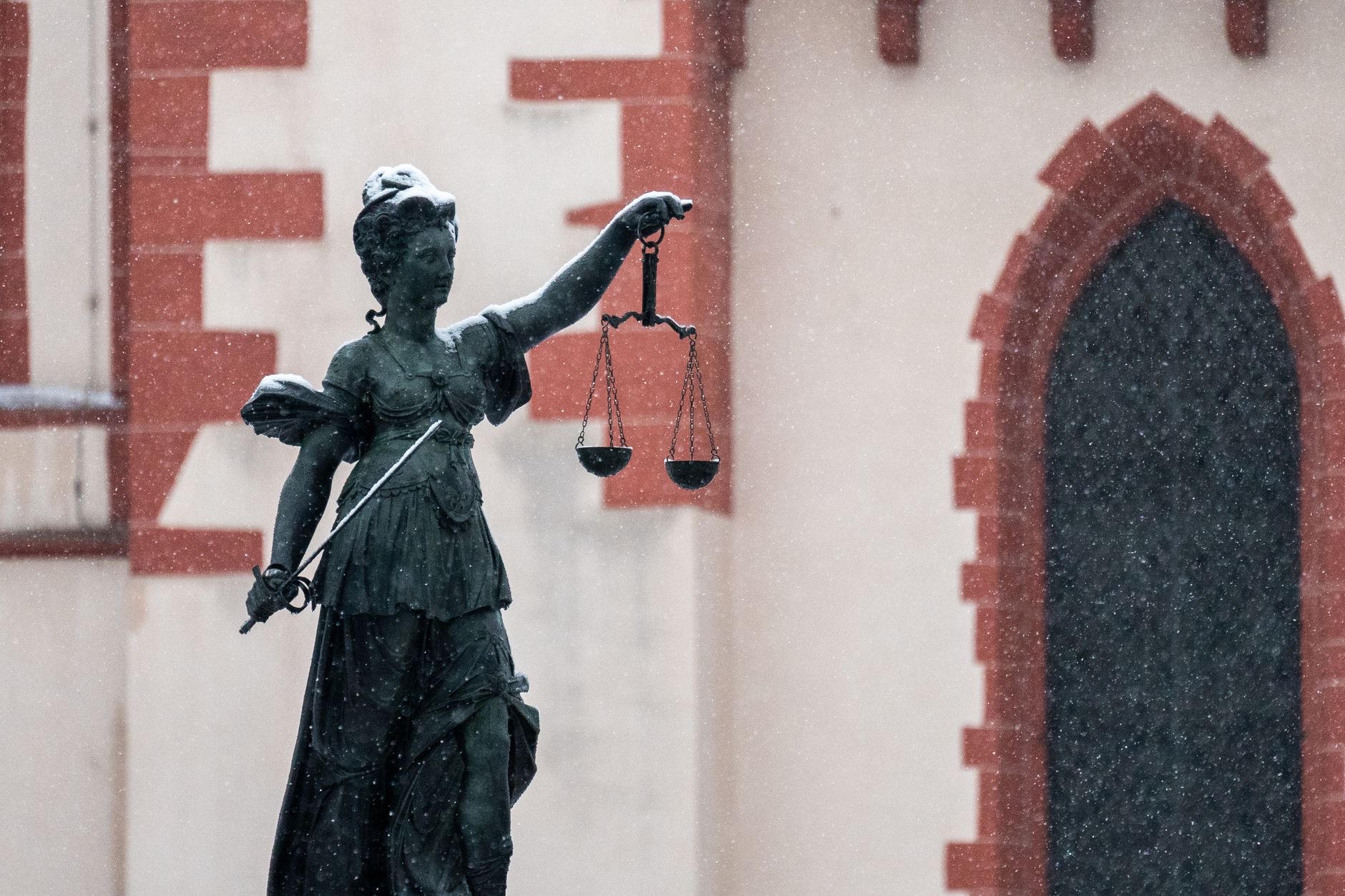
QUINCY, Mass. — A closely watched legal fight over whether Quincy may place statues of two Catholic saints on its public safety headquarters is nearing a decision from Massachusetts’ highest court, with the dispute potentially setting new boundaries for religious imagery displayed by local governments.
The Massachusetts Supreme Judicial Court is reviewing a lower-court order that stopped the city from installing 10-foot bronze statues of St. Michael the Archangel and St. Florian. The figures were commissioned for the exterior of a new headquarters housing police, fire, emergency-management and other public safety operations.
St. Michael is traditionally regarded as the patron saint of police officers, while St. Florian is associated with firefighters. Quincy officials contend that the statues represent courage, sacrifice, protection and the defeat of evil — qualities connected to first responders regardless of religious belief.
A group of 15 Quincy residents sued the city and Mayor Thomas Koch in May 2025, arguing that permanently displaying the statues as prominent exterior features of a government building would elevate Catholic imagery over other religious and nonreligious perspectives. The plaintiffs include residents from several religious backgrounds as well as people who do not practice a religion.
Their legal team includes the American Civil Liberties Union of Massachusetts, the national ACLU, Americans United for Separation of Church and State, the Freedom From Religion Foundation and private counsel. The challenge relies principally on the Massachusetts Constitution, including its protections against governmental preference for a particular religious denomination.
In October 2025, Norfolk County Superior Court Judge William F. Sullivan issued a preliminary injunction barring the installation while the litigation continued. Sullivan concluded that the residents had shown a likelihood of succeeding on their claim that the statues’ location, scale and religious identity could cause the government-sponsored display to communicate a sectarian message.
The preliminary order did not produce a final judgment on every claim. It preserved the existing situation while courts considered the constitutional questions, leaving the statues off the building. Quincy appealed, and the Massachusetts Supreme Judicial Court agreed to review the dispute directly.

Attorneys representing the city said in a report published Sunday that they expect the state high court to issue a decision soon. The court has not publicly committed to a specific ruling date, and Quincy officials said they were awaiting the decision.
Joseph Davis, a senior attorney at the Becket Fund for Religious Liberty, which represents Quincy, described the statues as civic art with historical and professional significance. The city’s position is that government does not endorse a religion merely by using an image that has religious origins, particularly when the image also has a longstanding connection to public service.
Quincy has also received support from police organizations. Briefs submitted on behalf of the National Fraternal Order of Police and its Massachusetts affiliate argue that St. Michael and St. Florian are recognized within first-responder culture by people with different religious and political views. Police and fire unions in Quincy have similarly defended the project as a tribute to their professions.
Koch has maintained that he selected the figures to honor and encourage first responders, improve morale and represent values such as truth, justice and protection. The mayor has rejected claims that the project was intended to advertise Catholic doctrine.
The challengers argue that the city’s stated purpose cannot be separated from the design and placement of the artwork. Their briefs describe the figures as overtly religious and emphasize that they would be the principal exterior adornments at a building where residents seek essential police, fire and emergency services.
Jessie Rossman, legal director of the ACLU of Massachusetts, said the state constitution requires government to remain neutral on religious questions. The plaintiffs maintain that such neutrality protects religious practice by preventing officials from conveying that one tradition has preferred status.
The controversy also involves public spending and transparency. The statues, created in Italy, were commissioned as part of a project estimated at approximately $850,000. Critics said the planned artwork was not included in earlier public renderings of the headquarters and that residents and some city council members learned of it only after local news coverage.

Supporters counter that decisions about public art routinely fall within municipal authority and that religious associations do not automatically disqualify historically significant subjects from government property. They warn that an overly restrictive ruling could expose other monuments, paintings and memorials to legal challenges merely because their imagery has roots in a faith tradition.
The state high court must initially determine whether the preliminary injunction was legally justified. Its analysis, however, could reach beyond that procedural question by clarifying how Massachusetts courts should evaluate a government’s stated secular purpose, the visual effect of a display and the perception of residents encountering it.
The dispute arises during a period in which the U.S. Supreme Court has generally taken a more accommodating approach toward religious expression in public life, particularly when displays are connected to history, tradition or equal access. Quincy’s case is different in an important respect because the residents’ central claims arise under the Massachusetts Constitution, which state courts may interpret as providing protections distinct from the federal Constitution.
That distinction could determine whether the controversy ever reaches the U.S. Supreme Court. A party may seek federal review after a final state-court judgment, but the nation’s highest court ordinarily does not reconsider a decision resting independently on adequate state-law grounds. A viable federal appeal would therefore depend on whether the Massachusetts ruling decides a federal constitutional question affecting the outcome.
For now, the statues remain blocked from their intended locations. A ruling supporting Quincy could allow the city to pursue installation and strengthen arguments that the figures function primarily as professional and civic symbols. A ruling for the residents could preserve the injunction and reinforce Massachusetts’ stricter approach to religious neutrality at government facilities.
Either result is likely to be studied by municipalities considering monuments with mixed religious, historical and cultural meanings. The case asks a question with consequences well beyond Quincy: when government selects the artwork, pays for it and places it prominently on a public building, where does civic symbolism end and religious endorsement begin?




Leave a Reply