
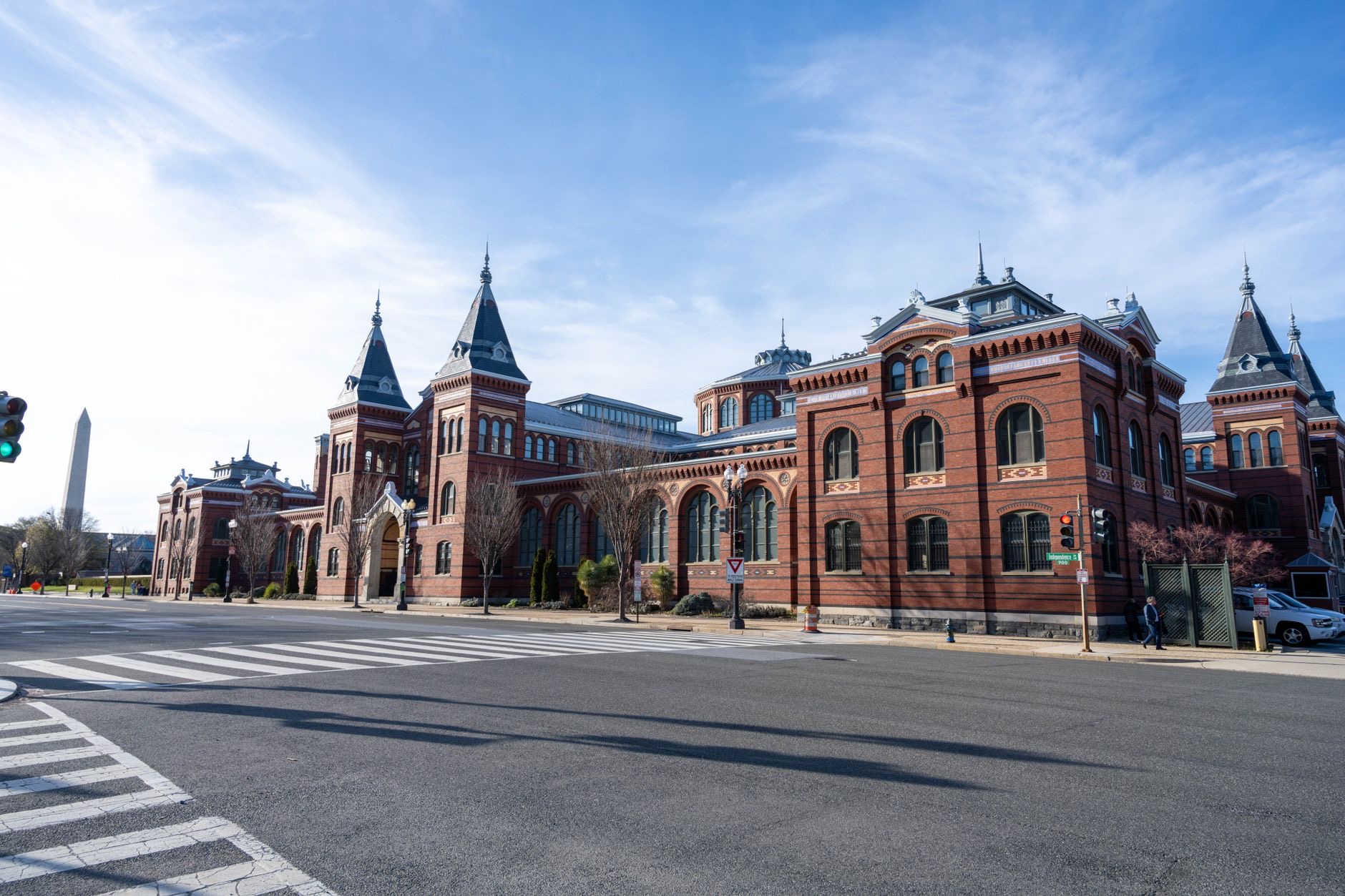
Smithsonian Secretary Lonnie G. Bunch III’s closely watched lunch with President Donald Trump did not produce the direct clash over museums and American history that some Smithsonian advisers feared, according to a newly published account that has put the institution’s political predicament back in the center of Washington’s cultural debate.
The lunch, first reported in detail by The Atlantic and followed by ARTnews on Tuesday, was portrayed as an encounter loaded with institutional risk but marked by an unexpected lack of confrontation. Bunch, who leads the Smithsonian’s sprawling network of museums, libraries, research centers and the National Zoo, had been called to the White House after months of criticism from Trump and allies who accused the institution of presenting an overly negative account of the United States.
The setting made the meeting unusually sensitive for the U.S. arts and museum sector. Bunch is the 14th secretary of the Smithsonian, the first Black person to hold the position and the founding director of the National Museum of African American History and Culture. His leadership has become closely associated with the institution’s defense of historical complexity, including the idea that museums can present slavery, racism and political conflict without abandoning a broader account of American achievement.
According to The Atlantic’s account, Bunch’s advisers expected the lunch could become a confrontation over the Smithsonian’s independence or even his future. Trump had already criticized the museum system’s approach to history, and his administration had issued an executive order calling for a review of how federal cultural institutions present the American past. A later White House letter to Bunch requested an internal review of selected Smithsonian museums and exhibitions, saying the effort was intended to align the institution with a directive to celebrate American exceptionalism and remove divisive or partisan narratives.
Instead, the lunch reportedly turned into what The Atlantic described as a charm offensive. Trump was said to have treated Bunch warmly and spent much of the meeting discussing White House decor and Washington buildings rather than pressing a sustained case about Smithsonian exhibitions. One detail that captured attention in the account involved Trump showing Bunch chandelier samples for the Oval Office and asking which he preferred. Another involved a conversation about the Eisenhower Executive Office Building, the large federal building next to the White House.
The episode also reportedly touched on the space shuttle Discovery, which is displayed at the Smithsonian’s Steven F. Udvar-Hazy Center near Dulles International Airport. Some Texas Republicans have supported relocating the shuttle to Houston, an idea that has periodically resurfaced as both a space-history and political issue. Bunch was described as prepared to defend Discovery’s current location on practical and public-access grounds. But the conversation, according to the account, veered toward Trump’s criticism of Dulles airport and did not become a sustained dispute over the shuttle or over Smithsonian history exhibits.

That contrast — high stakes, low confrontation — is what makes the lunch significant. For museum leaders and cultural policy observers, the concern is not only what was said at the table, but what the meeting revealed about the pressures surrounding a national museum system that depends heavily on public support while maintaining a structure designed to protect scholarly and curatorial independence.
The Smithsonian’s own public statements have emphasized that independence. In June 2025, after Trump said he had fired Kim Sajet, then director of the National Portrait Gallery, the Smithsonian’s Board of Regents said the institution was committed to scholarship free from political or partisan influence. The board also stated that personnel authority rested within the Smithsonian’s governance structure, not directly with the president. Sajet later stepped down, intensifying concern in the arts world about the vulnerability of museum leaders during political disputes over history, diversity and national identity.
The White House has framed its review differently. In its August 2025 letter to Bunch, officials said the Smithsonian should be a welcoming place of knowledge and discovery while also ensuring that national museums reflect unity, progress and enduring American values. The letter said the review would cover selected museums and exhibitions as the United States prepared for the 250th anniversary of the Declaration of Independence. To supporters of the administration’s approach, that effort is about restoring confidence in cultural institutions. To critics, it risks turning historical interpretation into a political loyalty test.
Bunch occupies a particularly visible position in that conflict. The Smithsonian says he oversees 21 museums, 21 libraries, the National Zoo and multiple research and education units. Two new museums — the National Museum of the American Latino and the Smithsonian American Women’s History Museum — remain in development, both of them politically sensitive projects because they ask how the national museum system should represent communities and histories long underrepresented in federal cultural spaces.
The lunch account also lands at a moment when the boundary between cultural programming and partisan power has become increasingly contested in Washington. Trump’s moves involving the Kennedy Center, the National Portrait Gallery and federal history policy have made cultural institutions a recurring front in broader fights over diversity initiatives, public funding and the interpretation of the nation’s past. In that environment, even a cordial private meal can carry institutional consequences.

For Bunch, the lunch appeared to be personally stressful even though it did not become the confrontation some expected. The Atlantic reported that Bunch later described the experience publicly as the most stressful lunch of his life, a remark that reflected the uncertainty surrounding the meeting more than any single exchange during it. That uncertainty remains. The Smithsonian is preparing for major public attention around the 250th anniversary, while the White House has signaled that museum narratives will remain part of its cultural agenda.
The practical question now is whether the Smithsonian can maintain its traditional balance: accepting public funding and national visibility while preserving the professional autonomy of curators, historians and museum directors. The institution’s influence is unusually broad. Its collections include art, scientific specimens, presidential history, aerospace artifacts and objects tied to slavery, civil rights and migration. Changes in how the Smithsonian tells those stories would not be a narrow personnel matter; they would affect how millions of visitors encounter the United States’ public memory.
The new reporting on Bunch’s lunch with Trump does not show a president ordering immediate changes across the museum system. It shows something more ambiguous: a powerful political figure circling a cultural institution whose authority depends on public trust, and a museum leader trying to preserve space for evidence-based history without escalating a conflict that could put the Smithsonian’s funding, leadership and future exhibitions at risk.
That makes the lunch less an odd Washington anecdote than a revealing cultural moment. It suggests that the pressure on the Smithsonian may not always arrive through direct commands or public firings. It can come through reviews, funding warnings, leadership disputes, board politics and private meetings whose implications extend far beyond the room. For the U.S. arts sector, the central issue remains whether national cultural institutions can withstand political attempts to reshape their mission while continuing to serve audiences across the ideological spectrum.




Leave a Reply