
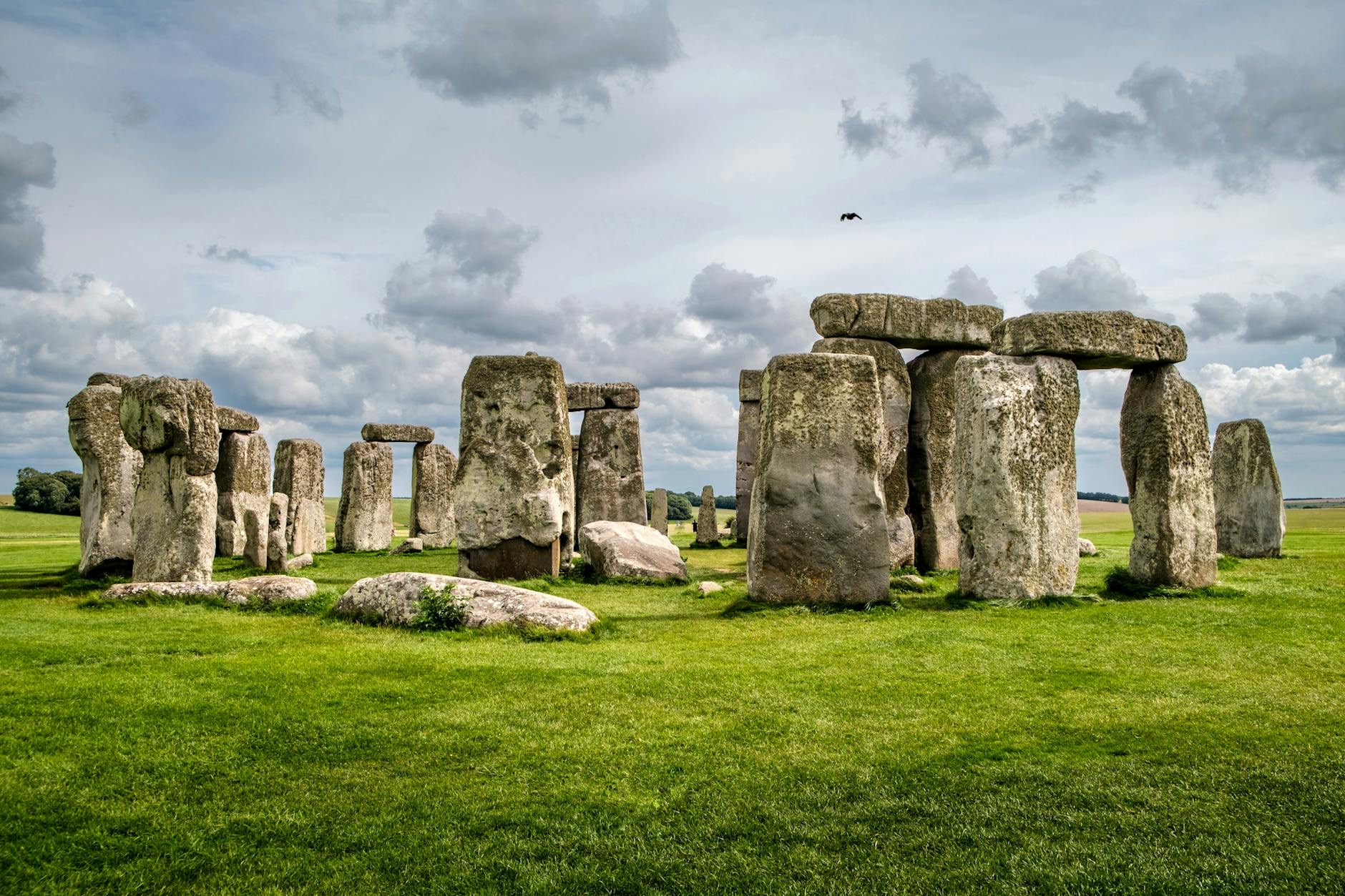
English Heritage has unveiled a large-scale reconstruction of a 4,500-year-old Neolithic building at Stonehenge, presenting the Kusuma Neolithic Hall as a new public and educational space that will open to visitors this summer before becoming part of the site’s school program in the autumn.
The 7-meter-high structure is described by English Heritage as the largest-ever replica of a prehistoric building at Stonehenge. It was built near the visitor center on Salisbury Plain and is based on archaeological evidence from a large prehistoric structure discovered about two miles from the stone circle, near the Durrington Walls settlement and Woodhenge landscape.
The project gives one of Britain’s most recognizable cultural sites a new interpretive feature at a moment when historic institutions are leaning more heavily into immersive experiences. Rather than relying only on display cases, diagrams or digital reconstructions, the hall invites visitors to step inside a full-size environment shaped by evidence from postholes, landscape analysis, material studies and experimental building methods.
English Heritage said the £1 million project was funded by the Kusuma Trust and completed over nine months by more than 100 volunteers. The team worked with thatch, coppiced timber, chalk daub and replica stone tools, including flint axes, to explore how Neolithic builders may have constructed large timber buildings in the Stonehenge landscape.
The replica is based on a structure known as Durrington 68, whose archaeological footprint included a distinctive arrangement of postholes. The site was first excavated in 1928 by archaeologist Maud Cunnington and later re-examined by the Stonehenge Riverside Project. Because ploughing and time erased much of the original floor evidence, English Heritage and outside researchers have avoided assigning a single settled purpose to the building.
That uncertainty is central to the way the hall is being presented. English Heritage says the original structure may have been used for large gatherings, celebrations, rituals, storage or other communal purposes. Nearby finds, including animal bones and Grooved Ware pottery, have been interpreted as evidence of major winter feasting in the wider settlement area, but the precise use of the original building remains unresolved.

The reconstructed hall is intended to function as both a visitor attraction and a teaching space. English Heritage said visitors will be able to experience the hall this summer, while school groups will begin using it from September. The organization has described the space as suitable for groups of up to 30 students, with activities built around hearth-centered gathering, replica tools, cooking, crafts and discussion of everyday life in the Neolithic period.
The project also forms the first phase of a broader learning expansion at Stonehenge. English Heritage said a new Learning Centre is due to open by the end of 2026, with facilities including the Clore Discovery Lab, the Weston Learning Studio, a digital production studio, an open-air courtyard and accessible learning spaces. The organization says school trips incorporating the Kusuma Neolithic Hall are available for the 2026-2027 academic year through its STEM in Heritage program.
For American audiences, the opening is relevant not only as a travel and archaeology story but also as a museum-practice case study. U.S. cultural institutions, from national parks to university museums, increasingly use replicas, reconstructed settings and interactive learning environments to help visitors interpret ancient or fragmentary evidence. The Stonehenge project illustrates both the promise and the risk of that approach: a replica can make the past tangible, but it must also communicate where evidence ends and interpretation begins.
English Heritage has tried to address that by foregrounding the experimental nature of the build. The use of historic techniques was not simply decorative; it was also a research exercise in labor, materials and construction sequence. Volunteers and specialists tested how long tasks might take, how tools performed and what kinds of collaborative work would have been required to raise a large timber structure in a prehistoric landscape.
The Guardian reported that experimental archaeologist Luke Winter, who helped guide the reconstruction, drew on European Neolithic carpentry and prehistoric environmental evidence in designing the hall. The work included counting tool strikes and observing how the frame behaved during construction, turning the replica into a practical experiment as well as a public-facing installation.

The hall also reframes Stonehenge as part of a broader inhabited and social landscape, rather than a solitary stone circle. Durrington Walls, Woodhenge and other nearby features have long been central to archaeological discussion of the people who built, visited or lived around the monument. By reconstructing a large building associated with that wider landscape, English Heritage is emphasizing the communities, gatherings and seasonal practices that may have surrounded the famous stones.
That interpretive shift matters for culture coverage because Stonehenge has often been treated as an isolated mystery or visual icon. The Kusuma Neolithic Hall pushes the visitor experience toward questions of labor, food, shelter, ritual and social organization. It asks audiences to consider the builders not only as engineers of a monumental stone circle but as members of communities that gathered, made objects, shared meals and transmitted knowledge.
The reconstruction is not a replacement for archaeological scholarship, and English Heritage’s own materials acknowledge that important questions remain open. The original structure’s appearance, function and full social meaning cannot be known with certainty from the surviving evidence. Still, the hall offers a concrete way to explore those questions with the public, especially younger visitors encountering prehistory through school curricula.
For Stonehenge, the new hall adds a cultural-programming layer to a site already central to global heritage tourism. For museums and heritage organizations elsewhere, including in the United States, it offers a closely watched example of how ancient evidence can be translated into immersive interpretation without abandoning caution about what the evidence can prove.




Leave a Reply