
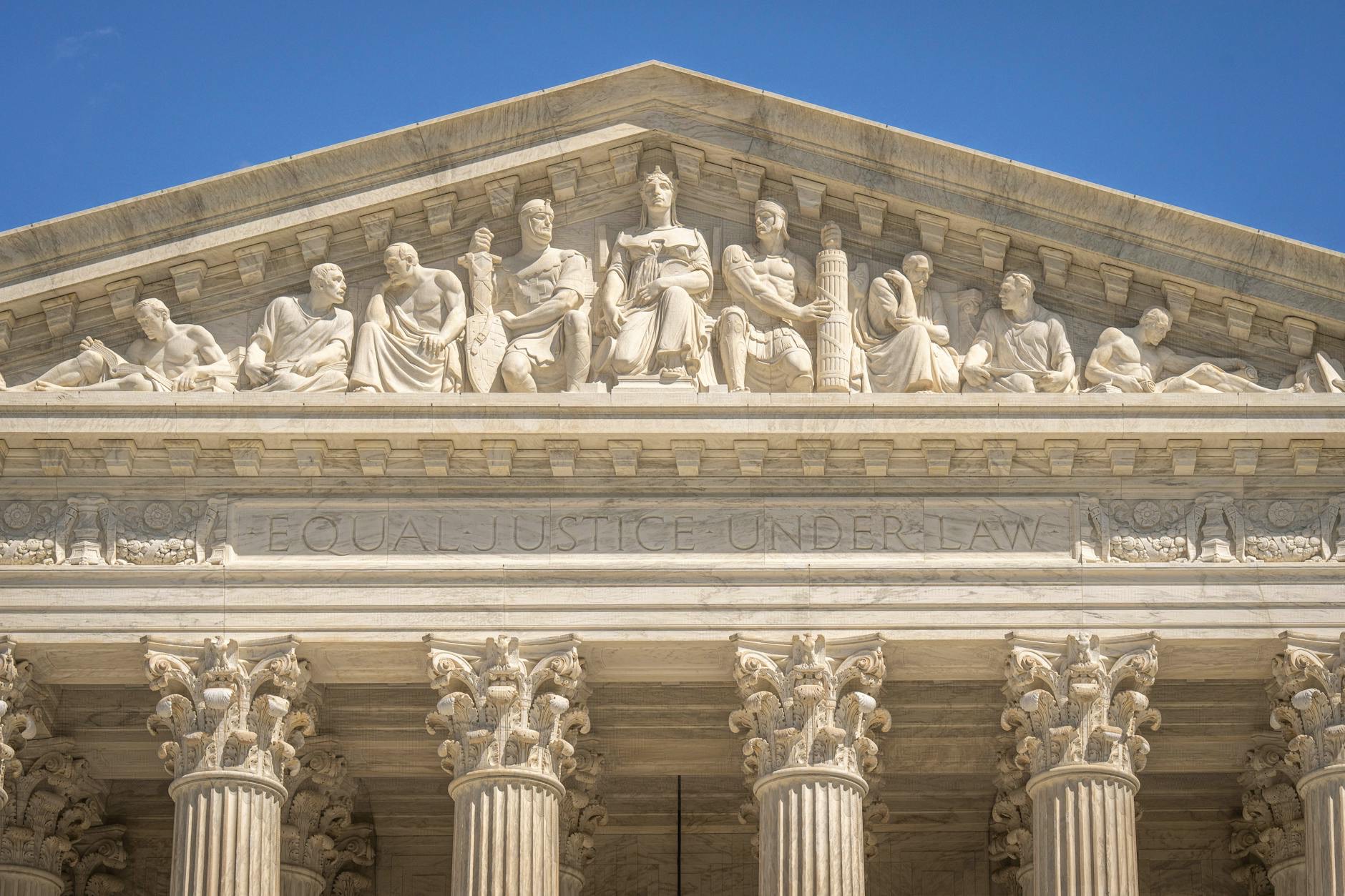
The U.S. Supreme Court’s new redistricting doctrine moved from theory to immediate political consequence Monday, when the justices allowed Alabama to pursue a congressional map more favorable to Republicans just days after a Louisiana ruling narrowed the use of race in drawing election districts.
The developments have triggered a sharp national debate over what supporters describe as a constitutional move toward race-neutral districting and what critics call a major weakening of the Voting Rights Act. Conservative commentator Larry Elder, in a column circulated through Google News and published by HotAir, framed the Louisiana decision as a “colorblind” ruling and cited Justice Clarence Thomas’s concurrence as a rebuke to race-based districting. The opinion piece reflects one side of a broader political and legal dispute, but the practical stakes are now unfolding in courtrooms, state capitols and congressional campaigns.
At the center of the fight is Louisiana v. Callais, decided April 29. In that case, the Supreme Court held that Louisiana was not required by Section 2 of the Voting Rights Act to create an additional majority-minority congressional district. The court concluded that the state’s use of race in creating the challenged map could not be justified and that the map violated the Equal Protection Clause as an unconstitutional racial gerrymander.
The case grew out of competing legal pressures on Louisiana after the 2020 census. A prior map had only one district where Black voters were a majority of the voting-age population. Voting-rights plaintiffs argued that the map diluted Black voting power and likely violated Section 2. Louisiana then enacted a new map that added another majority-Black district, but that replacement map was challenged by voters who said race predominated in its design. The Supreme Court’s majority sided with that challenge.
Justice Samuel Alito’s majority opinion said the court had long assumed, without squarely deciding, that compliance with the Voting Rights Act could be a compelling interest justifying race-based districting. The court’s new ruling significantly narrowed that assumption. It said Section 2, properly interpreted, did not require Louisiana’s additional majority-minority district and therefore could not justify the state’s race-conscious line drawing.
Thomas, joined by Justice Neil Gorsuch, wrote separately to argue for an even more restrictive approach. His concurrence said the court should not have interpreted Section 2 to create what he described as an entitlement to roughly proportional representation for racial groups. That language has been central to conservative reaction to the ruling, including Elder’s column, which defended the decision as a step away from racial classifications in election law.

Civil rights advocates and Democratic leaders have taken the opposite view. They argue that race-neutral language can obscure real-world vote dilution, especially in states with long histories of racially polarized voting and district maps that split minority communities. Their concern is that the ruling makes it harder to prove when a map unlawfully denies minority voters an equal opportunity to elect candidates of their choice.
The court’s Monday action in Alabama showed how quickly the Louisiana decision could reshape other cases. The justices lifted a lower-court order that had required Alabama to use a map with two districts in which Black voters had an opportunity to elect preferred candidates. Alabama officials had asked the court to revisit that order after Callais, arguing that the court-ordered map shared the same constitutional problem identified in Louisiana.
According to the Associated Press and Reuters, the Alabama order could allow the state to move back toward a legislature-approved map with only one such district out of seven. That change could help Republicans in the battle for control of the U.S. House, where even a small number of seats could determine the chamber’s majority after November’s midterm elections.
The court’s three liberal justices dissented from the Alabama order. Justice Sonia Sotomayor wrote that the lower-court ruling in Alabama was not limited to the Voting Rights Act issue addressed in Callais. She said the Alabama court had also found intentional discrimination under the Fourteenth Amendment and should have been allowed to consider whether its prior reasoning remained valid after the Louisiana decision.
The timing has heightened the controversy. Alabama primaries are scheduled for May 19, and state officials had sought quick action from the Supreme Court. The Associated Press reported that Alabama lawmakers had already approved legislation allowing special primaries in affected districts if the state is permitted to change congressional lines. That creates a fluid election calendar for voters, candidates and county election administrators.

Alabama Attorney General Steve Marshall welcomed the Supreme Court’s move, saying the decision returned mapmaking authority to elected state lawmakers. Civil rights groups criticized it sharply. The NAACP Legal Defense Fund said it would consider further options to preserve the court-ordered map, while the NAACP warned that the ruling threatened Black political representation in the state.
The legal fight is also being watched beyond Alabama and Louisiana. Several states have been pursuing mid-decade redistricting changes before the 2026 elections, and the Supreme Court’s new approach may encourage more challenges to maps designed to satisfy Voting Rights Act claims. Republican-led states are likely to argue that race-conscious remedial districts are constitutionally suspect after Callais. Voting-rights plaintiffs are likely to respond that Section 2 still prohibits districting systems that deny minority voters equal electoral opportunity.
The dispute exposes a fundamental tension in modern election law. One side argues that the Constitution generally bars government decision-making based on race and that district lines should be drawn under neutral criteria such as compactness, contiguity and political subdivisions. The other side argues that ignoring race in jurisdictions with racially polarized voting can preserve maps that weaken minority communities’ electoral power.
For now, the Supreme Court has not ended Section 2 litigation, but it has changed the leverage of those cases. Lower courts must now apply the Louisiana decision when evaluating whether the Voting Rights Act truly requires a race-conscious district and whether a state’s map can survive constitutional scrutiny. That recalibration arrives at a politically sensitive moment, as states, parties and advocacy groups race to lock in congressional maps before voters cast ballots in the midterms.
The immediate result is a national redistricting fight that is no longer confined to legal doctrine. It now reaches directly into campaign strategy, minority representation, state election administration and control of Congress. Whether the court’s approach becomes a durable “colorblind” standard or a flashpoint over weakened voting-rights protections will depend on how lower courts apply Callais in Alabama and in the next wave of redistricting disputes.




Leave a Reply