
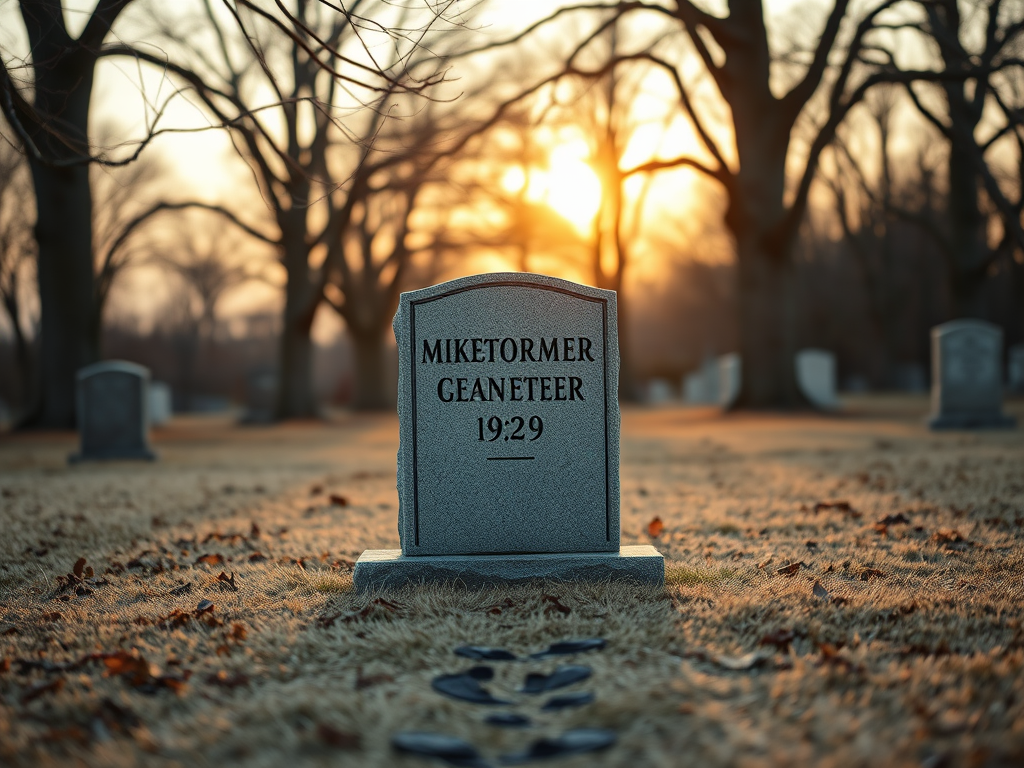

In the quiet hills of Arkansas, a modest cemetery in the small town of Heber Springs became the setting for an unexpected family discovery. On a winter day, Fred Stewart and his cousin Todd Minor walked slowly across the dry grass between cedar trees and bare oak branches, searching for the burial place of a man who had once lived quietly among them: the photographer Mike Disfarmer.
Disfarmer operated a small portrait studio in Heber Springs beginning around 1915. During his lifetime he lived simply and largely kept to himself. People in town remembered him as a solitary bachelor who enjoyed playing the fiddle, occasionally drinking beer, and indulging in ice cream. He had little interest in social life and was believed to have distanced himself from much of his family. When he died in 1959, he was buried without much public recognition. It would take more than a decade after his death for the art world to realize that the quiet photographer from a rural town had produced a remarkable body of work.
It took Stewart less than half an hour to locate the grave. The simple granite headstone was modest and easy to overlook. When he spotted it, he called out excitedly across the cemetery to his cousin. For Stewart and Minor, finding the grave was more than just locating a family resting place. It symbolized the rediscovery of a forgotten connection to an artist whose legacy had become the subject of growing interest and debate.

Just weeks earlier, Stewart, Minor, and more than ninety other distant relatives had reached a legal settlement that concluded a six-year dispute with the Arkansas Museum of Fine Arts Foundation. The conflict centered on ownership of Disfarmer’s photographic archive, including thousands of glass-plate negatives and the copyright associated with them. Because Disfarmer died without leaving a will, the question of who should control his artistic legacy became a complicated legal matter.
Although the specific details of the agreement remain private, the settlement appears to have granted the family ownership of the copyright as well as roughly 3,000 glass-plate negatives and hundreds of photographic prints created from them after Disfarmer’s death. For the relatives who had only recently learned about the photographer’s importance, the outcome represented both a legal victory and a chance to preserve their family history.
The first exhibition organized with the family’s authorization, titled “Disfarmer: The Homecoming,” opened on February 25 in the rotunda of the Arkansas State Capitol. The show features nine of the photographer’s works and is scheduled to remain on display through late May. For many visitors, the exhibition offers a glimpse into rural American life during the early twentieth century through the lens of an artist who captured everyday people with remarkable honesty.
The legal battle surrounding Disfarmer’s archive has also sparked broader discussion among art historians and legal experts. When an artist dies without a will, determining who should manage the estate can become a difficult question. Should the responsibility fall to distant relatives who may have had little personal connection to the artist, or to museums and collectors who helped preserve and promote the work?

This issue is not unique to Disfarmer. Similar disputes have emerged around the estates of other American artists who lived quietly and achieved fame only after their deaths. Two notable examples are the Chicago-based photographer Vivian Maier and the outsider artist Henry Darger. Like Disfarmer, both lived relatively unknown lives and left behind large bodies of work without clear instructions about ownership or management.
Legal scholars note that heirs can approach an artist’s legacy in different ways. Some families dedicate themselves to preserving and promoting the work, ensuring that it remains accessible to scholars and the public. Others may focus primarily on the financial value of the estate. The law provides a framework for determining inheritance, but it does not always guarantee that the outcome aligns with what might best serve an artist’s cultural legacy.
Despite these debates, there is little disagreement about the significance of Disfarmer’s photographs themselves. Beginning around 1914, he started documenting members of his local community in his small studio. Portrait sessions were affordable, sometimes costing as little as twenty-five cents, making them accessible to farmers and working-class families in the region.
The subjects in his photographs often wore simple handmade clothing and displayed the weathered expressions of people accustomed to hard physical labor. Yet the images reveal more than economic hardship. Disfarmer demonstrated a remarkable ability to capture the individuality of his subjects. His lighting and composition were carefully controlled, and his portraits often convey a sense of quiet dignity.
Many photography experts believe this ability to reveal authentic emotion is what sets his work apart. In front of his camera, people seemed to drop their social masks, allowing their genuine personalities to emerge. This rare talent eventually earned him recognition as a master of portrait photography.

For years after his death, however, the story of Disfarmer remained obscure. Part of the intrigue surrounding him came from stories about his unusual personality. Born Mike Meyer in Indiana in 1884 to German-American parents, he eventually rejected his birth name and legally changed it to “Disfarmer” in 1939. According to documents he filed at the time, he wanted to ensure that his family would not worry about him attempting to claim any share of their wealth. He believed the surname Meyer meant “farmer” in German and chose the opposite word to reflect his independence.
When Disfarmer died at the age of seventy-five, he left behind thousands of glass negatives along with a modest bank account. His estate was divided among surviving relatives, but the negatives themselves were sold for only a few dollars to a former mayor of Heber Springs. That mayor later sold them for one dollar to Peter Miller, a local newspaper editor and attorney.
Many of the glass plates had already suffered damage. Bacteria had eaten away parts of the photographic emulsion, threatening the images recorded on them. Miller worked to restore the plates that could still be saved and sent prints to Julia Scully, the editor of Modern Photography magazine in New York. In 1976 the two collaborated on a book featuring sixty-six of Disfarmer’s portraits.
The publication received enthusiastic reviews from critics and photographers alike. Reviewers compared the work to that of major figures in twentieth-century photography, praising the clarity and emotional depth of the portraits. The book transformed Disfarmer from an unknown small-town photographer into an artist recognized by museums and collectors.
Soon afterward, a community group in Arkansas known as The Group donated a large collection of the glass negatives to what later became the Arkansas Museum of Fine Arts Foundation. The institution preserved and maintained the fragile materials for decades, helping introduce the work to wider audiences.

As interest in Disfarmer’s photographs grew, collectors began searching for original prints made during his lifetime. These vintage prints were far more valuable than the later reproductions produced from the negatives. In the mid-2000s, art dealers even hired local buyers to travel around the region, purchasing photographs that residents still kept in family albums or displayed on their walls.
Today, vintage prints by Disfarmer can command high prices at auction and appear in the collections of major art museums. Institutions such as the Metropolitan Museum of Art, the Getty Center, and the Whitney Museum hold examples of his work.
Ironically, many of Disfarmer’s own relatives knew nothing about his artistic reputation until recent years. Todd Minor, whose great-grandmother was Disfarmer’s sister, learned more about the photographer only after discovering some old photographs among his father’s belongings. His father, a country music songwriter, had occasionally mentioned a great-uncle who worked as a photographer, but the family had never realized the scale of his legacy.
The rediscovery of that legacy was partly driven by Ron and Fawn Slattery, a couple deeply interested in the legal questions surrounding artists who die without wills. While traveling across the United States, they noticed that Disfarmer’s photographs were widely reproduced but credited to collectors rather than to family heirs. Curious about the situation, they conducted genealogical research and located several living relatives.
Their efforts eventually brought together members of Disfarmer’s extended family, many of whom initially suspected the situation might be a scam. Over time, however, more relatives joined the effort to reopen the estate and assert legal claims to the archive. The result was the long court case that finally ended with the recent settlement.
The debate surrounding the case highlights a broader cultural dilemma. Museums and collectors often play an essential role in preserving artworks and bringing them to public attention. At the same time, families may feel that the legacy of a relative should remain within the family lineage.
Some curators worry that transferring control entirely to heirs could limit public access to important works of art. Others argue that legal ownership should remain with the artist’s closest living relatives. The Disfarmer case illustrates how these competing perspectives can lead to complicated legal battles.

For Fred Stewart and other family members, however, the focus is now on honoring the photographer’s memory. Plans are already underway for larger exhibitions and educational projects celebrating Disfarmer’s work. One idea under consideration is recreating a vintage portrait studio inspired by the one he once operated in Heber Springs. Visitors could dress in period clothing and have their photographs taken using techniques similar to those used a century ago.
Such projects reflect a growing enthusiasm among the descendants who only recently discovered their connection to the artist. For them, the story is not simply about legal ownership but about rediscovering a family member whose quiet life produced images that continue to resonate with viewers decades later.
Standing beside the modest headstone in the Arkansas cemetery, Stewart felt a sense of pride and connection. The photographer who once lived largely unnoticed had become an important figure in American photography. Whether Mike Disfarmer himself would have welcomed the renewed attention remains impossible to know, but his work now ensures that the faces of the people he photographed will remain part of history.




Leave a Reply