
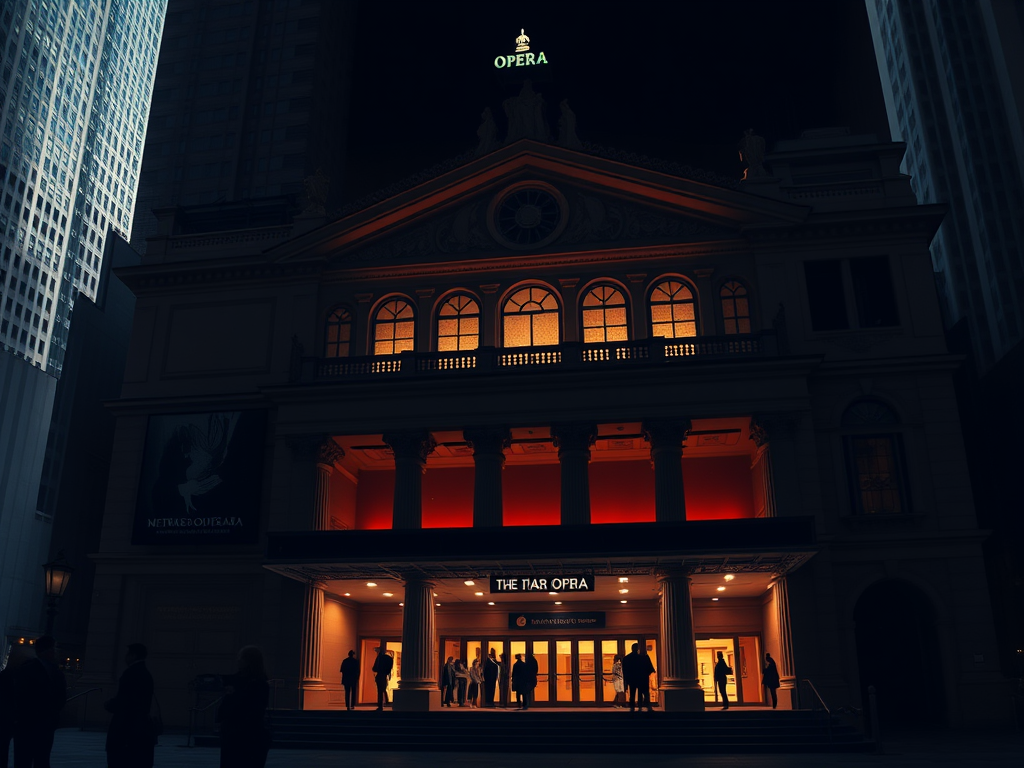

The Metropolitan Opera Faces Financial Strain as Leaders Seek New Funding Paths
The Metropolitan Opera, one of the most prominent performing arts institutions in the United States, is navigating one of the most challenging financial periods in its long history. Confronted with ongoing budget pressures, the organization has already used a significant portion of its once-protected endowment fund and is now exploring unconventional strategies to stabilize its finances.
Over the past few years, the company has drawn heavily from its endowment, a reserve traditionally preserved for emergencies. Roughly one-third of the fund has been depleted as the organization worked to cover operating deficits. This financial pressure has pushed the Met’s leadership to pursue a variety of fundraising and partnership initiatives.
General manager Peter Gelb has been actively searching for new sources of capital. One highly publicized effort involved discussions with Saudi Arabia regarding a potential cultural partnership. The proposal has been under negotiation for several months and would involve performances at a new cultural venue near Riyadh.
Gelb has also attempted to attract support from prominent figures in the technology world. In a recent interview, he described how he once reached out to Elon Musk with a creative proposal. Gelb joked that the Met could even stage an opera on Mars if Musk supported the institution financially. Despite the imaginative pitch, Musk never responded.
The financial challenges facing the Metropolitan Opera have encouraged Gelb to explore additional revenue-generating ideas. Among them is the possibility of selling naming rights to the opera house itself. The building in Manhattan currently seats about 3,800 people, and attaching a corporate sponsor’s name could provide a significant financial boost.
Another proposal involves installing corporate-style luxury boxes inside the venue, similar to those found in major sports arenas like Madison Square Garden. Gelb has even suggested selling two famous murals created by Marc Chagall that decorate the opera house lobby, though the artworks would remain on display if a buyer agreed to keep them in place.

Despite these creative ideas, the institution’s financial challenges remain serious. The opera company has already implemented layoffs and salary reductions this year. At the same time, credit rating agency Moody’s downgraded the Met’s debt twice in the previous year, citing concerns about its extremely limited cash reserves.
Adding to the pressure, the company faces tens of millions of dollars in short-term debt obligations in the coming year. Some of those debts are backed by the Chagall murals as collateral.
Gelb maintains that the organization is not facing an immediate crisis and believes his team has a workable strategy for recovery. According to him, temporarily using funds from the endowment was a calculated decision while a new long-term business model is developed.
Not everyone agrees with this assessment. Some financial experts who have reviewed the Met’s financial filings believe the situation is more urgent than the leadership suggests.
Laurence Scot, a nonprofit accounting specialist based in New York, said the organization is losing money and has relied heavily on investment income to maintain daily operations. In his view, the financial situation is fragile.
A major factor behind the Met’s difficulties has been declining ticket revenue. Even before the global pandemic forced the theater to close temporarily, attendance-related income had already begun to fall. Compared with a decade ago, the company now earns roughly $20 million less annually at the box office.
The Metropolitan Opera had once hoped that its live cinema broadcasts would become a major source of income. However, revenue from those broadcasts has declined by more than $10 million per year since 2019.
Given the organization’s enormous annual budget of approximately $326 million, the drop in revenue has widened the operating deficit. To compensate, the company made unusually large withdrawals from its endowment. The fund has shrunk from about $340 million in 2022 to roughly $212 million today.

Because the endowment has become smaller, it now generates less investment income, making it harder for the organization to rely on those funds to support its operations.
Some observers believe that an institution as iconic as the Metropolitan Opera is unlikely to collapse entirely. They argue that wealthy donors or major benefactors could step forward if the situation became truly dire.
Arts administration scholar Hannah Grannemann noted that the Met has a vast network of supporters, including donors and government stakeholders in New York City. In her view, a large financial rescue from a wealthy individual or organization remains a possibility.
Others question whether the current leadership is capable of reversing the company’s financial decline. Gelb, who has led the organization since 2006, has faced criticism from some observers who believe a leadership change may be necessary.
Anne Midgette, formerly the chief classical music critic for The Washington Post, suggested that draining the endowment is not a sustainable solution. She argued that the company should consider new leadership to guide it through the crisis.

Over the years, the Met has continued to spend heavily even as revenue declined. Gelb has invested in modern and experimental productions aimed at attracting younger audiences and new donors. While some of these productions have been critically praised, they have not always translated into strong ticket sales. New productions also require significant upfront investment.
Gelb, however, defends his strategy. He points to innovations such as the Met’s live global broadcasts as evidence that he has successfully expanded the institution’s reach. He believes the organization still offers an artistic experience that audiences deeply value.
At the same time, the Met has been experimenting with new uses for its performance space. The opera house has begun hosting events that extend beyond traditional opera performances. Recently, a fashion show by designer Michael Kors took place on the venue’s grand staircase.
Additional events are planned in the near future. A musical featuring Sting is scheduled to open in June, and Gelb has even contacted Bob Dylan’s management to explore the possibility of a concert appearance.
The goal, according to Gelb, is to continue searching for solutions without abandoning the institution’s artistic mission.
Opera productions are famously expensive to stage. Labor costs alone can account for up to three-quarters of the company’s total budget. The Metropolitan Opera employs about 2,000 full-time workers, and most salaries are determined by contracts with multiple labor unions.
Producing large-scale opera requires a significant workforce, including musicians, stagehands, technicians, costume designers, and administrative staff. As industry experts often note, staging a classic opera today requires roughly the same number of people as it did more than a century ago.

In an effort to control costs, the Met has outsourced the construction of some stage sets to contractors outside New York, including companies in California and Wales. While this strategy has saved money in some cases, it has also created tension with labor unions.
One recent outsourcing project ran into trouble when a contractor failed to complete an ambitious stage set for the upcoming production of Tristan und Isolde on schedule. The delay forced the Met to hire another builder, and donors contributed $1.4 million to cover the additional expenses.
To reduce spending, the organization has also cut staff positions and reduced salaries for some administrative employees. The number of performances scheduled for next season has been lowered as well.
Peter Gelb originally joined the Metropolitan Opera with a reputation as an outsider to the traditional opera world. Before his appointment, he served as president of Sony Classical and advocated modernizing the art form to attract younger audiences.
He says that the average age of single-ticket buyers has dropped significantly during his tenure, suggesting that new audiences are indeed discovering opera.
The organization has also begun adjusting its programming strategy. Consultants recommended focusing more on popular classic works that consistently attract audiences while extending their performance runs to reduce production costs.

Another area under review is the management of the endowment fund itself. Many nonprofit institutions typically withdraw around five percent of their endowment annually to support operations. Last year, however, the Met withdrew more than twenty percent.
Financial experts warn that such a high withdrawal rate cannot continue indefinitely without damaging the fund’s long-term sustainability.
Investment strategy has also been questioned. In recent years the Met allocated a large portion of its endowment to alternative investments such as hedge funds and private equity, leaving only a small amount invested in U.S. stocks during a period when stock market returns were strong.
As a result, the endowment generated a return of about 6.8 percent last year, significantly lower than the 16 percent gain of the S&P 500.
The Met’s board of directors is now reviewing the investment strategy to determine whether adjustments are necessary.
Board members themselves have stepped in to provide financial support. Tod Johnson, a senior leader of the Met’s board, personally provided a $20 million loan to the organization in 2024 and has indicated that he plans to forgive the debt.
Nevertheless, the Met still carries millions of dollars in outstanding loans and credit lines. Some analysts caution that relying heavily on borrowing to fund operations could create additional risks in the future.
Gelb remains optimistic about the possibility of securing significant funding from international partnerships, particularly the potential Saudi Arabia cultural collaboration. He believes such agreements could cover a substantial portion of the Met’s financial needs for several years.

At the same time, the organization is exploring other revenue opportunities, including expanding digital streaming options for opera performances and forming partnerships with music schools that could use the Met as a training or research center.
Another potential financial boost may come from a large estate donation expected in the future, possibly exceeding $100 million. The gift will depend on the sale of two companies previously owned by a deceased benefactor.
Even some of Gelb’s critics acknowledge that he has repeatedly managed to find new funding sources over the years. Still, many observers wonder whether those opportunities are becoming harder to find.
For Gelb, the ideal solution remains simple: a major philanthropist willing to provide transformational funding.
In his words, what the Metropolitan Opera truly needs is a billionaire supporter prepared to make an extraordinary gift that secures the institution’s future for generations to come.




Leave a Reply