
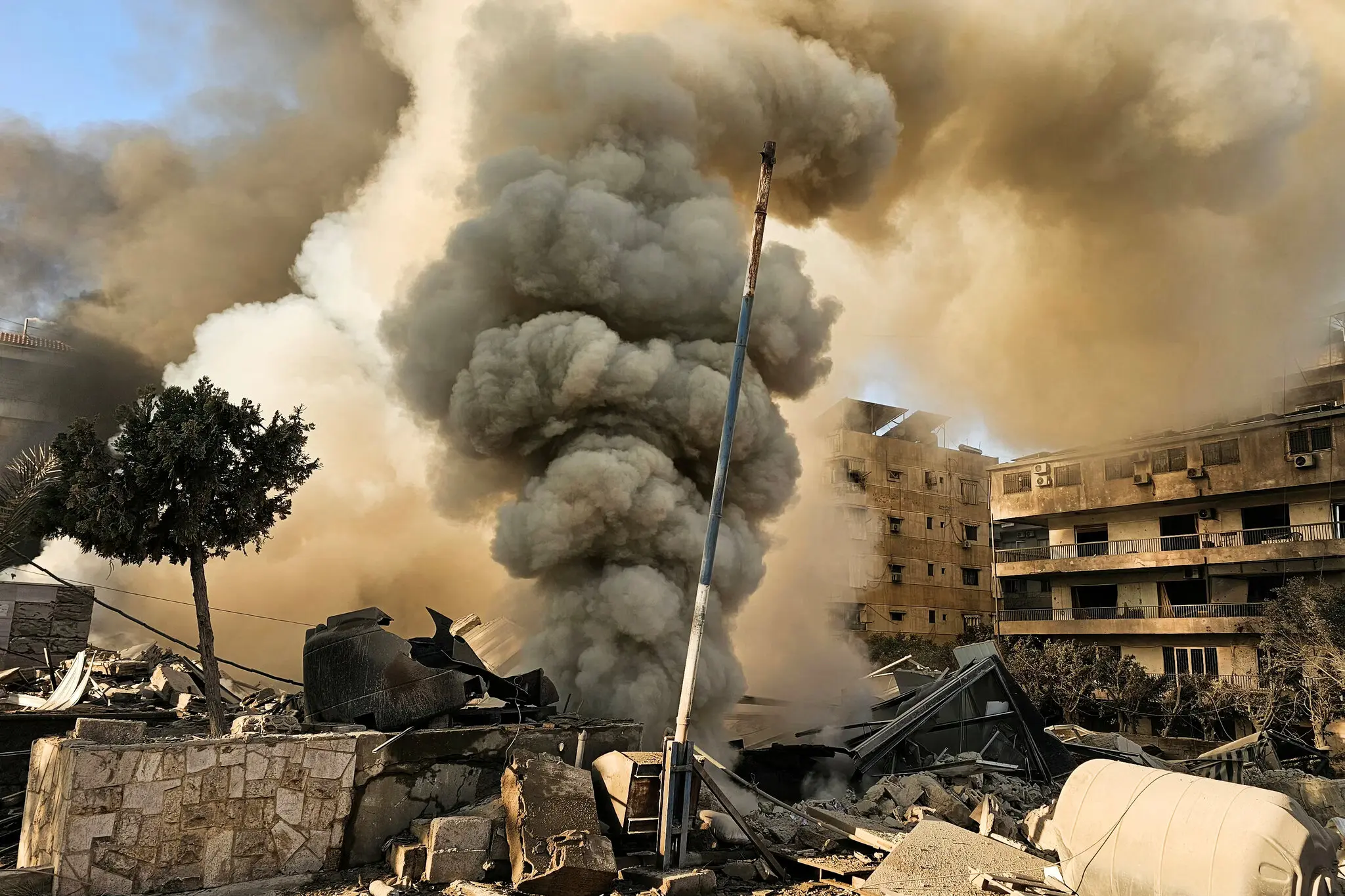
As airstrikes and missile exchanges intensify between Iran, Israel, and the United States, another battle is unfolding beyond the physical destruction: a fierce struggle over information. While Iranian cities, military installations, and political figures have been targeted by thousands of strikes, Tehran’s official media outlets are working relentlessly to project calm, strength, and victory.
Across state television networks and a constellation of aligned social media accounts, Iran is presenting an image of resilience. Broadcasts and online posts portray the country not as a victim of overwhelming force, but as a determined power striking back decisively. In this narrative, Iranian missiles have devastated Tel Aviv and other Israeli urban centers, fighter jets have crippled an American aircraft carrier, and U.S. forces across the region have suffered hundreds of casualties.
Yet independent reporting and official statements from Washington and Jerusalem suggest a far more limited impact. Although Iran has launched retaliatory strikes that caused damage in Israel and at nearby American facilities, the scale of destruction and loss of life appears significantly smaller than Iranian state media claims.
Analysts say this gap between portrayal and reality reflects a deliberate strategy. Moustafa Ayad of the London-based Institute for Strategic Dialogue, which monitors disinformation campaigns, describes the approach as “flooding the zone” with content designed to project power while blurring the facts. By saturating the information space, Iran makes it harder for audiences to distinguish verified developments from exaggeration or fabrication.
Propaganda has always accompanied warfare, but the digital era has transformed its speed and reach. Social media platforms allow narratives to travel globally within minutes, while advances in artificial intelligence have made fabricated images and videos increasingly convincing. Similar tactics have been observed in Russia’s war in Ukraine, and Tehran appears to have adopted comparable methods, including the strategic use of AI-generated content.
Recognizing the potential influence of these campaigns, both Israel and the United States have made efforts to counter them. Among the sites reportedly targeted in Israeli strikes was the headquarters of Islamic Republic of Iran Broadcasting, Iran’s state television and radio organization. Meanwhile, American officials have publicly rebutted certain claims circulating online, while also managing how much information they disclose about their own losses.
With internet access inside Iran periodically restricted or shut down, much of Tehran’s messaging appears aimed at international audiences rather than domestic viewers. Official statements released in Persian, Arabic, and English frequently emphasize what they describe as sweeping and successful counteroffensives. One senior Iranian official, speaking on state television, characterized operations against Israel and its allies as so extensive that they left military experts “in awe.”
Digital risk analysts at Alethea have tracked the spread of unverified or misleading claims through state-linked outlets. For example, reports that Iran completely destroyed an American radar facility in Qatar were circulated by the Tehran Times and echoed in social media posts accompanied by AI-altered imagery attributed to the Tasnim News Agency. Independent confirmation of such claims has been lacking.
In another case, Tasnim reported that Iranian forces had shot down a U.S. fighter jet near Kuwait in what it called a “brilliant move.” U.S. officials, however, described the incident differently, suggesting it involved friendly fire by Kuwaiti air defenses. Even so, commentators on the Islamic Republic of Iran News Network argued that Iran deserved indirect credit, claiming earlier Iranian strikes on radar systems had contributed to the confusion.
The messaging strategy also extends to highlighting the destruction within Iran itself. According to Omid Memarian, a senior analyst at the Washington-based nonprofit DAWN, state outlets are circulating images of bombed neighborhoods and damaged infrastructure to signal that regime change would not be simple or peaceful. The implied warning to Washington and Jerusalem is clear: any attempt to force a political transition would be costly and destabilizing.
Casualty figures have been another focal point. A social media account linked to the Iranian military claimed that 560 Americans had been killed or wounded in the conflict, vastly exceeding the six fatalities acknowledged by the Pentagon. The figure was subsequently amplified by Russia’s state news agency Tass and later by RT, before spreading widely across social media networks. Researchers note that many of the accounts sharing the claim appeared coordinated, with some previously focused on unrelated entertainment content before pivoting to wartime messaging.
Iranian broadcasters have also accused foreign media of misrepresenting the conflict. On the Islamic Republic of Iran News Network, commentators have criticized international outlets for what they describe as selective reporting that ignores Iranian successes while emphasizing setbacks.
Artificial intelligence has played a visible role in this evolving information war. PressTV, Iran’s English- and French-language broadcaster, posted a video on X that appeared to show a high-rise building in Bahrain engulfed in flames following Iranian airstrikes. The post was later removed, and no credible evidence supported the scenario depicted. Another widely circulated image claimed to show the U.S. Embassy in Saudi Arabia ablaze after a missile strike, but independent footage from the ground did not corroborate the claim.
Memarian describes the scale of AI-generated output from Iran’s cyber apparatus as striking, noting the rapid production and distribution of content designed to bolster the image of Iranian military effectiveness online.
Pro-Iranian social media accounts have also promoted exaggerated or false claims about the deaths of senior American and Israeli officials, including Israeli Prime Minister Benjamin Netanyahu. Some posts relied on “copypasta” tactics, repeatedly sharing identical text to create the impression of widespread confirmation.
Researchers at Alethea identified a recurring format in which AI-generated videos purported to show American or Israeli soldiers visibly shaken or in tears after missile strikes. These videos often carried identical captions, reinforcing a narrative of psychological defeat. Similarly, NewsGuard, an organization that tracks misinformation, reported that footage of a massive explosion attributed to an Iranian strike on a nuclear facility in southern Israel was actually from a 2017 ammunition depot fire in Ukraine. Another clip allegedly depicting a CIA building in Dubai on fire was traced back to a residential tower blaze in 2015.
American officials have responded selectively to some of the more prominent claims. Early in the conflict, Iranian state television announced that the aircraft carrier USS Abraham Lincoln had been struck by four ballistic missiles. The claim spread rapidly across pro-Iranian social media accounts, often illustrated with imagery drawn from video games or created using AI tools.
The U.S. Central Command, responsible for American military operations in the region, publicly rejected the report on X, stating bluntly that the carrier had not been hit and that the missiles did not come close. The post labeled the claim a “lie,” underscoring how governments are increasingly forced to engage directly in online fact-checking during wartime.
As the conflict continues, the digital front remains as contested as the physical battlefield. In an era where AI can fabricate convincing scenes in seconds and social media can propel them worldwide almost instantly, shaping perception has become a strategic objective in its own right. For audiences around the globe, separating verified developments from manufactured narratives is becoming ever more challenging, illustrating how modern warfare now extends far beyond the range of missiles and drones.




Leave a Reply