
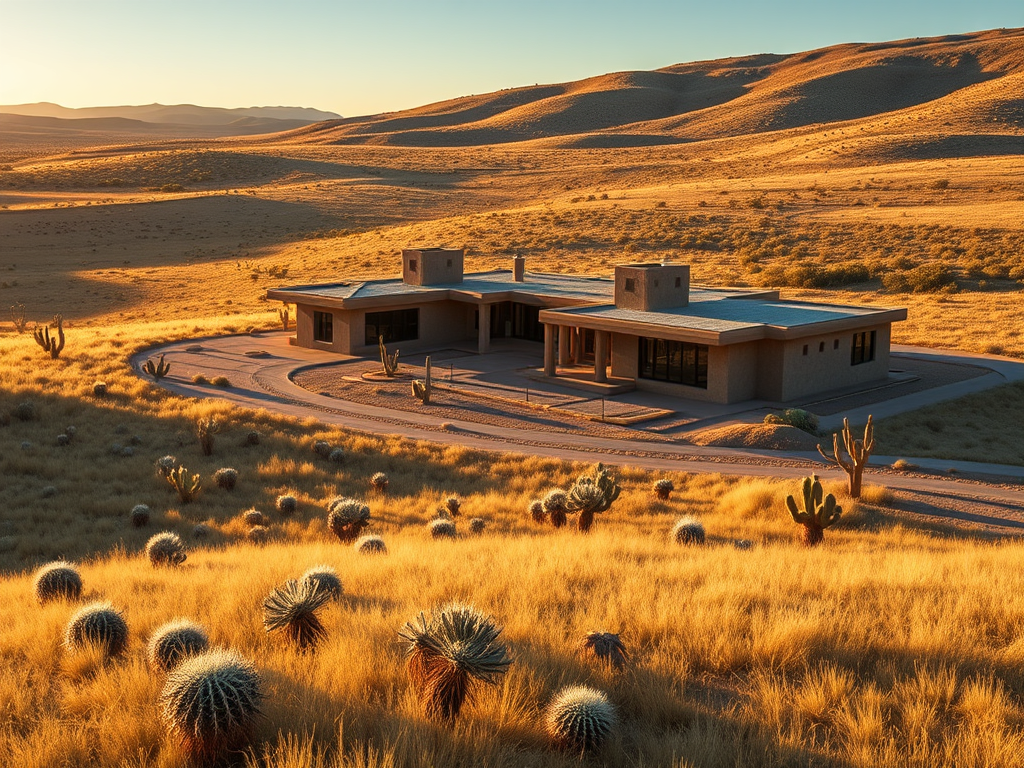

Far from the headlines that once fixated on private jets and tropical islands, one of Jeffrey Epstein’s most secluded properties lies deep in the high desert of New Mexico. It is not surrounded by ocean, but by miles of scrubland and silence. For years, the vast estate known as Zorro Ranch operated with little public scrutiny, tucked into a remote stretch of land south of Santa Fe.
The property spans thousands of acres and centers on a 30,000-square-foot mansion perched on a ridge. The surrounding terrain is classic Southwestern desert: rolling grasslands, scattered cholla cactus, and dry arroyos that carve through the earth. Neighbors are few and far between. Privacy is not just valued here—it is part of the culture.
Several of Epstein’s accusers have alleged that they were trafficked to the ranch. High-profile guests were said to have visited over the years. According to previously reported accounts, Epstein even discussed using the ranch as a base for controversial genetic research projects. Despite these allegations, state officials now acknowledge that no comprehensive investigation into potential criminal activity at the ranch was ever fully carried out during the 26 years Epstein owned it.
In 2019, as federal authorities intensified their case against Epstein, a state-level inquiry in New Mexico was effectively absorbed by federal prosecutors. According to state officials and emails that later became public, the investigation appeared to lose momentum after that transition.
Eddy Aragon, an Albuquerque radio host who has independently researched Epstein’s presence in the state for years, argues that Zorro Ranch was largely overlooked while attention centered elsewhere. Other properties associated with Epstein—particularly Little St. James in the Caribbean—were subjected to extensive media coverage and law enforcement scrutiny. Properties in cities such as New York City and Miami also drew sustained attention. By contrast, the New Mexico estate remained comparatively underexamined.
That dynamic may now be changing. Prompted in part by the U.S. Department of Justice’s recent release of additional Epstein-related documents, lawmakers in New Mexico voted unanimously to establish a bipartisan “truth commission” within the state legislature. The four-member panel has subpoena power and is tasked with investigating the history of Zorro Ranch. At the same time, the state’s attorney general announced plans to reopen a previously closed inquiry into activities connected to the property.
Andrea Romero, a state representative from Santa Fe who is leading the commission, has said the goal is to understand how Epstein was able to operate for so long without meaningful accountability. For many in the state, the unanswered questions are no longer tolerable.
Complicating matters is the fact that the ranch changed ownership in 2023. The new owner, Don Huffines, a Dallas real estate developer and former Texas state senator, has publicly stated that he intends to cooperate with any law enforcement requests. However, the change in ownership may present logistical and legal challenges for investigators seeking access or evidence.
Among the most troubling claims to emerge from recently unsealed documents is an anonymous tip submitted in 2019. The tipster, who claimed to have worked at the ranch, alleged that two abused girls had died and were secretly buried in the hills surrounding the property. It remains unclear whether federal authorities thoroughly investigated that allegation. The Federal Bureau of Investigation has declined to comment on the matter or confirm whether a full search of the property was conducted.
Correspondence included in the document release suggests that as of December 2019, the ranch had not been searched by federal investigators. That same year marked the point at which the state’s investigative efforts appeared to stall.
Hector Balderas, who served as New Mexico’s attorney general at the time, has said his office had begun interviewing witnesses about potential local misconduct when federal prosecutors in the Southern District of New York requested that state authorities halt their work and share their findings. According to Balderas, federal officials believed consolidating the case at the national level would strengthen the prosecution.
Over time, however, Balderas grew concerned that progress was insufficient. In 2020, his office sent a formal letter urging federal authorities to seize Epstein’s New Mexico assets, asserting that the ranch may have been used to facilitate and conceal child trafficking. He has said that no response was received.
The Southern District of New York referred inquiries to the U.S. Department of Justice, which did not publicly elaborate. Balderas has since expressed the view that additional prosecutions tied to conduct in New Mexico may have been warranted.
The state’s complex relationship with secrecy is not new. During the 1940s, the U.S. Army Corps of Engineers selected Los Alamos as the hidden site for the Manhattan Project, where scientists developed the first atomic bomb. The initial nuclear test took place near Alamogordo and was kept secret for weeks. The high desert has long been associated with classified work, remote compounds, and powerful interests operating out of sight.
In more recent decades, celebrities and affluent individuals have purchased expansive tracts of land in northern New Mexico, drawn by its dramatic landscapes and culture of discretion. Residents often describe an unspoken code: people tend to respect boundaries and avoid prying into their neighbors’ affairs.
Epstein acquired Zorro Ranch in 1993 from the family of Bruce King, a three-time governor of the state. The purchase connected him to influential political circles, echoing patterns seen elsewhere in his network. At the time of acquisition, the property was relatively modest. Epstein oversaw extensive development, transforming it into a sprawling compound.

Over the years, the ranch came to include a private airstrip, a helicopter pad, an airplane hangar for his jet, and what is believed to be the largest private residence in the state. Barbed-wire fencing lined the perimeter, and surveillance cameras monitored activity. Locals could see bright lights illuminating the compound at night and observed frequent aircraft arrivals and departures, yet few knew who lived there.
Longtime residents say such detachment is typical. New Mexico’s appeal, particularly around Santa Fe, lies partly in its quiet tolerance of privacy. As one former county commissioner put it, people generally mind their own business—an attitude that has attracted artists, actors, and entrepreneurs seeking refuge from public scrutiny.
Stephanie Garcia Richard, New Mexico’s commissioner of public lands, has suggested that geography played a role in Epstein’s choice of location. In addition to owning Zorro Ranch, he leased approximately 1,200 acres of adjacent public land, ostensibly for cattle grazing. The leases were canceled in 2019. According to Garcia Richard, the additional acreage effectively expanded the property’s isolation.
Some state officials now argue that the ranch’s remoteness may have been a deliberate advantage. Sparse population, limited oversight, and permissive sex offender registry laws at the time allowed Epstein to avoid registering locally after pleading guilty to felony sex crimes in Florida. Combined with high-level political connections—including ties to Bill Richardson, the former governor and U.N. ambassador who died in 2023—the environment may have enabled him to operate with minimal interference.

Today, the property has been renamed San Rafael Ranch by its new owner. Huffines has said he plans to convert it into a Christian retreat. Construction is underway on a new front gate, which he has indicated will bear a religious inscription referencing healing and faith.
Meanwhile, lawmakers in New Mexico face a pressing concern: whether critical evidence has already been lost. Years have passed since Epstein’s death in 2019, and the ranch has undergone ownership changes and physical alterations. The newly formed truth commission will attempt to reconstruct events and determine whether further legal action is possible.
For many in the state, the effort represents more than an inquiry into one property. It is a reckoning with how power, influence, and geography can converge to shield wrongdoing. In the vast openness of the New Mexico desert, silence once prevailed. Now, officials say, that silence is being challenged.




Leave a Reply