

In November, photographs circulating in the news shocked many observers. Massive demolition cranes, reminiscent of prehistoric beasts, were shown tearing apart the East Wing of the White House — a structure long associated with national history and public symbolism.
The reason soon became clear. The current president had proposed the construction of a new 400-million-dollar ballroom on the White House grounds, and the East Wing happened to stand in the way of this vision. What had once been part of “the People’s House” was sacrificed to make room for a personal architectural ambition.
Not long after, another announcement stirred concern. The administration declared that the John F. Kennedy Center for the Performing Arts would close on July 4 for a two-year overhaul. Officials described the project as a transformation into a modern, dazzling entertainment complex.
To many in Washington’s cultural and artistic communities, these moves felt deeply troubling. Critics fear that such projects signal a broader disregard for federally owned landmarks, many of which date back to the New Deal era — a period that invested heavily in public art, architecture, and cultural heritage.
Among these threatened treasures is a remarkable yet little-known collection of murals created in the early 1940s by two of America’s most significant political artists, Philip Guston and Ben Shahn. Their work resides in a federal building that most tourists have never visited and that few even know exists.
These paintings were commissioned for the Wilbur J. Cohen Federal Building, completed in 1940. The structure was originally conceived as the headquarters of the Social Security Administration, itself a cornerstone of Franklin D. Roosevelt’s domestic policy legacy.
Today, however, the future of both the building and its murals is uncertain. The General Services Administration, which manages federal properties, has placed the Cohen building on an “accelerated disposition” list — effectively preparing it for sale to private buyers.
Congress approved this sale under one condition: the building must be completely vacated first. While the G.S.A. claims that any sale would include legal preservation protections, many preservationists now doubt that such safeguards would truly be respected, especially in light of recent demolitions.
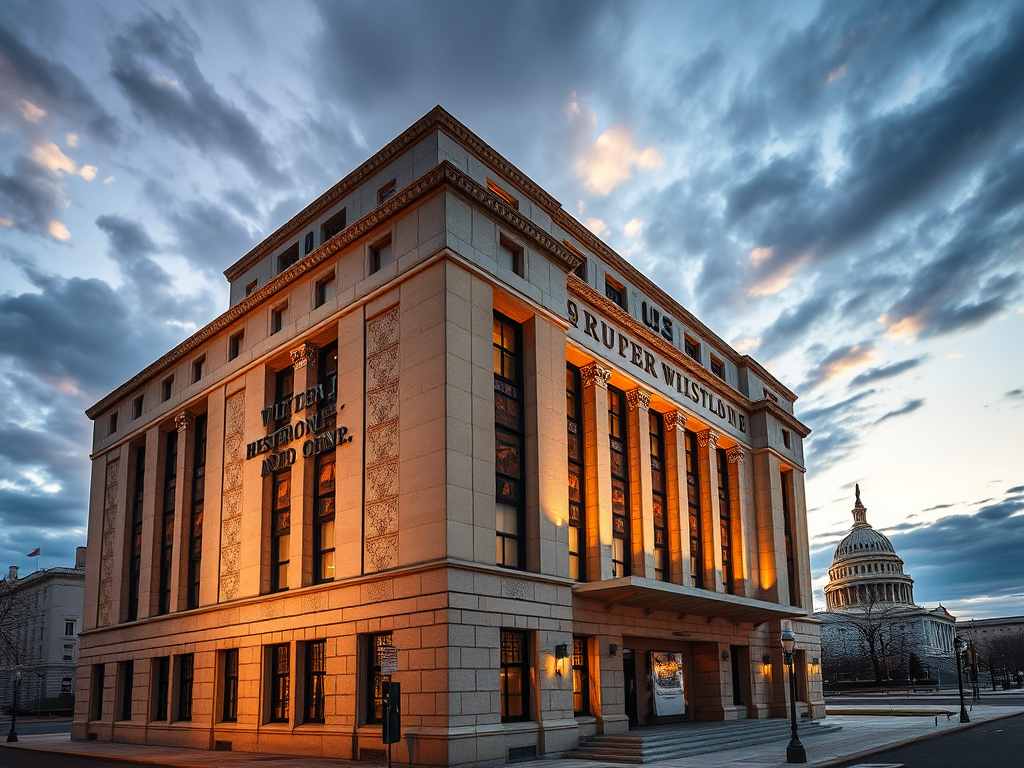
Standing just two blocks from the U.S. Capitol and facing the National Mall, the million-square-foot granite and limestone building has housed various government agencies over the decades. During World War II, it was used by defense agencies before later becoming home to Voice of America, the nation’s largest international broadcaster.
Since 9/11, the building has been closed to the general public, though limited tours have recently begun. Architecturally, it blends elements of Art Deco, Stripped Classical, and Egyptian Revival styles. Yet its greatest value lies not in its design alone but in the New Deal-era artworks embedded within its walls.

Art historian Gray Brechin has described the interior as a kind of Sistine Chapel of the New Deal. His organization, Living New Deal, is now leading efforts to preserve both the murals and the building itself.
The murals were commissioned by the Treasury Department’s Section of Fine Arts and completed in 1942–1943. They reflect a nation still recovering from the Great Depression and striving toward a more just and democratic society.
Among the three artists featured in the building, Seymour Fogel is the least well-known. Yet his two fresco panels near the Independence Avenue entrance vividly express Roosevelt’s vision of social progress.
In one panel, titled “Wealth of the Nation,” scenes of scientific research, architectural planning, and industrial labor depict a smoothly functioning modern society. In the companion piece, “Security of the People,” a family enjoys leisure time together in a harmonious, almost idealized domestic setting.
Philip Guston’s mural, painted in 1943 and titled “Reconstruction and the Wellbeing of the Family,” takes a more complex and emotionally layered approach. Unlike Fogel’s bright optimism, Guston introduces shadows, tension, and ambiguity.
His work is arranged like a Renaissance triptych, with workers confined to narrow side panels while a family gathers in the central space. The scene feels both intimate and theatrical, as if the family were actors on a stage rather than ordinary citizens at home.

Ben Shahn’s paired murals, collectively called “The Meaning of Social Security,” occupy opposite walls of the lobby. They contrast life before and after the creation of Social Security in 1935.
One wall depicts progress: families, athletes, and construction workers building radiant, almost heavenly cities. The other wall presents a darker vision of America plagued by unemployment, poverty, and despair.
In this grim landscape, men sit idle, families wander homeless, and children sleep on the streets. Elderly and disabled figures lean on crutches, symbolizing a society that had failed to protect its most vulnerable citizens.
Shahn later remarked that this was the best work of his career. Yet over time, some government employees found the bleak imagery uncomfortable and covered part of the mural with a curtain.
Now, however, the threat is far greater than mere censorship. The building itself may vanish entirely.
During Trump’s first term, tensions with Voice of America led to funding cuts and pressure to vacate the building by 2028. Although the situation appeared to stabilize under Biden, little action was taken to preserve the site.
In 2024, a Republican senator quietly inserted a clause into a water resources bill mandating the sale of the Cohen building within two years of it becoming empty. President Biden signed the bill with that condition included.

A report that same year found that only about 72 people regularly used the enormous facility. With so few tenants remaining, the G.S.A. has moved ahead with plans to sell the property.
Preservationists worry that a private developer might demolish the structure, valuing only the land beneath it. While Guston’s canvases could potentially be relocated, the wall-bound murals by Fogel and Shahn would be at serious risk of destruction.
The G.S.A. insists that it will include preservation covenants in any sale agreement, but its own arts oversight division has been significantly reduced in recent years, casting doubt on its ability to enforce such protections.
Petitions are now circulating nationwide. One led by Living New Deal calls for the building to be preserved as a symbol of America’s shared values and artistic heritage.
Another open letter, signed by hundreds of artists and addressed to the Jewish Museum in New York, urges that institution to take a leading role in saving the murals created by three Jewish-American artists.

At a moment when public art is being reshaped to reflect political power rather than collective history, many believe it is more important than ever to defend works that celebrate labor, community, and social responsibility.
The president clearly recognizes the symbolic power of monuments and cultural institutions, as seen in his plans for a grand ballroom, a redesigned Kennedy Center, and a new triumphal arch.
For that very reason, cultural organizations across the country are now being called upon to unite in defense of a different kind of public art — one that honors ordinary people rather than political leaders.
These murals are not simply decorations. They are visual records of a nation’s struggle, resilience, and moral imagination.
Anyone who doubts what is at stake should visit Washington while the Cohen building still stands. The artworks inside may soon be lost forever, but for now, they remain powerful reminders of what public art once meant — and what it could still be.




Leave a Reply