
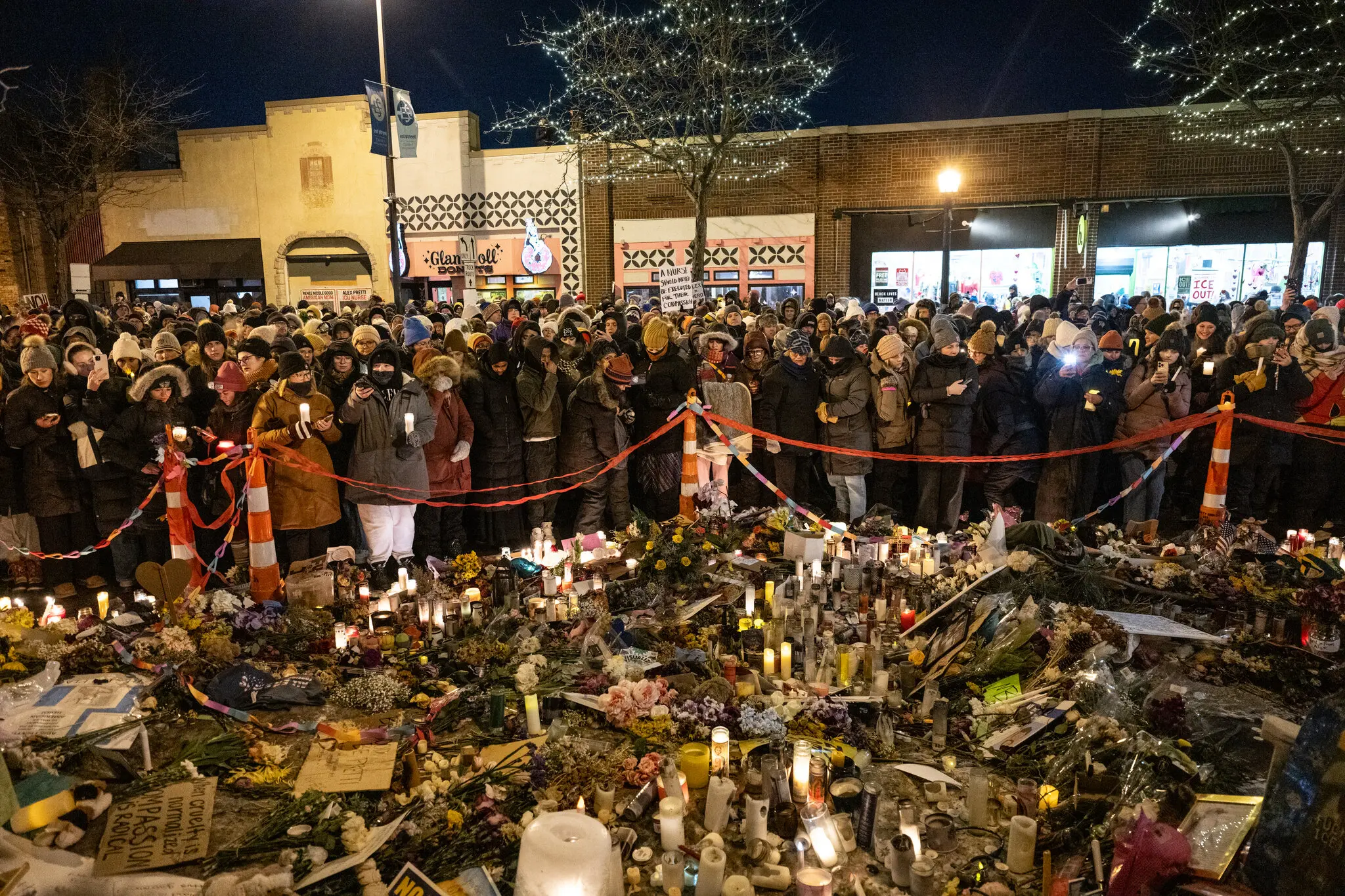
On January 7, Renee Good was shot dead. On January 24, Alex Pretti met the same fate. In both cases, federal agents were responsible for the killings, and in both cases the administration swiftly branded the victims as “terrorists.” Yet as more information and video footage emerged, those labels quickly unraveled in the eyes of the public.
Still, it was Pretti’s death that marked a turning point. His killing ignited a broader backlash against federal tactics, pushing the Trump administration into an unusual retreat.
Gun rights organizations openly criticized the White House. Republican senators demanded investigations. A national survey even showed that support for abolishing ICE among independent voters nearly doubled.
Both deaths sparked outrage. But Pretti’s resonated far beyond liberal circles. It reached conservatives who had previously defended the crackdown, as well as independents who had been largely disengaged. Why did his case cross political boundaries when Good’s, despite intense anger, largely did not?
There is rarely a single explanation for why one tragedy becomes a national flashpoint while another fades from view. History offers many examples.
George Floyd was not the first Black man killed by police in 2020, yet the video of his death, combined with existing tensions over policing, transformed his case into a nationwide movement. Rosa Parks was not the first person to refuse to give up her seat on a Montgomery bus, but circumstances made her stand the catalyst for civil rights activism. Often, tipping points are only clear in retrospect.
Kevin Drakulich, a criminologist at Northeastern University who studies crime and public perception, summed it up bluntly: Good’s death was heartbreaking, but Pretti’s symbolized a larger pattern.
The federal crackdown had already claimed lives elsewhere, including a Mexican immigrant shot by ICE agents in Chicago months earlier, but that incident never sustained national attention. Minneapolis was different. Two American citizens were killed within weeks in a city already synonymous with protests against police violence.
Good’s death first raised national questions about federal operations in Minneapolis, leading to demonstrations and media scrutiny that weakened Trump’s credibility on immigration. Then, just days before Pretti was killed, a widely circulated image deepened public unease: a five-year-old boy in a blue bunny hat and school backpack being led away by federal agents after being picked up from school. The image intensified public concern.
Still, images alone do not explain the different reactions.
Good was shot while sitting in her car. Officials claimed her vehicle posed a threat, framing it as a potential weapon. Although video analysis challenged this narrative, it could not completely disprove the agent’s claim of feeling endangered.
Pretti’s case was far less ambiguous. He was on foot, recording with his phone, assisting a woman who had been pushed to the ground. The administration described him as an “assassin” intent on attacking law enforcement.
Within hours, multiple videos showed him holding only his phone before being tackled, pinned face down, and shot repeatedly in the back. An agent had already removed a gun from his waistband. Analysts later concluded that the shots occurred after he was restrained, raising serious doubts about whether the use of force was justified.
Many viewers saw not self-defense, but an execution. The government’s narrative collapsed almost immediately. Yet even that did not fully explain the political shift that followed.
Part of the explanation lay in who Pretti was and how he was perceived.
Drakulich describes what he calls the “ideal victim,” someone whose life is widely valued and who is seen as entirely blameless. Pretti fit that image for many Americans.

He was not an undocumented immigrant, but a white American citizen. He worked as an intensive care nurse at a veterans’ hospital and had been praised for his compassion toward patients. He legally owned a firearm and had no criminal record. In the footage before his death, he appeared calm and composed.
He did not flee. He stepped in to help a stranger. And still, masked federal agents killed him.
Sarah Gaither, a psychology professor at Duke University, noted that Pretti matched cultural expectations of respectability and non-threatening behavior, making it harder for critics of ICE to dismiss his case.
His profile did not necessarily generate more sympathy, but it removed barriers to empathy. For many who had hesitated to criticize federal enforcement, his death gave them permission to do so.
For gun rights advocates, Pretti’s death carried even deeper meaning.
For years, conservative arguments for the Second Amendment rested on the idea that armed citizens serve as a safeguard against government tyranny. The language was often dramatic, warning of oppressive federal power. Minneapolis made that fear feel real.
Here was a law-abiding gun owner, legally armed, killed by federal agents without ever drawing his weapon.
Gun rights groups responded fiercely. Gun Owners of America stated that armed peaceful protest is not radical but fundamentally American, and vowed to hold any administration accountable.
Pretti embodied exactly the kind of citizen these groups claimed to defend.

Then, new video surfaced showing a confrontation between Pretti and federal agents 11 days before his death. In the footage, he spits at agents and kicks their vehicle, breaking a taillight. He is tackled, a gun appears visible in his waistband, but he is released without arrest.
President Trump initially softened his tone, calling Pretti’s death “very unfortunate” and suggesting a desire to de-escalate tensions in Minnesota.
Days later, however, he reversed course, labeling Pretti an agitator and criticizing his earlier behavior in a social media post. The comments were widely condemned as an attack on a dead man.
Pretti’s family responded that nothing that happened a week earlier could justify his killing.
By then, the political tide had already shifted. Even Tom Homan, the administration’s border enforcement chief, admitted that the Minneapolis operation had been mishandled, a rare acknowledgment from a figure known for hardline tactics. Shortly afterward, a planned immigration operation in Maine was abruptly canceled.
What occurred on that icy Minneapolis street was now echoing far beyond the city itself, reshaping the national debate over federal power, policing, and civil liberties.




Leave a Reply