
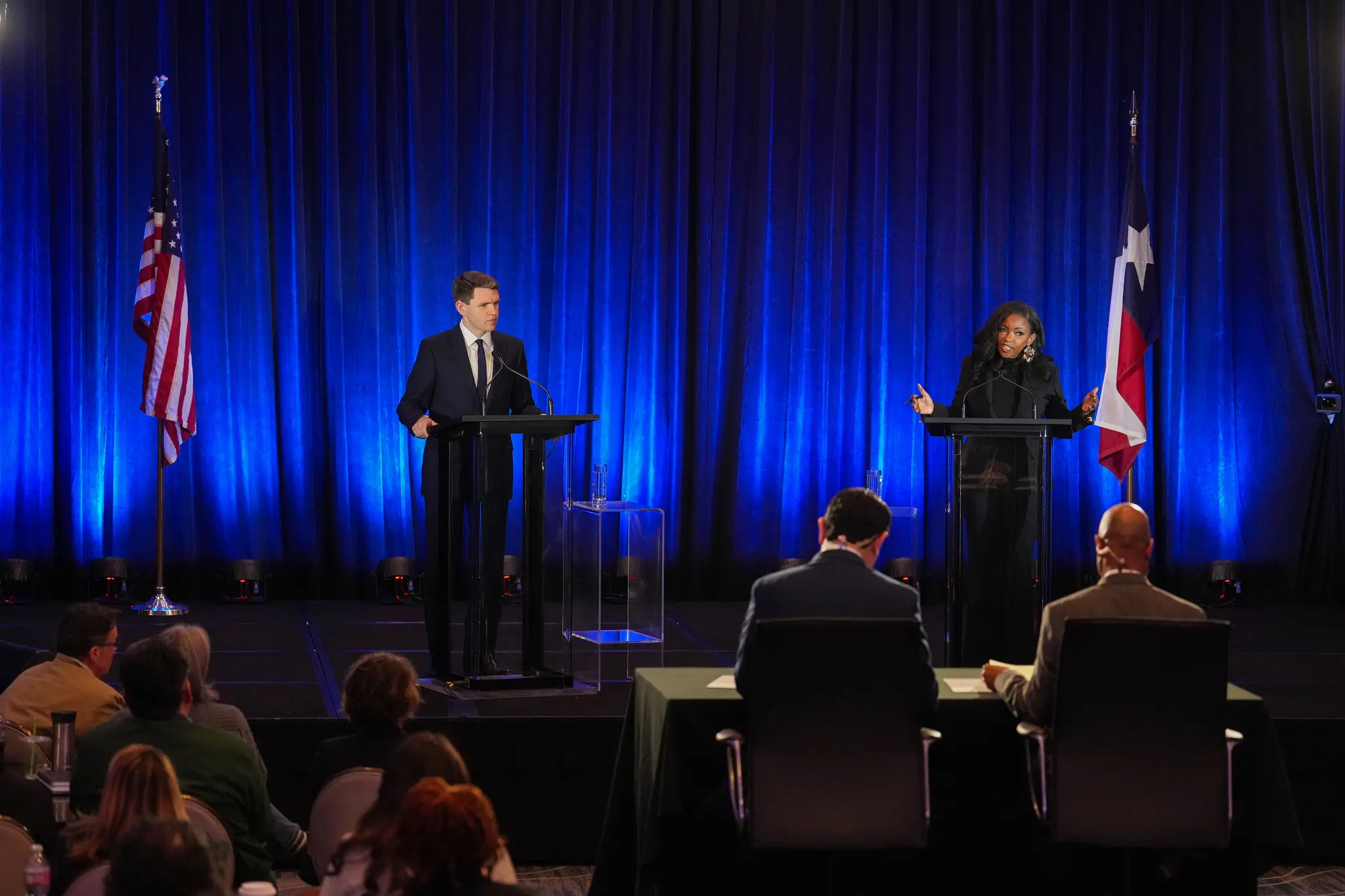
Two leading Democratic contenders in Texas’s U.S. Senate primary used their first televised debate on Saturday to highlight sharp differences in political style and campaign strategy, even as they largely aligned on policy. The race has attracted national attention as an early signal of where the Democratic Party may be headed in the 2026 election cycle.
The candidates, U.S. Representative Jasmine Crockett and state Representative James Talarico, devoted much of their most forceful criticism not to each other, but to the Trump administration and the conduct of Immigration and Customs Enforcement officers. The debate took place only hours after federal agents fatally shot a 37-year-old man in Minnesota, an incident that loomed over the discussion.
Mr. Talarico, a progressive lawmaker known for openly discussing his Christian faith, called for sweeping accountability within federal law enforcement. He argued that ICE had become an unaccountable force operating in secrecy and said Congress must act to expose and punish abuses of power. He urged that agents who overstepped their authority be prosecuted and publicly questioned.
Ms. Crockett, a nationally recognized Democratic voice with a large social media following, used even more striking language. She accused immigration agents of using tactics that echoed authoritarian regimes, including targeting people based on their accents or skin color and conducting aggressive neighborhood operations. She said the federal government must take decisive action to overhaul the agency from within.
Despite these fiery exchanges, the two candidates agree on many core issues. Both support higher taxes on billionaires and oppose what they describe as reckless foreign policy decisions under President Trump. Because of that alignment, the contest has centered less on ideology and more on how Democrats can realistically compete in Texas, a state where the party has not won a statewide race in roughly 30 years.
That strategic divide was front and center from the opening moments of the debate, which was hosted by the Texas AFL-CIO at an outdoor venue near Austin. The first topic raised was electability.
Ms. Crockett argued that Democrats need to abandon overly cautious political instincts. She said she was willing to take risks and break norms that traditional consultants often discourage, even if it meant sounding rougher or more confrontational. For her, success depended on channeling public anger and urgency rather than polishing rhetoric for broad appeal.
At 44, Ms. Crockett is a former defense attorney who believes her national visibility and willingness to confront Republicans directly will energize voters who might otherwise stay home. Though she entered the race only a month ago, she already enjoys higher name recognition among Democratic voters than her opponent.
She acknowledged that advantage directly during the debate, suggesting that her prominence was the result of engaging in high-profile political fights. Her remarks, while measured, came close to a critique of Mr. Talarico’s lower public profile.
Mr. Talarico, 36, brings a different background and approach. A former middle school teacher and current seminarian, he has emphasized coalition-building beyond the Democratic base. Throughout the debate, he stressed that his campaign aims to reach independents and disaffected Republicans who are uncomfortable with Trump-era politics.
Rather than attacking Ms. Crockett, he repeatedly underscored their shared values while directing his criticism toward wealthy elites. He argued that billionaires exert outsized influence over American politics and are responsible for rising costs and growing inequality.
Mr. Talarico said that writing off any voter group would be a mistake and warned against repeating divisive strategies. In his view, political polarization benefits the wealthy by distracting voters from those at the top of the economic ladder.
Early voting in the Texas primary is scheduled to begin on February 17, and Democrats believe the timing and political climate could offer a rare opening in the state. That optimism has intensified internal debate over which candidate is best positioned to defeat a Republican in November.
Supporters of both Democrats have already clashed online, reflecting the high emotions surrounding the race. Still, both candidates acknowledge that unity will be essential after the March 3 primary, particularly in what is expected to be a closely contested general election.
Democratic hopes have also been buoyed by turmoil on the Republican side. Incumbent Senator John Cornyn is locked in a bitter primary battle with Texas Attorney General Ken Paxton, along with U.S. Representative Wesley Hunt. The infighting is expected to drag the Republican contest into a runoff, prolonging divisions within the party through late May.
In his closing statement, Mr. Talarico framed the election as a moral obligation, emphasizing the stakes for democracy and governance. He said winning in November was not merely political, but a responsibility.
Ms. Crockett ended the debate on an equally urgent note. Pointing to recent violence and a death threat she had personally received, she warned that the next senator from Texas would need to be prepared for intense political conflict in Washington. For her, the consequences of the election were not abstract, but matters of survival.
“This is life or death,” she said, underscoring the gravity she believes defines the moment.




Leave a Reply