
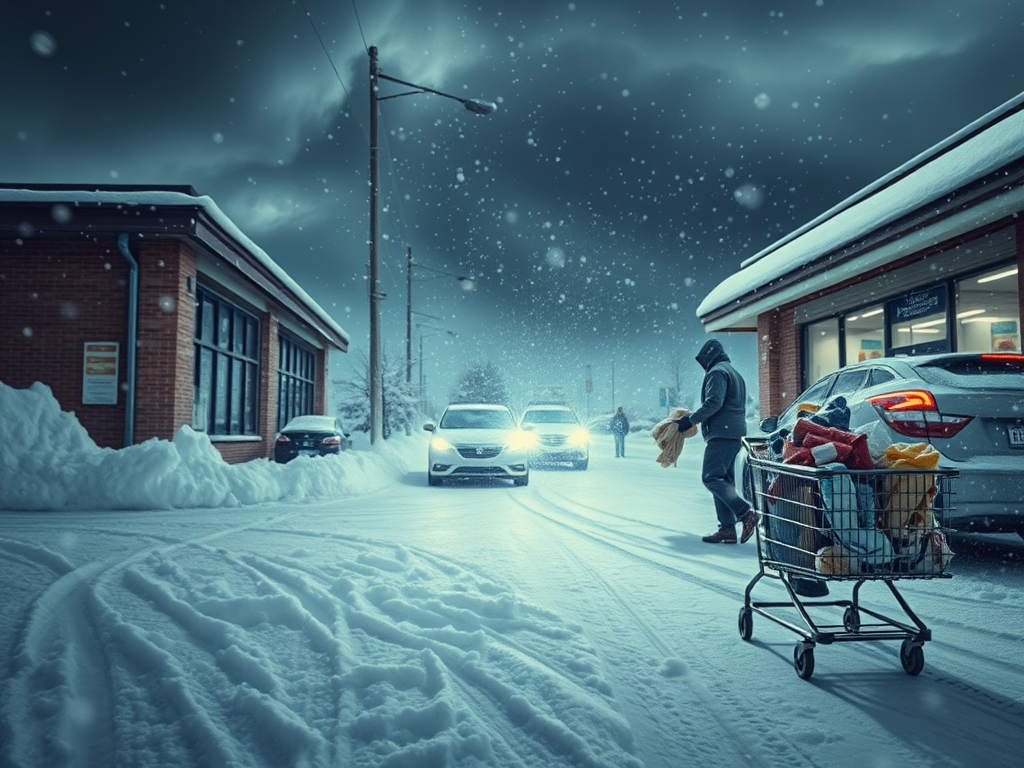

Blankets of snow, layers of ice, fierce winds, and temperatures cold enough to burst water pipes are all on the table this week. Across a large portion of the United States on Thursday, officials and weather experts urged residents to prepare for a wide range of dangerous winter conditions.
While forecasts have sounded increasingly serious, they have also remained uncertain. Meteorologists broadly agree that severe winter weather is likely to sweep across roughly the eastern two-thirds of the country in the coming days, but the exact locations that will be hit hardest have been difficult to pinpoint. With each update, the projected path of the storm has continued to shift.
For some people, the uncertainty alone was enough to prompt action. On Wednesday evening in Atlanta, Ocie Fulford left a Kroger supermarket pushing a cart loaded with canned food, bread, and peanut butter. He hoped the supplies would be enough to feed his two teenage sons through whatever weather might arrive.
“I’ve also got more supplies being delivered to the house later,” said Fulford, 51. “And I went to Home Depot to buy a five-gallon gas can and filled it up.”
Fulford had vivid memories of Atlanta’s infamous 2014 winter storm, often referred to as the “snowpocalypse,” which paralyzed the city. He was fortunate at the time not to lose power, but he had no interest in taking chances again. This year, he had already purchased a generator.
The constantly changing forecast has served as a sharp reminder, especially for Southerners, of how unsettling sudden winter weather can be. Many areas in the South are accustomed to hurricanes, tornadoes, flash floods, and tropical storms. Snow, sleet, ice, and prolonged cold, however, are a different challenge altogether.
Most residents have just enough experience with winter storms to know how disruptive they can be. Icy roads, frozen pipes, and power outages present unfamiliar risks in regions where such conditions are rare. Driving becomes hazardous, and homes not designed for freezing temperatures can suffer serious damage.
Beyond individual households, winter storms place strain on infrastructure and test the preparedness of local governments, school systems, and businesses. Compared with regions like the Midwest or Northeast, many Southern communities have fewer resources and less experience dealing with prolonged cold and snow.
“It may only happen once or twice a season,” said Renée Pratt, executive director of Metropolitan Social Services in Nashville. “But when it does, it’s a big deal.”
The storm system, moving steadily from west to east, is expected to strengthen on Friday. Snow is forecast to fall across parts of New Mexico and Colorado before spreading into Texas, Oklahoma, and Kansas. By Saturday, freezing rain, sleet, and snow are likely in Texas, Arkansas, and Tennessee, while snow continues across the Midwest.
By Saturday evening, the system is expected to reach Georgia and the Carolinas, then push into the Mid-Atlantic and the Northeast on Sunday, potentially intensifying further. After the storm passes, forecasters are predicting a wave of bitter cold across much of the eastern United States well into next week.
While widespread cold appears likely, predicting the exact impact on individual communities has been challenging. “The models keep changing,” said Kelly Reed, 46, as she loaded groceries into her car in Nashville. “We don’t know if we’ll get a lot of snow or end up under a major ice storm that knocks out power.”
Inside the supermarket, shelves of bread, canned food, and hot cocoa mix were quickly emptying. Reed, who works at an artificial intelligence company, said she even used ChatGPT to help plan what to buy, stocking up on peanut butter, canned meats, and several days’ worth of food and supplies for her pets.
In Georgia, Governor Brian Kemp released a video on social media reassuring residents while urging caution. “We’ll get through this as we have before, carefully and together,” he said.
Texas Governor Greg Abbott announced that road crews were preparing for icy conditions and that the Texas National Guard was on standby to assist stranded motorists. Several Southern governors, including South Carolina Governor Henry McMaster, declared states of emergency, warning that winter weather can shift rapidly and become dangerous with little notice.
Past winter storms in the region have caused widespread disruptions, from gridlocked roads to overwhelmed emergency services. In Texas, memories remain fresh of the 2021 winter storm that crippled the state’s power grid, leaving millions without electricity in freezing conditions. State officials later reported that 246 people died during that crisis.
Speaking at a news conference on Thursday, Abbott sought to calm fears of a repeat, saying the state’s power grid had “never been stronger” or more prepared.
Still, many residents were not taking chances. Curtis Rigney, 50, who lived in the Dallas area during the 2021 storm, went searching for a generator ahead of this one. At a Harbor Freight store north of the city, all 12 generator models on display were already marked “out of stock.”
“The whole city shuts down with a little snow, let alone ice,” Rigney said.
In Lewisville, Texas, northwest of Dallas, Omolera Salawu, 35, pushed a cart through a crowded Walmart, filling it with food that could be prepared without electricity. She said failing to do that in 2021 had been a hard lesson.
“It was very stressful,” she said. “This time, I don’t know exactly what will happen, but I have more experience.”
She glanced at her 18-month-old son sitting in the cart and added, “I need to be prepared. It’s not just me anymore.”
Further east, an REI store in Raleigh, North Carolina, was packed with shoppers hunting for winter gear that is rarely needed in the region. Racks of heavy sweaters were bare, and most snow boots had already sold out.
Nineteen-year-old Henry Clark stopped by looking for down-filled gloves but came up empty-handed. A first-year student at the University of North Carolina at Chapel Hill, Clark said this was the first time he truly felt the need to prepare for serious winter weather.
“This is the first time I’ve thought there could actually be a lot of snow or ice on the ground,” said Clark, who grew up in Charlotte.
He eventually found a pair of boots on sale for about $70 and hoped they would be enough. The rest, he planned to figure out as he went along.
“I’ll just wear two pairs of pants,” he said with a shrug, “and try to move on with my life.”




Leave a Reply