
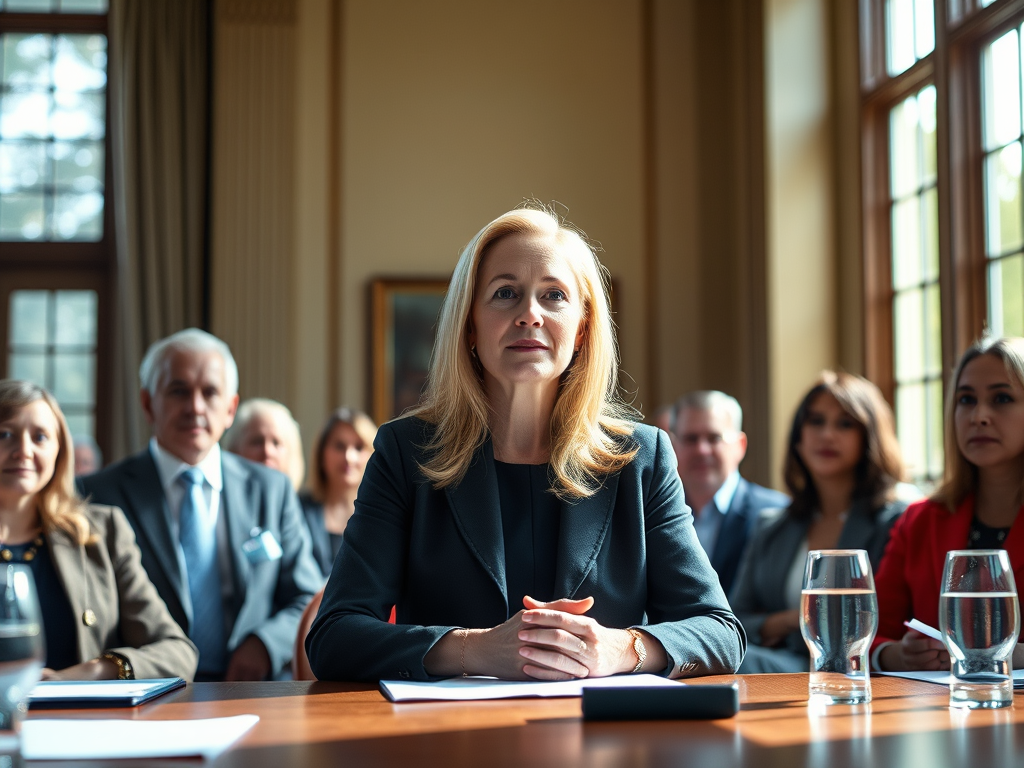

Virginia Governor Abigail Spanberger moved quickly on Saturday to reshape the leadership of the University of Virginia, announcing the appointment of 10 new members to its governing board just hours after taking office. The appointments dramatically altered the balance of the 17-member Board of Visitors and signaled a sharp shift in the university’s political direction. At the same time, Spanberger also took action to restructure the governing boards of two other major public institutions in the state.
One day earlier, Spanberger had formally requested that five members of the University of Virginia’s board resign. All five had been appointed by her Republican predecessor, former Governor Glenn Youngkin. The rapid overhaul followed more than a year of intense political conflict over the university’s leadership and priorities.
That conflict reached a peak last summer, when conservative board members, working in alignment with the Trump administration, successfully removed University President James E. Ryan. Ryan had become a target largely because of his strong support for diversity and inclusion initiatives at the school.
Tensions escalated again more recently when the Youngkin-appointed board entered into an agreement with the Trump administration to dismantle diversity programs at the university. Federal officials had argued that such programs were unlawfully discriminatory and pushed the university to adopt new admissions policies in line with the administration’s views. The agreement drew sharp criticism from faculty members, who warned that it threatened academic independence and campus culture.
Despite objections from Spanberger, who had urged the board to wait until after her inauguration, the board moved ahead with naming Ryan’s successor. Just days before she took office, the board appointed Scott C. Beardsley, then dean of the university’s business school, to a five-year term as president.
By compelling the resignation of five board members — including the chair, the vice-chair, and a major donor who had contributed $100 million to the university — Spanberger gained an unusually high level of influence over the institution in a very short time. Under normal circumstances, a Virginia governor can appoint only four board members per year over a four-year term.
Rachel Sheridan, who had served as rector of the board, expressed deep concern in her resignation letter, which was released publicly on Saturday. She wrote that the board’s ability to act in the best interests of the university had been undermined by deliberate political confrontation. According to her, the ongoing political struggle posed serious risks to the institution’s future.
Even before the resignations, five board seats had already been vacant. Democratic lawmakers in the state legislature had declined to confirm several of Youngkin’s nominees, leaving openings that Spanberger was now able to fill. As a result, she had the opportunity to appoint 10 new members at once.
Among the newly named appointees are Carlos Brown, a senior executive in the utilities sector; Peter Grant, a private equity leader who previously spearheaded a successful fundraising effort for the university; and Victoria Harker, a former executive in publishing and broadcasting. Both Brown and Harker have served on the Board of Visitors in the past, bringing prior institutional experience to the new lineup.
In addition to the changes at the University of Virginia, Spanberger announced new appointments to the boards of George Mason University and the Virginia Military Institute.
At George Mason University, the state’s largest public university, tensions had also flared under the previous administration. Board members appointed by Youngkin had worked with the Trump administration in an unsuccessful effort to remove President Gregory N. Washington, another prominent supporter of diversity initiatives. On Saturday, Spanberger appointed 12 new members to George Mason’s board, including Tom Davis, a former Republican congressman who had served on the board before. One day earlier, the board’s chair, Charles Stimson, an official with the Heritage Foundation, had resigned.
At the Virginia Military Institute, where conservative board members last year declined to extend the contract of Superintendent Maj. Gen. Cedric T. Wins, Spanberger appointed five new board members. Among them was Ralph Northam, a former Democratic governor of Virginia, marking another clear departure from the prior administration’s approach.
Together, the sweeping changes underscore Spanberger’s intent to quickly redirect the governance of Virginia’s public universities and to move away from the partisan battles that have dominated higher education politics in the state over the past year.




Leave a Reply