
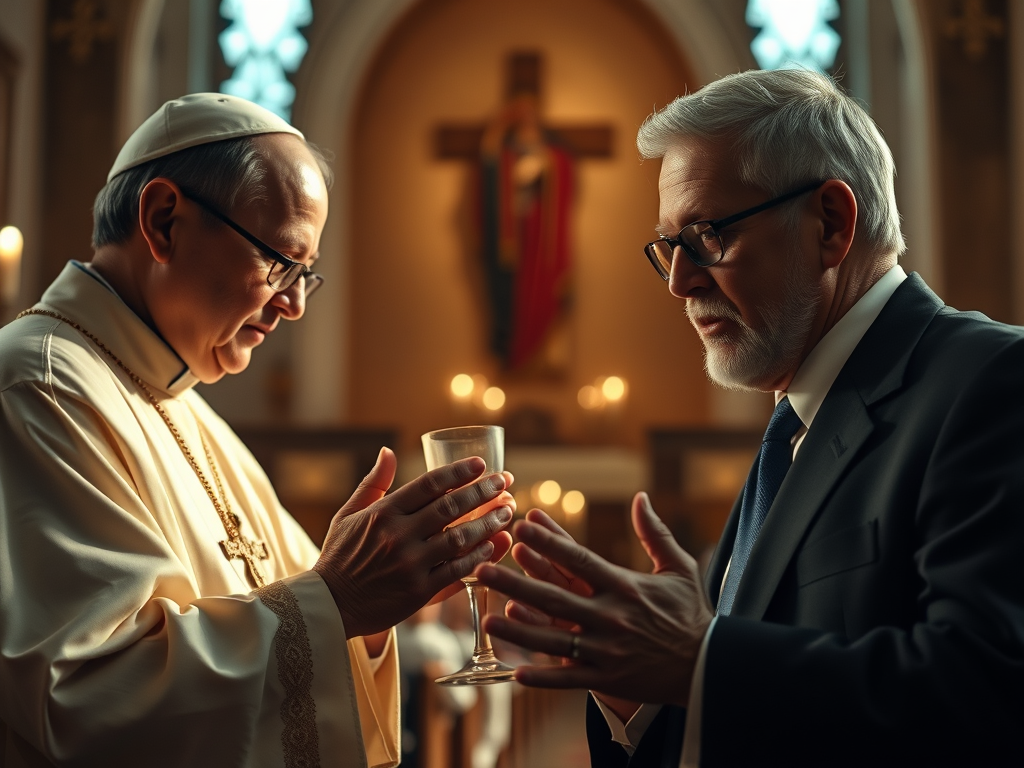

As federal immigration agents intensified deportation operations in Louisiana this month, reactions among faith leaders revealed sharply contrasting approaches. Some Roman Catholic priests, concerned that undocumented immigrants were too frightened to leave their homes, quietly brought the Eucharist directly to them. The goal was pastoral care without exposing vulnerable families to potential arrest.
In Baton Rouge, however, Lewis Richerson, pastor of Woodlawn Baptist Church, said he would take a very different stance. He stated that he would not knowingly offer communion to undocumented immigrants attending his church, arguing that being in the United States illegally constitutes a moral violation.
According to Richerson, Christians are obligated to follow the laws of the country. From his perspective, the most appropriate form of ministry would be encouraging undocumented immigrants to turn themselves in to authorities. He said they should voluntarily leave the country rather than remain unlawfully.
Woodlawn Baptist Church is affiliated with the Southern Baptist Convention, the largest Protestant denomination in the United States, representing approximately 12.7 million members. Historically, the denomination has supported immigration reform, influenced by its global missionary presence and biblical teachings emphasizing compassion for the vulnerable.
Yet tensions within the Southern Baptist Convention have become more visible in recent years. While Catholic bishops have publicly criticized the Trump administration’s deportation policies, Southern Baptists are increasingly divided. A growing conservative faction within the denomination openly supports stricter immigration enforcement, even as many local churches continue outreach programs for immigrants.
Signs of internal disagreement surfaced in April, when leaders from 13 ethnic Southern Baptist groups issued a joint appeal urging denominational leadership to defend religious liberty and advocate for immigrants and refugees. They also called on the federal government to consider alternatives to deportation.
Despite that appeal, immigration was largely absent from the agenda at the Southern Baptist Convention’s annual meeting in June. Delegates instead focused on resolutions addressing abortion, pornography, and sports betting. Immigration did not receive the same level of attention or formal debate.
At the same convention, however, delegates voted on whether to dismantle the denomination’s public policy arm, the Ethics and Religious Liberty Commission. The commission has been a leading voice within the denomination on immigration issues.
Although the commission narrowly survived the vote, its president effectively stepped aside. In September, the commission severed ties with the Evangelical Immigration Table, a coalition of evangelical organizations it helped establish more than a decade ago to advocate for immigration reform. According to Baptist News Global, the commission said it planned to take a more independent approach to immigration-related work.
These developments mark a shift from the denomination’s position just two years earlier. At that time, Southern Baptist delegates approved a resolution urging government leaders to expand protections for asylum seekers and create legal pathways for immigrants already living in the United States through no fault of their own, with an emphasis on keeping families together.
Gary Hollingsworth, the interim president of the Ethics and Religious Liberty Commission, declined to discuss immigration publicly. Clint Pressley, president of the Southern Baptist Convention, also declined to comment through a spokesperson. Leaders from Baptist associations in states such as Georgia, Texas, and Michigan did not respond to interview requests, nor did leaders of several ethnic Baptist organizations.
Demographics play a significant role in shaping these divisions. According to the Pew Research Center, 43 percent of Catholics in the United States were either born abroad or have at least one parent born abroad. Among Southern Baptists, that figure is just 8 percent, rising to 19 percent when considering evangelicals overall.
Many evangelical leaders have long emphasized hospitality toward strangers and respect for human dignity, principles rooted in biblical teaching. At the same time, the Southern Baptist Convention has moved in a more conservative political direction in recent years. Some leaders privately express concern that speaking out on immigration could provoke backlash from the denomination’s right wing.
Organizations such as the Center for Baptist Leadership and Founders Ministries have gained influence by opposing what they see as progressive shifts within the church, including on immigration. Their messaging has been amplified through social media. In 2023, a conservative insurgent movement successfully pushed to remove women from certain church leadership roles.
At last year’s convention, delegates voted to oppose the use of in vitro fertilization. This year, they approved efforts aimed at overturning same-sex marriage. These votes highlight the denomination’s focus on social issues that resonate strongly with its conservative base.
Despite these internal conflicts, mission work remains central to Southern Baptist identity. In Oklahoma, Eric Costanzo, pastor of South Tulsa Baptist Church and a trustee of the Ethics and Religious Liberty Commission, expressed concern for Burmese immigrants in his community. Earlier this month, some Burmese residents had their citizenship ceremonies canceled after the Trump administration halted immigration processing for individuals from 19 countries, including Myanmar.
Costanzo said many of these immigrants are persecuted Christians who have played a major role in building local congregations. He noted that Burmese families in Tulsa alone have helped establish more than 20 churches.
Other church leaders report that immigration enforcement has begun to affect ministry participation. Craig Tuck, executive director of the Charleston Baptist Association in South Carolina, oversees 76 Southern Baptist churches and helps manage a community center focused on missionary and refugee services. He said attendance in English as a Second Language classes has fallen by nearly 50 percent this year, especially among Hispanic participants.
Tuck added that while few church leaders explicitly endorse the way immigration raids are conducted, the larger challenge lies in coordinating efforts among Baptist groups that share similar concerns but lack unified action.
In West Virginia, Joel Rainey, pastor of Covenant Church in Shepherdstown, echoed similar frustrations. Rainey has helped plant more than 100 churches across North America and has participated in mission work on five continents. His church is located near a U.S. Customs and Border Protection training facility.
Rainey said the current immigration climate places immense strain on both immigrant communities and those working in national security. In his view, the situation is deeply unjust and harmful to everyone involved.
Some pastors, however, say immigration is simply not a priority among their congregations. David L. Allen, a professor at Mid-America Baptist Theological Seminary, advises pastors nationwide and said he is frequently asked about preaching on issues related to gender identity and sexuality. Immigration, he said, rarely comes up.
Allen noted that many Baptists strongly oppose illegal immigration and therefore support the administration’s aggressive enforcement measures. He described this position as widely held within the denomination.
Southern Baptists are predominantly white and Republican, and they tend to align closely with Donald Trump’s broader political agenda. For pastors like Richerson, opposition to undocumented immigration is driven not only by theology but also by economic concerns.
Richerson argued that housing undocumented immigrants can drive up rent prices, placing additional burdens on taxpayers and low-income American citizens. He described this impact as unfair and harmful.
In contrast, Dale Huntington, pastor of City Life Church in San Diego, highlighted the contributions immigrants make to his congregation. He said undocumented immigrants serve on the church’s prayer team and regularly support his family during times of illness.
Huntington ministers in a low-income community of color and acknowledged that some congregants are disappointed by his church’s affiliation with the Southern Baptist Convention due to its public reputation. Still, he emphasized that many Southern Baptist churches across the country continue to support his church’s food pantry and mission efforts.
For Huntington, being part of the Southern Baptist tradition means working across differences rather than allowing the loudest voices to define the whole.
He said that while some may claim immigrants are unwelcome, there remains a large and committed network of churches that care deeply about those who are struggling and marginalized.




Leave a Reply