
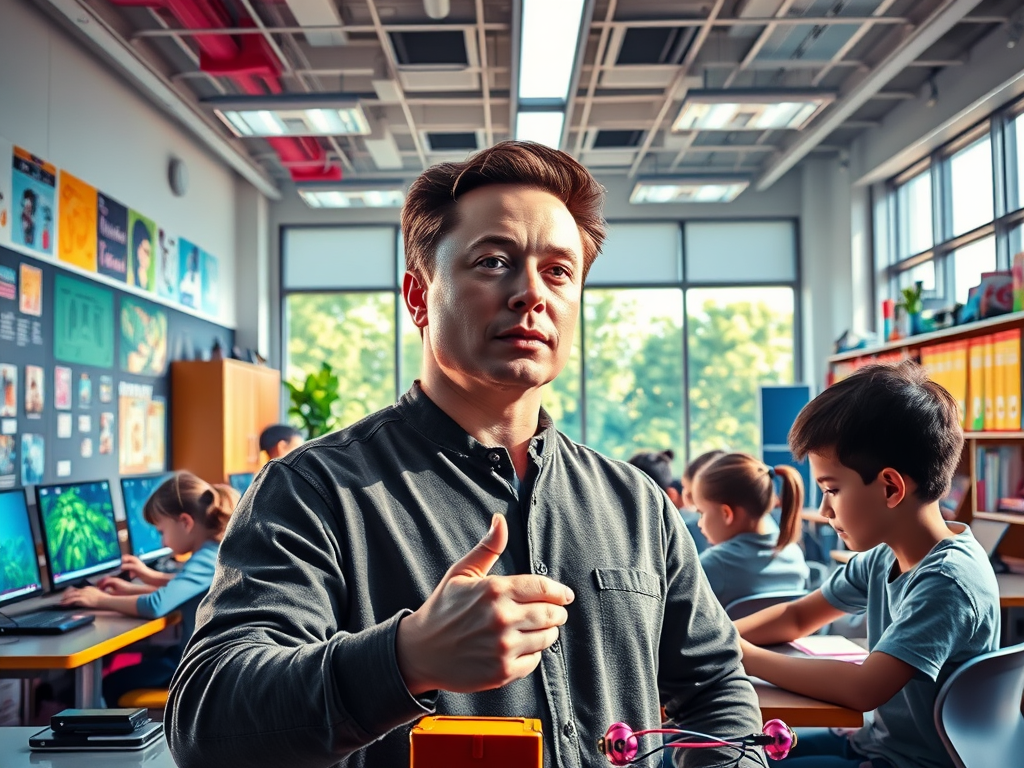

Elon Musk has never hidden his ambitions for reimagining education. For years, he has argued that learning should be highly interactive and engaging, once describing his ideal classroom as something “as close to a video game as possible.” He has also emphasized that schools should allow children to move at their own speed, shaping education around individual talents and strengths rather than forcing everyone into the same mold.
Beginning in 2023, Musk attempted to bring this vision to life through a new elementary school in Bastrop, Texas, located just minutes away from several of his companies, including SpaceX. The project drew immediate attention and enthusiasm, fueled by Musk’s reputation as a disruptor willing to challenge traditional systems.
The billionaire acquired nearly two dozen acres of land and assigned two trusted aides to oversee the creation of the private school. Educators from across the United States were interviewed, and some were hired to teach students from prekindergarten through fifth or sixth grade. When enrollment opened last year for roughly 50 spots, demand surged, with thousands of families submitting applications.
“Everyone wants their child to grow up like Elon Musk,” said Judah Ross, a 37-year-old real estate agent in Bastrop who applied on behalf of his three-year-old son.
Despite the early excitement, Ad Astra — named after the Latin phrase meaning “to the stars” — does not appear to be functioning today as a full-fledged elementary school. The campus, housed in a stately white-columned building with a Texas flag and surrounded by an iron fence, now operates under a different designation.

According to records from the Texas Health and Human Services Commission, which oversees such facilities, Ad Astra is currently licensed as a child care program rather than a school. It serves about 10 children aged five and under and employs two caregivers. State inspection reports note that snacks include items like apples and graham crackers, and children rest on individual cots labeled with their names during scheduled nap times.
“The operation does not care for school-age children,” a January state report stated.
Musk is far from the only billionaire to experiment with founding schools. Figures such as Mark Zuckerberg, Jeff Bezos, and LeBron James have all launched educational initiatives, with mixed results. In Musk’s case, Ad Astra’s shift toward functioning more like a daycare represents the latest chapter in a costly and complicated effort — one that has reportedly involved more than $600 million aimed at reshaping education, with limited success so far.
Since at least 2021, Musk, who is the father of at least 14 children, has explored building not only elementary schools but also a high school and even a university. According to public documents and interviews with people familiar with the projects, three schools were launched under his broader vision. Two later closed or significantly downsized, while a third transitioned to online learning. Plans for a university appear to have stalled altogether.
Musk’s own children are unlikely to be enrolled at the Bastrop Ad Astra campus. He and his partner, Shivon Zilis, who share at least four children, have told acquaintances that they are homeschooling their kids, according to people with direct knowledge of the situation.
Education experts say such outcomes are not unusual when wealthy entrepreneurs enter the school space. Larry Cuban, an emeritus professor of education at Stanford University, noted that many underestimate the complexity of running a school. “They believe they understand teaching and schooling simply because they went through it themselves,” he said.
Still, it remains possible that Ad Astra could expand in the future. Musk’s business ventures often begin on a small scale before growing rapidly. Musk, who this year advised President Donald Trump and focused much of his attention on his artificial intelligence company, xAI, did not respond to requests for comment.

Musk’s interest in education stretches back more than a decade. He has repeatedly described a school model where children are encouraged to pursue their strongest interests rather than follow rigid grade-level structures. In an interview last year with the Milken Institute, he reiterated his belief that classrooms should be dynamic, hands-on environments.
His first school, also called Ad Astra, opened in 2014 at SpaceX’s headquarters in Hawthorne, California. It enrolled about 50 students, many of whom were children of SpaceX employees. Musk sent five of his children from his first marriage to Justine Musk to the school, withdrawing them from a well-known private school in Los Angeles.
During the COVID-19 pandemic, the school moved to virtual instruction and opened enrollment to students outside SpaceX families. Control of the institution was later transferred to a nonprofit organization established by Josh Dahn, a co-founder of the school. Dahn has not commented publicly on the school’s later developments.
In 2021, Musk jokingly suggested online that he might start a university with a playful acronym, signaling at least some interest in higher education. That same year, his chief personal adviser, Jared Birchall, established a nonprofit organization aimed at launching an independent primary school, high school, and university. Musk donated $100 million to the effort, which later stated its goal was to create elite STEM-focused schools.
Since 2022, Musk’s primary charity has contributed more than $600 million to the organization. However, by 2023, official filings no longer detailed concrete plans for a university. An accrediting agency later stated it could find no record of communication from Musk regarding accreditation for such an institution.
Musk ultimately concentrated his educational efforts in Texas, where he relocated from California in 2020. A separate Ad Astra school was established near SpaceX’s south Texas launch site, with early plans for kindergarten through middle school. By early last year, however, that campus appeared to have closed to the public, and its current status remains unclear.
The Bastrop Ad Astra school was designed to follow a Montessori-inspired approach, emphasizing student-centered learning. Documents indicated plans for 54 students and a full-time teaching staff. Leadership roles were assigned to Musk associates Jared Birchall and Jehn Balajadia, and teachers were told to expect a sizable faculty.
The project encountered administrative obstacles, including permit resubmissions and staffing credential issues, which delayed its opening multiple times. Parents received updates through emails and were invited to an informational Zoom meeting in October 2024 outlining the curriculum and expected learning outcomes.
According to parents who attended the meeting, the school emphasized flexibility and STEM-focused instruction, including outdoor science lessons and caring for animals such as horses and chickens. Tuition was expected to be around $1,000 per month, with mixed-age classrooms and no preferential treatment for Musk employees’ children. Families were also told they would need to sign nondisclosure agreements.

Interest in the school extended well beyond Bastrop. Ross said he received inquiries from families across the country considering relocation in hopes of securing a spot. Ultimately, his son was not admitted. In an email, the school administrator explained that thousands of applications had been received for only a limited number of openings.
On a recent visit to the campus, activity appeared minimal. Only two cars were parked outside, and security declined to allow questions or pass messages to school officials.
Zarema Saldana, a baker from Austin, said she applied for her two daughters but never received a response. She had believed the school would offer a broad, innovative curriculum suitable for older children and was surprised to learn it currently serves only very young ones.
“They had really big plans,” she said.




Leave a Reply