
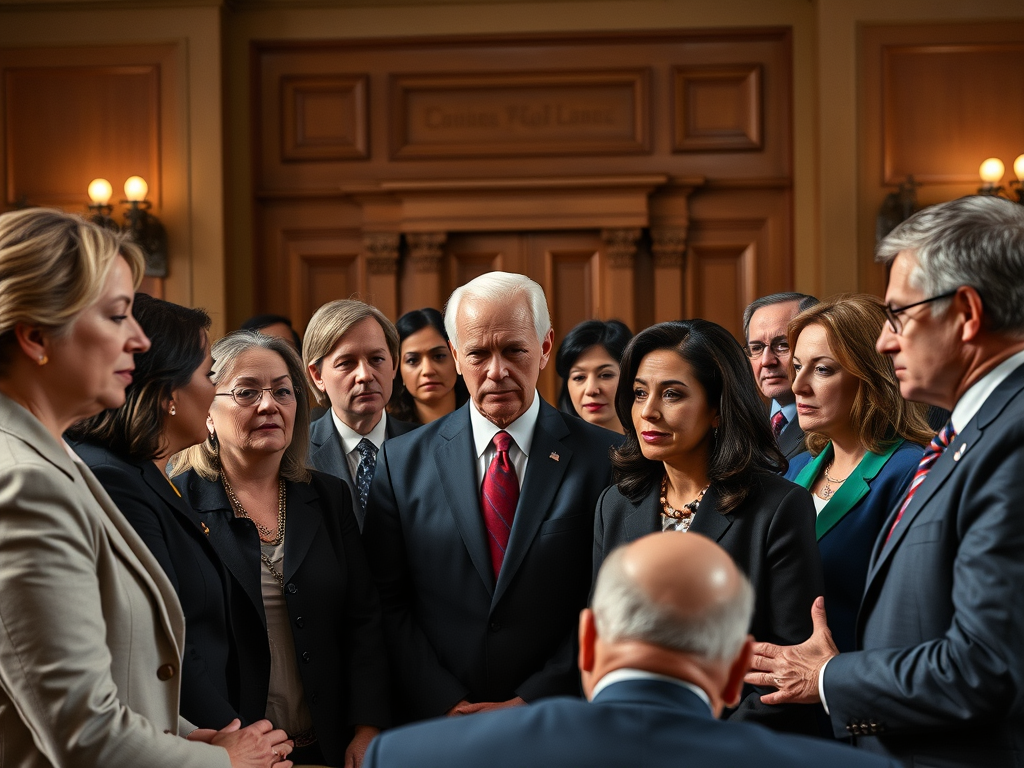

Democratic lawmakers from more than six U.S. states said on Thursday that they plan to mount a coordinated legislative response next year to President Trump’s large-scale deportation agenda. Their strategy is designed to reinforce the legal challenges already underway, led by Democratic state attorneys general who have been contesting the administration’s immigration policies in court.
The proposed legislation would focus on safeguarding places where immigrants gather, restricting the use of masks by law enforcement officers, and limiting certain federal enforcement practices. State Democrats say they are increasingly confident, citing recent court victories and electoral gains, and see an opportunity to confront the Trump administration on broader rule-of-law concerns, including what they view as violations of constitutional protections. At the same time, they are responding to growing fear within immigrant communities, anxieties that have begun to resonate with both immigrant and nonimmigrant voters.
“It has never been more critical in our lifetimes for state legislators who share common values to work together, exchange ideas, and coordinate strategies,” said Mike Weissman, a Colorado state senator who represents Aurora, a city President Trump has repeatedly described as a center of Venezuelan gang activity. Weissman argued that states should be seen not only as testing grounds for democratic ideas, but also as places where solutions are being crafted to counter what he described as an expanding culture of authoritarianism emanating from Washington.
This legislative push builds on a year of legal action by as many as 20 Democratic attorneys general. Through lawsuits, they have challenged a range of federal measures, including steep increases in H-1B visa fees, the withholding of antiterrorism funding, and the dismissal of federal employees.
Organizers of the effort say the approach mirrors tactics long used by conservative networks such as the American Legislative Exchange Council and the State Policy Network, which have coordinated state-level campaigns on issues ranging from religion in public schools to abortion restrictions and limits on diversity initiatives. Gaby Goldstein, the founder of State Futures, an organization that brings together Democratic state lawmakers, helped convene Thursday’s meeting.
In a recent essay, Goldstein acknowledged that conservative groups have historically been more effective at drafting model legislation, convening officials, and spreading policy ideas across states, giving them a structural advantage in shaping state-level agendas.
The White House dismissed the effort. Abigail Jackson, a spokesperson for the administration, criticized the lawmakers for what she characterized as political theater, saying they would be better served by focusing on policies that directly benefit American citizens.
Thursday’s gathering included roughly a dozen legislators from California, Colorado, Illinois, Maryland, New York, Pennsylvania, and Virginia.
Several Democratic-led states have already taken action independently. In some legislatures, lawmakers passed bills this year barring agreements that allow state or local police to carry out certain federal immigration enforcement functions. Other states have introduced proposals to prohibit law enforcement officers from operating while masked or without clear identification.
Participants said recent developments have given them renewed momentum.
Irene Shin, a member of the Virginia House of Delegates representing Fairfax County, said strong Democratic results in November’s elections would help advance a broad legislative agenda aimed at protecting local communities and limiting what she described as excessive federal intrusion. In Virginia, Democrats won all statewide offices and secured a near two-thirds majority in the legislature.
Shin pointed to proposals that would end cooperation agreements on immigration enforcement and strengthen protections for private data held by state and local governments against federal access.
In New York, State Assemblyman Micah Lasher, who represents Manhattan’s Upper West Side, said he had co-sponsored legislation to designate schools, houses of worship, and nonprofit offices as protected locations where federal agents would be barred from making administrative arrests or conducting arrests without judicial warrants. Such measures, he said, would allow residents to go about their daily lives without fear. Similar legislation was enacted in Illinois earlier this month.
Pennsylvania State Senator Amanda Cappelletti, who represents part of suburban Philadelphia, said she plans to intensify her push for a bill requiring law enforcement officers to display clear identification, including their name, badge number, and official uniform. Another proposal would ban officers and agents from wearing masks or other coverings that conceal their identity, with violations carrying potential civil or criminal penalties.
Cappelletti said many of her constituents have witnessed neighbors being detained without what they see as adequate due process. She called the situation unacceptable.
Passing such measures in Pennsylvania will be difficult. Republicans control the state Senate by a 28–22 margin, and Cappelletti said they have so far shown little willingness to advance the legislation. Still, she said the multi-state collaboration has left her encouraged.
“Today’s conversation makes it clear that we’re not facing this alone,” she said. “There is momentum, and that gives me hope.”




Leave a Reply