
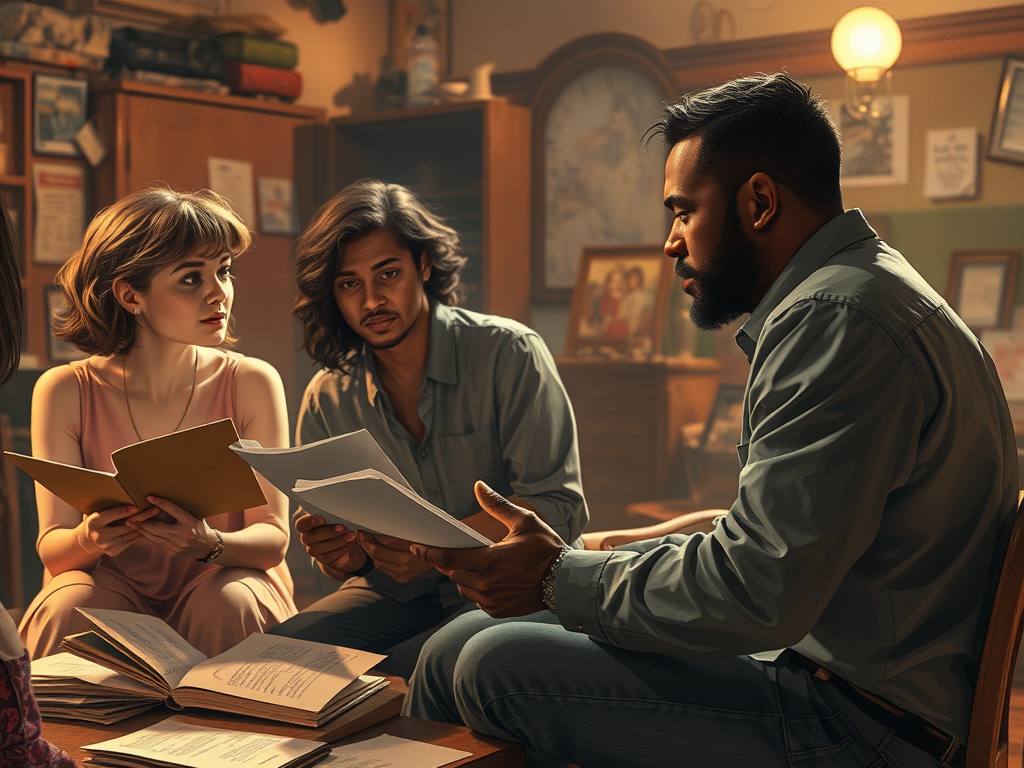

At the very first rehearsal of the new Off-Broadway production This World of Tomorrow, director Kenny Leon stopped the actors almost immediately. Barely two minutes in, he paused the room and offered a simple but piercing note. He told us he was not interested in how the lines were delivered. What mattered to him was what the lines were actually saying.
As actors, we had been concentrating on accents, rhythms, and performance choices. Kenny, however, was listening for something deeper: the language of the play itself. That language originated on the page, in prose I had written years earlier.
The production was adapted from a collection of my short stories, and suddenly those sentences were being spoken aloud by an extraordinary cast that included Kelli O’Hara, Ruben Santiago-Hudson, and Jay O. Sanders. I was sharing the stage with them, while also bearing responsibility for every word they spoke. Would the dialogue give them something meaningful to play? Would it help them express the ideas Kenny was searching for beneath the surface?

Inside the rehearsal room, rewriting became a constant state of being. The script that playwright James Glossman and I had reviewed endlessly over months transformed once it passed through the voices of the actors. Hearing Ruben portray a futuristic technology visionary explaining the dangers of time travel, or Kelli embodying a Bronx bookkeeper recounting her enchanted visit to the 1939 World’s Fair, was both familiar and strange. Their performances matched our intentions, yet revealed unexpected textures. Each table read led to revisions, rehearsals sparked more changes, and only after countless iterations did the script finally settle.
These words have followed me for more than a decade. The stories were first published in 2017 as part of a collection titled Uncommon Type. Over the next three and a half years, two of those stories slowly evolved into a stage script. I am accustomed to long creative commitments, whether months spent developing films or working on the Broadway play Lucky Guy back in 2013. This project, however, unfolded over years, testing patience and resolve in new ways.
Once I pushed past my own hesitation, I committed to the process with a clear goal: to put onstage lives suspended between a fixed past and an unknowable future. I wanted audiences to reflect on how fragile and powerful the present moment truly is.
The journey began during the Covid shutdown, when James presented a staged reading of my work at a fund-raiser for Shadowland Stages in Ellenville, New York. Though we had never collaborated before, our paths had run parallel in theater circles decades earlier. His reading wove together two stories: The Past Is Important to Us, about a future tech magnate vacationing in 1939, and Go See Costas, inspired by my father-in-law’s escape from Communist Bulgaria and his arrival in New York after World War II.

James believed these stories could live onstage as theater. Both followed men leaving their pasts behind, stepping into new worlds, and being reshaped by America before and after the war. I saw no reason not to let him try.
What he titled Safe Home grew from a single reading into a full production at Shadowland, opening in July 2022. I found the result exhilarating, even if the play felt overloaded with ideas, plot threads, and explanatory dialogue. There was too much of everything, but the heart of the piece was beating.
Because of our shared history and affection for the source material, we felt compelled to return to it. Starting over proved daunting. For two years, James and I exchanged drafts, revised each other’s scenes, debated language, and struggled to shape believable dialogue. Although the story involved science fiction, we gradually realized we were stretching logic, physics, and reasoning beyond what the audience could comfortably accept.
A weeklong workshop in 2024 at Portland Stage in Maine clarified what we needed to do next. We had to work face-to-face. We chose my agent’s office in the Chrysler Building as our creative battleground and dove back into research, especially around the 1939 World’s Fair. Again and again, we encountered a line from the Futurama exhibit designed by Norman Bel Geddes: “The present is but an instant between an infinite past and a hurrying future.” That idea became a quiet compass.
We refined character histories, tested which speeches resonated, and gauged how much humor audiences would tolerate. Authenticity mattered. Sanders’s character runs a Greek diner near Sheridan Square. O’Hara’s Carmen works in a handbag factory and shares a Bronx apartment with her brother’s family. Carmen’s niece Virginia, played by Kayli Carter, leads her school’s radio club and is fascinated by the rise of television. I portray a wealthy entrepreneur from the year 2089 who encounters them after traveling back in time.

In the summer of 2024, we shared the latest draft with trusted readers. Debating small phrasing choices felt agonizing, but the feedback was sobering. The polite reactions made it clear the play still needed serious work.
Eventually, the script reached Alex Poots and Laura Aswad at the Shed, who offered an official staged reading. The scale of the opportunity was intimidating, but we accepted and plunged back into revisions.
The timing proved uncanny. The reading of This World of Tomorrow took place the day after the 2024 presidential election. As the audience was transported to 1939, a period shadowed by looming war and economic uncertainty, the present moment carried its own sense of unease about the nation’s future. The feedback that followed was honest and precise, highlighting where the narrative, themes, and language still lacked clarity.
Armed with notes from Alex, dramaturg Todd Kreidler, audience members, and friends, we returned to the script once more. Despite the challenges ahead, the Shed offered us a fall production slot. James and I decided to take the risk.
Rehearsals at the Gibney Center revealed new gaps. More rewrites followed. Fresh pages appeared daily. Often, the actors’ work inspired changes, their confidence exposing moments that needed refinement. Kenny continued to stop us, urging us to focus on what the play was truly communicating.
When previews began, I finally set aside my role as writer and embraced being just an actor. James and I handed the finished script to the cast and let it go.
Playwriting has been both thrilling and terrifying, unlike any creative experience I have known. It has also been a privilege to collaborate with a cast and crew marked by commitment, humor, and courage. Some nights, performing before a live audience, it feels as though the world itself is echoing the play’s central idea: remain present, cherish the moment, and keep moving toward the future that is already rushing toward us, right up to the final performance on December 21.




Leave a Reply