
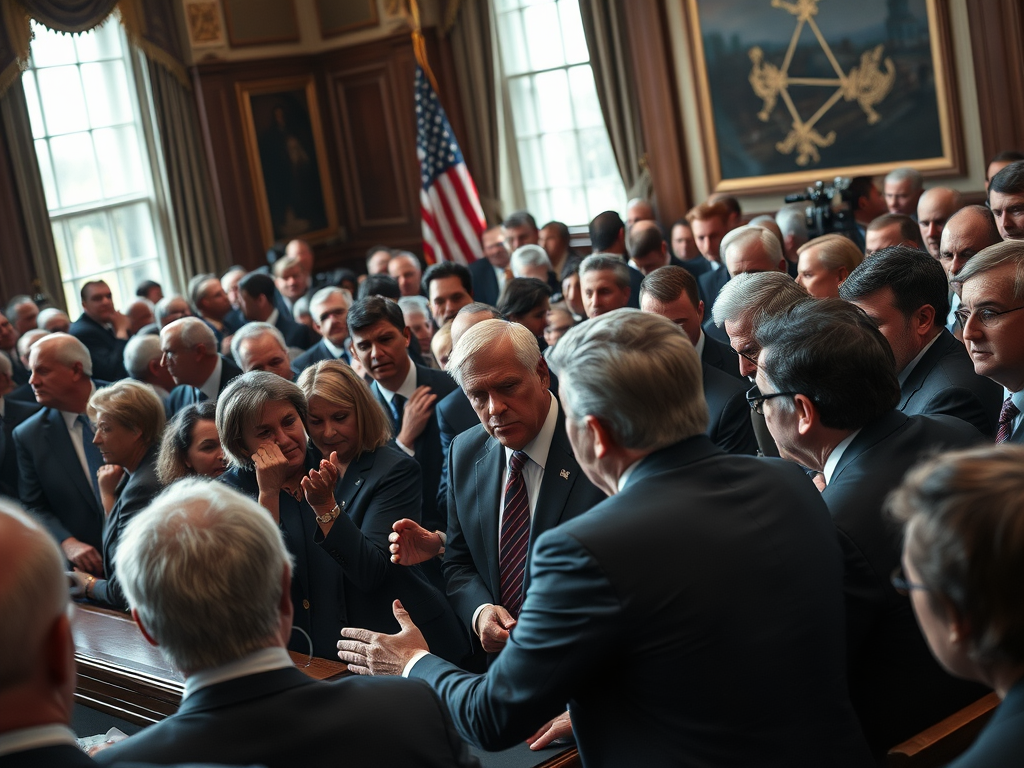

In a striking rebuke to former President Donald Trump, Republican lawmakers in the Indiana Senate sided with Democrats on Thursday to defeat a proposed congressional map that would have positioned the GOP to dominate all nine of the state’s U.S. House seats. The proposal, which many expected to pass easily in a chamber where Republicans hold forty of fifty seats, instead failed by a decisive 19-31 margin.
The vote represents one of the most notable political defeats for Mr. Trump in recent months. He had invested substantial political energy in pushing for redrawn congressional boundaries in several Republican-led states, repeatedly warning GOP legislators in Indiana that opposing the plan could come with electoral consequences. His strategy was clear: tighten Republican control over congressional districts nationwide at a crucial moment for the party. Yet the Indiana vote underscores how fissures inside the Republican Party have widened, even in states with strong conservative majorities.
The Senate’s rejection of the plan came after months of direct appeals from Mr. Trump, whose lobbying effort grew increasingly aggressive as the vote approached. Several senators reported that the former president had contacted them personally, while others were publicly criticized by him on social media. In multiple posts, Mr. Trump questioned their loyalty to the party and threatened to support primary challengers willing to embrace his redistricting agenda.
As tensions mounted, reports of threats and swatting incidents targeting lawmakers surfaced, adding a troubling dimension to an already heated political confrontation. The conflict revealed deeper ideological and stylistic divisions within Indiana’s Republican ranks. Long-established GOP legislators skeptical of the map clashed openly with Trump-aligned conservatives who viewed the proposal as a strategic necessity for maintaining national party dominance. Had the map passed, Republicans were widely expected to flip the state’s two Democratic-held congressional districts.
Despite reluctance from many senators to take up the bill—especially because the proposal fell outside the traditional once-a-decade redistricting cycle—the chamber’s leadership ultimately brought it to debate after sustained pressure from the former president and his allies. The vote itself, however, illustrated the boundaries of Trump’s influence. While his endorsement can still mobilize voters and shape political narratives, he was unable to persuade a critical mass of GOP legislators to support a plan they viewed as legally risky or politically damaging.
State Senator Greg Walker, one of several Republicans who opposed the proposal, argued that the measure was unconstitutional. Walker, who recently endured a swatting incident at his home, said the experience strengthened his resolve to reject political tactics he sees as corrosive to democratic processes. Another Republican senator, Spencer Deery, emphasized that approving the map would undermine public confidence in the state’s electoral system. He urged colleagues to resist outside political pressure, declaring that Indiana should not be governed by directives from Washington or by interests seeking to shape state politics from afar.
Supporters of the redistricting effort had framed the map as a necessary response to what they described as aggressive Democratic gerrymandering in other states. They argued that Republicans needed to counter perceived partisan advantages elsewhere in order to protect their prospects for reclaiming or retaining control of the U.S. House. Some senators issued dire warnings about the national consequences if Democrats were to secure a majority in the chamber.
Senator R. Michael Young voiced fears that Republicans could lose control of the House by a single seat if they failed to act. Senator Mike Gaskill similarly defended the effort, asserting that Trump was not demanding blind loyalty but encouraging lawmakers to “stand up and fight” in pursuit of what they believed would strengthen the nation’s political stability.
The broader national redistricting battle, which began this summer when Texas Republicans initiated a new map outside of the typical census cycle, has shown signs of slowing. Kansas legislators recently rejected a Trump-backed plan to consider a new map during a special session. In Maryland, Democrats have publicly split on whether to pursue redistricting this year. Illinois’s Democratic governor suggested he might consider revising his state’s map if Indiana proceeded, but he has not taken action.
As Indiana senators debated the proposal inside the chamber, protestors gathered outside chanting demands for fair representation. Their message resonated throughout the building: voters should not be sorted into districts engineered primarily for political gain. Democrats in the legislature sharply criticized the proposed map as manipulative and unbalanced. They highlighted concerns that the plan would divide Indianapolis—Indiana’s leading Democratic stronghold—into four separate districts, merging its urban neighborhoods with conservative rural counties.
Lawmakers and community advocates warned that splitting the city, which has large Black and Hispanic populations, raised serious legal and ethical concerns. Several argued that the fragmentation of Indianapolis could amount to racial gerrymandering, a violation of federal law and a threat to the representation of minority communities.

State Senator J.D. Ford described the proposal during a committee hearing as “an unprecedented and profoundly cynical exercise of political power.” He argued that the map was crafted not to reflect communities of interest or ensure fair representation but to secure political rewards for one party. He urged legislators to consider the long-term consequences of such actions, noting that the ability to redraw districts does not justify doing so without a compelling public reason.
The defeat of the map highlights a growing debate inside the Republican Party as it grapples with how closely to align itself with Mr. Trump’s political strategies. While many GOP voters remain loyal to the former president, elected officials increasingly face a delicate balancing act: respond to Trump’s influence without sacrificing institutional norms, statewide interests, or their own political independence.
Indiana’s decision suggests that even in a conservative state where Trump maintains considerable support, his demands are not always decisive. Republican lawmakers appear to be reassessing when to follow the former president’s lead—and when to assert the autonomy of state governance.
As the redistricting battles continue to evolve nationally, the Indiana vote stands as a symbolic moment. It reveals both the potency and the limitations of Trump’s role in shaping Republican priorities in 2026 and beyond. It also underscores the enduring tension between partisan power plays and the fundamental democratic principle that district lines should reflect the people, not political pressure.




Leave a Reply