
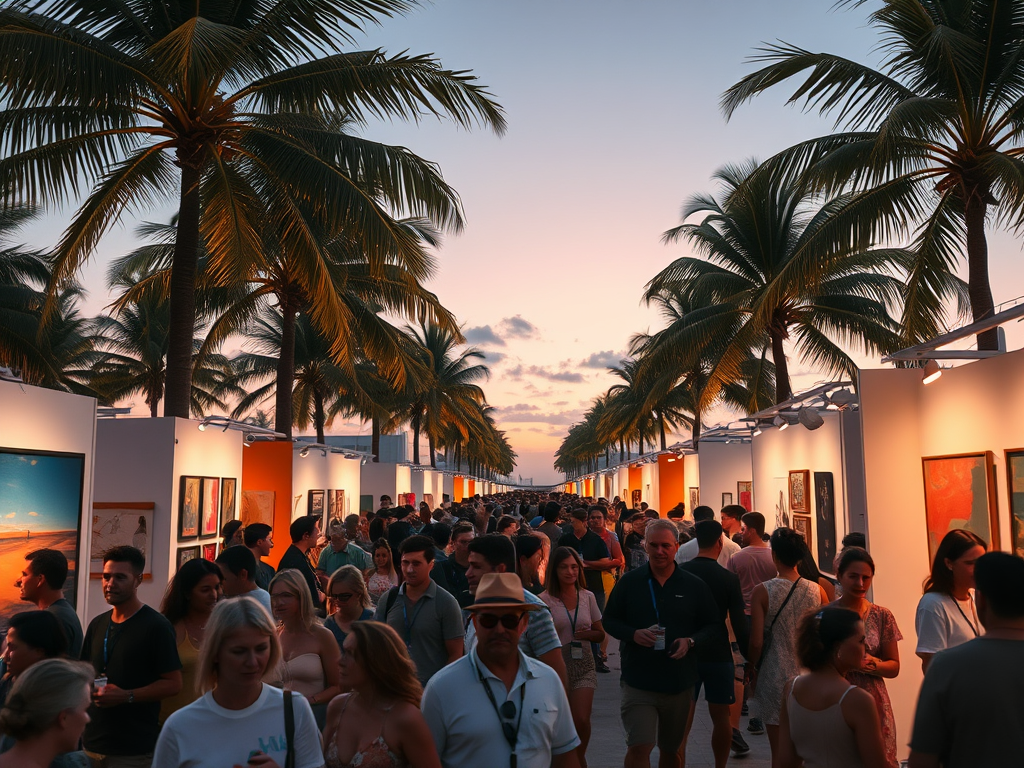

For many years, during the height of contemporary art’s cultural influence, Art Basel Miami Beach held an unmatched position in the United States. It was where collectors sought out the newest works, where gallerists and curators from every continent gathered, and where early December nights were infused with an abundance of sponsor-backed tequila.

Part of the fair’s appeal was its dual identity: the energetic, sun-soaked American counterpart to its more restrained Swiss origin. Visitors could spend the morning examining museum-quality work—often listed at prices well above those at regional fairs in New York or Chicago—and then dive into a whirlwind of nightly dinners and parties, provided they survived the gridlocked traffic along Collins Avenue.
This year, however, the fair opened under what locals might describe using beachside caution signals: a “medium hazard” atmosphere. The global market for modern and contemporary art has softened in noticeable ways, underscored by the 2025 closures of several major galleries in New York and Los Angeles. Although recent auction results hinted at stabilizing prices at the ultra-high end, the broader calendar of cultural events has become crowded, while the pool of exceptional art remains finite.
Art Basel itself has expanded dramatically since three Swiss dealers founded it in 1970. The brand now spans four major fairs annually across Europe, Asia, and North America. Its longtime competitor, Frieze, already runs five fairs, and both organizations are preparing Middle Eastern expansions—Art Basel’s upcoming edition will take place in Doha. With this global saturation, the choice of which fair to attend has become strategic. I personally return each year to the Swiss edition, affectionately—and somewhat redundantly—known as “Art Basel in Basel.” But Miami had slipped from my routine after 2020, as admired galleries withdrew and a surge of post-pandemic crypto-wealth reshaped the city’s December demographic.
This year I decided it was time to reassess. For the first time, I attended all four Basel fairs: Hong Kong in March, Basel in June, Paris in October, and finally Miami Beach in December. Even for someone who treats jet lag as a meditative ritual, the pace was formidable. When the final tally was done, I had walked through more than a thousand booths, ranging from multimillion-dollar modern masterpieces to modest works by emerging artists offered at a fraction of that cost. My notebook carries the stains of overpriced convention-center espresso, and my phone’s pedometer logged roughly 20,000 steps on each opening day—Miami earning the highest count.

After completing this fair marathon, I drew several conclusions.
Art Basel continues to be one of the most reliable places to observe where global art is heading—whether the trajectory inspires optimism or concern. Despite the increasing homogenization of global culture through technology and finance, the fairs reveal subtle shifts toward regional distinctions and artistic fragmentation. The international market, infused with corporate money, still maintains pockets of independence that feel increasingly rare in industries like entertainment. And while money alone cannot produce good taste, it can certainly fund someone who will try to guide it.
Most importantly, the gallery system that forms the backbone of these fairs has changed so dramatically that both institutions now depend on one another for survival.
Many critics avoid art fairs altogether, wary of the commercialization of creativity. Artists themselves may feel uncomfortable watching their work transform instantly into commodities. But for observers who are not directly involved in buying or selling, fairs provide an unmatched opportunity to survey artistic trends at high speed. They reveal not only what is being made but also what is losing cultural relevance.
Each fair has its own personality. Basel remains the most conservative and academically focused, drawing discreet collectors and European industry professionals. Paris, staged beneath the stunning glass ceiling of the historic Grand Palais, has quickly become the most glamorous, appealing to global elites who prefer the French capital over Basel’s quieter environment. This encourages exhibitors to showcase their strongest material.

Miami Beach has evolved into a regional edition, much like Hong Kong—aimed squarely at American collectors. Here, visitors encounter a mix of interesting historical works and the kind of flashy pop aesthetics South Beach reliably endorses. At both Miami and Hong Kong, I ran into the same oversized, gold-plated “sexy robot” sculpture by Hajime Sorayama, suspended inside a mirrored cube. Seeing it twice did not improve its appeal, nor justify the environmental cost of the encounter.
Each city draws a distinct crowd. Private jet companies and luxury watch brands appear at all four fairs, though only Basel offers fondue. Paris rewards formal dress; Basel welcomes felt jackets; Hong Kong demands layers for transitioning between outdoor heat and indoor air-conditioning; Miami embraces everything from bold designer logos to tiny lap dogs. But one constant across all fairs is the popularity of On-brand tennis shoes, famously favored by Roger Federer, Basel’s most celebrated modern resident.
Despite the playful teasing, I wore the same On sneakers throughout my tour—my own net worth a mere rounding error compared to others sporting them—because the trek between convention centers required it. Paris felt especially chaotic during its opening days, while Miami offered a more relaxed pace compared with the frenzied “running of the bulls” atmosphere I remembered from years past.
In Miami, standout presentations included a compelling display of works by Wifredo Lam at the booth of Italian gallery Mazzoleni and a striking series of athlete portraits by Emma Amos at Ryan Lee, where woven elements merged seamlessly with paint. Yet genuine risk-taking felt scarce. Those irreverent early 2000s years—when adventurous dealers like Michele Maccarone or Gavin Brown would present near-empty booths or let artists disrupt the space—now feel like distant memories. Many midsize galleries have stopped exhibiting due to the overwhelming costs of shipping and insurance, replaced instead by newcomers who are sometimes less compelling. Art Basel promoted this year’s fair as featuring the largest number of new exhibitors in more than a decade, an achievement that felt oddly self-congratulatory. The fair once highlighted how many galleries returned, not how many were replaced.

The differences between the fairs extend to their visions of the future. Miami Beach is the only edition with a dedicated digital art sector, though the section left much to be desired. Many pieces felt algorithmically generated and intellectually thin, catering to a tech-forward regional audience. The area was dominated by NFT personality Beeple, whose installation “Regular Animals” featured robotic dogs with surreal celebrity heads. These mechanical creatures jittered around while leaving behind QR-coded “droppings” that offered buyers fractional digital ownership. Alchemy has long sought the transformation of waste into gold—though at least earlier alchemists understood the difference between the two.
Art Basel Miami Beach has undergone a remarkable transformation since its delayed debut in 2002. In its early years, young galleries displayed work in shipping containers set directly on the beach. Mark Bradford, not yet a Venice Biennale artist, turned one container into a replica of his mother’s beauty salon and offered hair styling to fair attendees. The fair quickly evolved into a massive cultural event with dozens of satellite exhibitions and large-scale celebrations in the surrounding hotels. By 2013, Jay-Z casually referred to parking “twin Bugattis outside the Art Basel,” an entirely appropriate lyrical detail given Miami’s traffic.

My first visit, in 2005, introduced me to major galleries from across Latin America, especially Brazil, Colombia, and Mexico. Miami was one of the few American venues where such work appeared prominently. The fair also housed a peculiar mix of celebrities, reality TV personalities, and in one infamous moment, a real-life stabbing that some horrified onlookers initially mistook for performance art. And although the parties ranged from unforgettable to forgettable, what mattered most was the quality of the work inside the convention center—an ecosystem that brought international creators into view long before museums caught up.
Yet during my 2025 circuit, I sensed a looming shift: Art Basel and Frieze may be drifting into a business model less reliant on galleries. Ticket sales and booth fees once formed the foundation, but new revenue streams—from AI-driven apps to blockchain offerings to limited-edition collectible toys—suggest an attempt to build independent commercial ecosystems. Still, the fairs rely on galleries to supply the very work that fills their halls, and galleries depend on fairs to reach audiences they can’t access alone.
For all their spectacle, art fairs still serve a vital purpose: they gather the most influential artists under one roof and give them a chance to compete with the massive entertainment forces shaping today’s culture. Commercial galleries remain essential discovery engines, introducing audiences to unfamiliar ideas and emerging talents. And when the parties end, the fair provides the financial support many galleries need to keep operating.
The commercial art world will never represent the entire artistic landscape. But someone must uphold the responsibility of bringing new work into view—and someone must sustain the institutions that make this possible.




Leave a Reply