
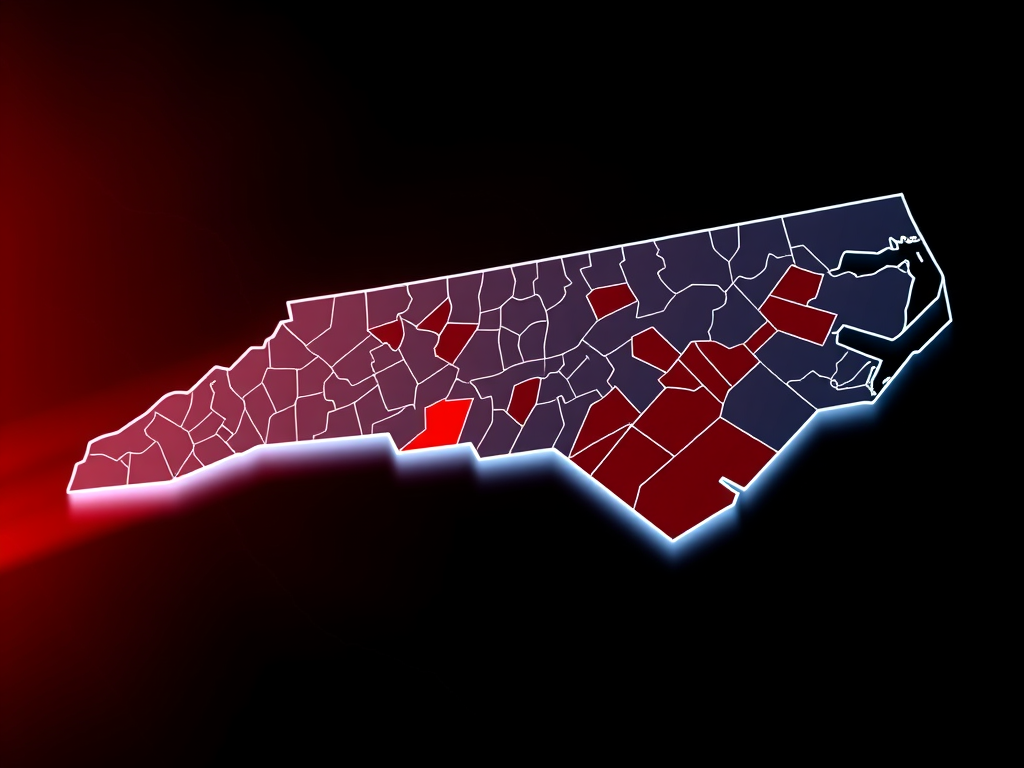

A panel of three federal judges in North Carolina ruled on Wednesday that the state’s newly redrawn congressional map can be used in the 2026 midterm elections—marking a significant victory for the Trump administration and Republican strategists aiming to maintain their hold on the U.S. House next year.
The unanimous decision, issued by the U.S. District Court for the Middle District of North Carolina, sided with Republican leaders in the state legislature. Their attorneys argued that the latest map was created for political advantage, not for racial or retaliatory reasons as the plaintiffs alleged. This distinction proved decisive, particularly because the U.S. Supreme Court effectively permitted partisan gerrymandering in a landmark 2019 ruling, weakening challenges based on political motives alone.
The newly approved map is widely expected to give Republicans an additional congressional seat. North Carolina’s Republican-controlled legislature redrew the lines in October, following a summer in which Texas initiated its own redistricting effort at the request of President Trump to help the GOP secure more congressional seats. Since then, states such as Ohio and Missouri have also revised their maps in ways that favor Republican candidates.
In response, Democrats in California crafted a new map that state voters approved earlier this month. Meanwhile, political tension escalated in Indiana on Tuesday, when Republicans unexpectedly reversed their stance and announced that they would proceed with a vote on a revised map, although the level of internal support remained uncertain.
It remains unclear whether the plaintiffs in the North Carolina lawsuit—including the N.A.A.C.P.—will appeal the ruling to the U.S. Supreme Court. Earlier this month, the Court temporarily permitted Texas to use its own controversial map for the upcoming elections, suggesting the justices may be hesitant to intervene in state-level mapping decisions in the near term.
In their 57-page opinion, the three North Carolina judges—all appointed by Republican presidents, including two by former President Trump—concluded that the plaintiffs had not demonstrated clear evidence that lawmakers intended to diminish the voting influence of Black residents. The ruling stated that there was insufficient proof the legislature acted with the purpose of “minimizing or canceling out the voting potential” of Black North Carolinians.
Even before this round of litigation, North Carolina’s congressional map was frequently cited as one of the most aggressively gerrymandered in the nation. The structure of district boundaries in previous years enabled the Republican Party to maintain its dominance in the legislature. These advantages were further reinforced when the conservative-led State Supreme Court upheld the maps in earlier battles.
Under the previous configuration, 10 of the state’s 14 congressional districts were tilted in favor of the Republican Party. The latest overhaul could further widen that advantage. In particular, the First Congressional District—which once included all eight of North Carolina’s majority-Black counties—has been redrawn to incorporate several more conservative counties. This shift threatens the seat currently held by Democratic Representative Don Davis, potentially flipping the district into Republican hands.
The plaintiffs challenging the map argued that lawmakers effectively erased North Carolina’s historic Black Belt district, claiming the redrawn boundaries stripped Black voters of a meaningful opportunity to elect candidates of their choice. In their view, the legislature’s actions amounted to intentional disenfranchisement.
During a court hearing last week, Hilary Harris Klein, an attorney representing the Southern Coalition for Social Justice and other plaintiffs, urged the court to recognize what she described as a coordinated attempt to retaliate against Black voters for the way they cast their ballots in the 2024 election. Klein emphasized that this latest map—the fifth in six years—was not part of a standard redistricting cycle but rather an extraordinary effort aimed at suppressing a specific group of voters.
“This is not redistricting as usual,” Klein said in a statement after the hearing. “It’s a mid-decade, no-pretext attempt to cancel Black voters’ voices because those in power did not like the outcome of the last election.”
Republican lawmakers offered sharply different testimony. State Senator Ralph Hise, who supervised the redistricting process and served as the primary witness at the hearing, insisted that racial data played no role in crafting the new map. He stated that the primary objective was to enhance Republican political advantage, not to target any racial group. “We undertook the process to improve the partisan advantage for Republicans,” Hise testified.
Phil Berger, the Republican leader of the State Senate, echoed this position after the ruling, characterizing the court’s decision as a rejection of what he described as the “radical left’s latest attempt to circumvent the will of the people.” According to Berger, the newly approved map reflects legitimate political strategy rather than discriminatory intent.
Yet Berger’s involvement in the timing and execution of the redistricting raised questions among political observers. He is currently engaged in a challenging primary race against Sam Page, a well-known county sheriff. Some critics have speculated that Berger’s redistricting decisions may have been influenced by efforts to secure former President Trump’s endorsement. Berger has firmly denied these allegations, dismissing them as unfounded.
Wednesday’s ruling represents the latest chapter in an ongoing national struggle over control of congressional boundaries. As demographic shifts and political polarization reshape the American electoral landscape, both major parties have increasingly turned to redistricting as a critical tool for consolidating power. North Carolina’s case is only one example of a larger trend, with Republican- and Democratic-led states alike redesigning maps in a race to shape the outcome of federal elections.
Supporters of the North Carolina map argue that political motivations have long been part of American redistricting, and that efforts to gain a partisan advantage fall well within the boundaries of constitutional law, particularly after the Supreme Court’s 2019 decision. Critics counter that unchecked gerrymandering erodes democratic fairness, undermines voter representation, and disproportionately harms minority communities whose political influence can be diluted through strategic line-drawing.
The decision is expected to influence political calculations ahead of the 2026 midterm elections, not only in North Carolina but across the country. As more states complete or revisit their maps, legal battles are almost certain to continue. For now, however, Republicans have secured a crucial win in a state where congressional boundaries have been a source of national attention for more than a decade.
Whether the dispute will escalate to the Supreme Court remains to be seen. If an appeal is filed, the justices may again find themselves at the center of a debate over how far states can go in designing maps that shape the balance of political power in Washington.




Leave a Reply