
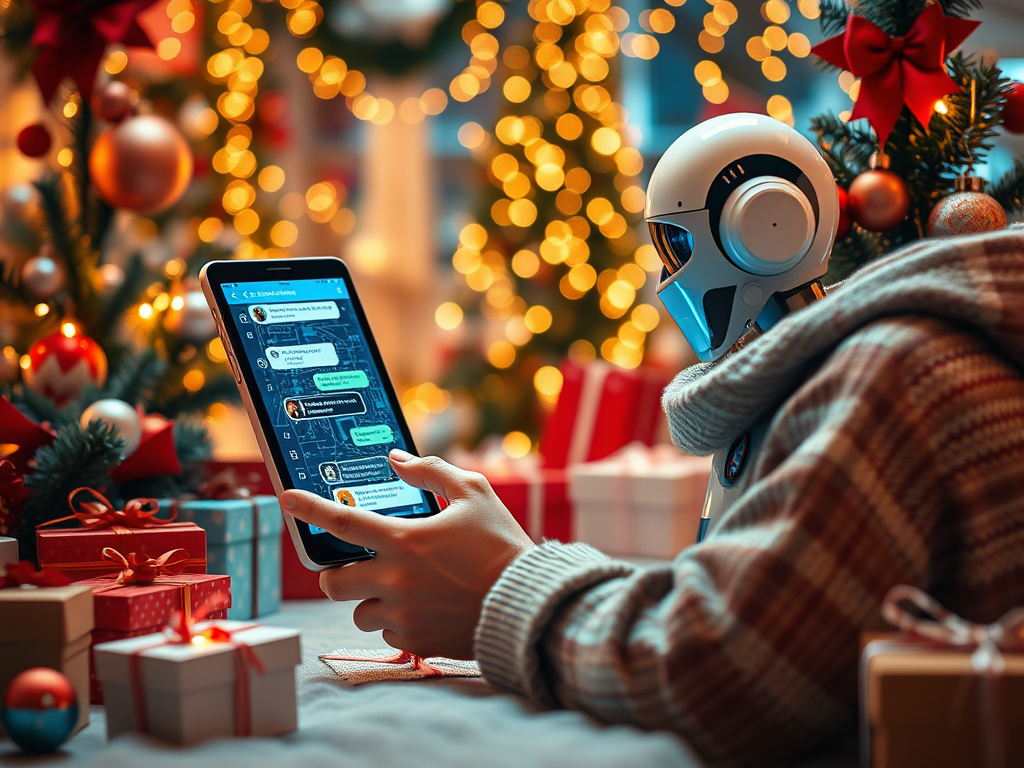
As the holiday season approaches, many shoppers are turning to artificial intelligence to streamline the search for the perfect gifts. Major retailers and tech giants are rolling out new A.I.-powered tools that promise to make browsing, comparing, and purchasing gifts faster and more personalized than ever.
Over the past few months, companies such as Target, Walmart, and Ralph Lauren have introduced conversational chatbots designed to act as digital shopping assistants. These tools function less like traditional customer service bots and more like personal stylists, capable of discussing preferences, analyzing options, and offering curated recommendations. A user looking for coordinated family pajamas can now ask a chatbot to sift through an entire catalog, summarize reviews, or highlight the best-value picks.
Meanwhile, A.I. developers are rapidly entering the retail arena themselves. In September, OpenAI launched an instant checkout feature within ChatGPT that allows users in the United States to complete purchases from select merchants—such as Etsy sellers—directly inside a chat window. Google recently announced an assistant that can call local stores to confirm whether a product is in stock. Amazon introduced a feature that monitors prices and automatically completes a purchase when an item falls within a shopper’s preset budget.
According to companies behind these tools, the overarching goal is to make the shopping experience more seamless, intuitive, and personalized. These next-generation A.I. “agents” can interpret context, ask clarifying questions, and take initiative—abilities that go far beyond the scripted responses of older chatbots, which could only assist with simple issues like order tracking or return policies.
Lori Schafer, chief executive of Digital Wave Technology, believes these tools are transforming how people discover products. She notes that A.I. can bring curated selections directly to shoppers instead of forcing consumers to dig through endless online listings. This shift, she says, changes not just the mechanics of shopping but the mindset around it, making the process more efficient and cost-effective.
Marketing researchers say the psychological impact is equally significant. Luca Cian, a professor at the University of Virginia’s Darden School of Business, explains that modern consumers are overwhelmed by choices. With thousands of similar products available online, many people experience decision fatigue long before reaching the checkout page. A.I., he says, helps reduce that cognitive burden by narrowing options and guiding users toward confident decisions.
“It’s not only a technological transition,” he notes. “It’s a psychological one. We’re learning how to assign certain decisions to A.I. while deciding which ones we still want to control ourselves.”
This shift is already well underway. According to a recent survey of more than 4,000 consumers conducted by Harris Poll for Mastercard, about 42 percent of holiday shoppers are already using A.I. tools to help select gifts. Among Gen Z and millennial shoppers, more than half say they trust A.I. to suggest creative or unique presents.
But despite the momentum, today’s A.I. shopping assistants still have limits. Many tools remain experimental, and some users say the results feel repetitive or incomplete. For example, Olivia Meyer, a 24-year-old professional in New York’s fashion industry, recently tried ChatGPT to look for winter boots. She was disappointed when the assistant repeatedly surfaced similar brands instead of offering a wider range of options. In the end, she returned to more traditional searches on Google and TikTok.
Industry experts acknowledge that the vision of fully autonomous A.I. shopping is still a work in progress. Tyler Murray, chief enterprise solutions officer at VML, says that while current tools can assist with recommendations, they do not yet understand individual preferences deeply enough to manage an entire purchase journey. The technology capable of delivering a truly comprehensive, personal shopping experience remains a few steps away.
Still, retailers continue to refine and expand their A.I. offerings. Earlier this month, Target launched a new chatbot designed to help shoppers discover gifts through natural conversations. The tool asks about the recipient’s age, interests, occasion, and the shopper’s budget. It builds on Target’s earlier gift-finding A.I. tool but adds more flexibility and conversational freedom.
OpenAI has also enhanced ChatGPT’s shopping features in multiple ways. In April, it began including product images and more structured results. By September, ChatGPT users in the United States gained access to instant checkout for select Etsy items. In recent months, additional merchants on Shopify—such as Skims, Spanx, and Glossier—have become available through this feature. OpenAI earns a portion of the revenue from these transactions, although the company has not disclosed the exact amount.
This week, OpenAI rolled out a new product research feature within ChatGPT, designed to refine and improve the accuracy of shopping suggestions. Michelle Fradin, who leads ChatGPT’s commerce product team, describes A.I. shopping as being in an early developmental stage. The company plans to expand its catalog of purchasable products and has announced a partnership with Walmart, though Walmart items are not yet supported through instant checkout.
Some shoppers, however, are already enthusiastic about the possibilities. James Wilsterman, a 38-year-old tech executive in San Francisco, turned to ChatGPT this summer to prepare for a wedding in France. With the help of A.I., he found blazers and linen shirts from brands he had not previously considered. Shopping typically feels like a chore for him, but the streamlined interface and curated visuals made the process easier and more enjoyable.
As he prepares his holiday shopping list, Wilsterman says he plans to rely on A.I. again. The technology, he notes, has made browsing less overwhelming. And in a lighthearted twist, he says he has found one extra benefit: if a gift doesn’t land well with his family, he jokingly tells them he’ll “blame it on ChatGPT.”
As retailers and tech companies continue experimenting with new tools, this year’s shopping season represents a glimpse of the future—a preview of how artificial intelligence may soon influence not only what we buy, but how we choose, compare, and decide. The technology may still be evolving, but its impact on the consumer experience is already unmistakable.




Leave a Reply