
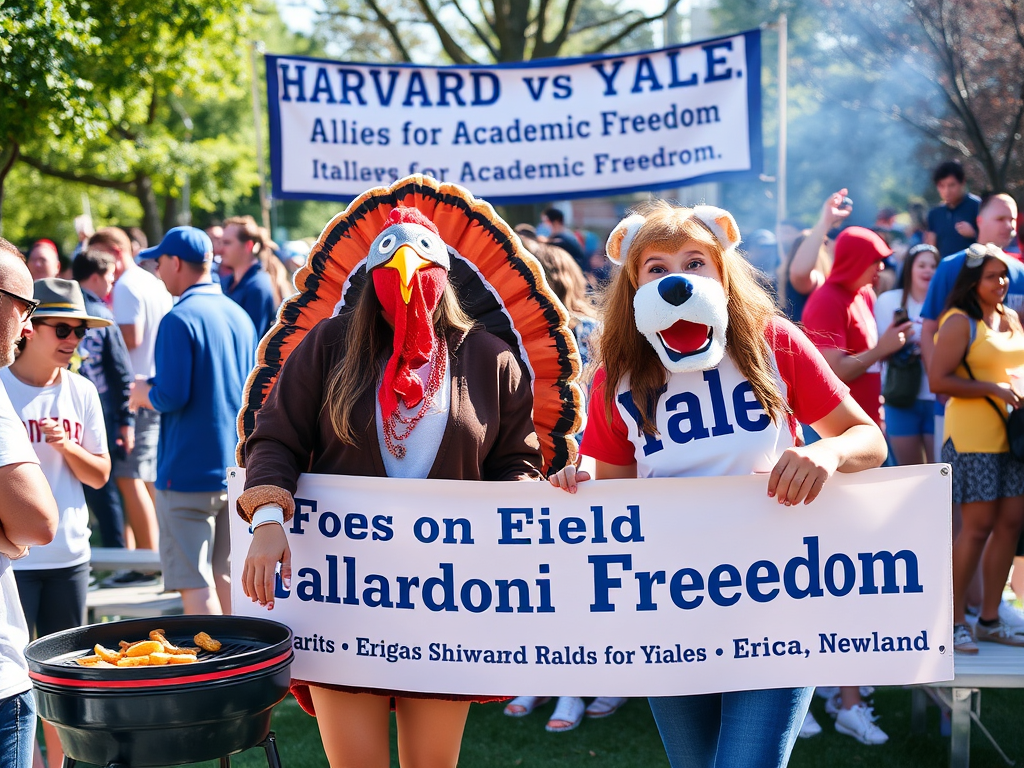

In the hours leading up to the 141st face-off between the Harvard and Yale football teams on Saturday, the usually quiet grassy fields at Yale University transformed into a sprawling, high-energy tailgate scene. Students and alumni dressed proudly in Harvard crimson and Yale blue played cornhole, grilled chicken, munched on bagels, and passed around Pabst Blue Ribbon and bottles of wine as if it were a festival dedicated to collegiate nostalgia.
Amid the sea of revelers were two eye-catching figures: Regina Schwartz, a Harvard graduate clad in a full turkey costume—an unofficial symbol of Harvard spirit—and Erica Newland, a Yale and Yale Law alum, fully suited as a Yale bulldog, complete with an oversized headpiece reminiscent of a Times Square street performer.

But they were not there simply to enjoy the pregame festivities. Their purpose was both serious and urgent: encouraging fans to “stand firm against attacks on higher education,” as their flyers proclaimed.
“Do you want to defend academic freedom and the First Amendment?” Schwartz shouted over competing DJ speakers, each blasting music with clashing rhythms. A group of students paused long enough to answer with a hesitant but supportive, “I guess so?”
Schwartz and Newland were part of a rare collaboration. For the first time at a Harvard-Yale football game, alumni groups from both universities joined forces as the political climate surrounding higher education continued to shift under the Trump administration. The administration had advanced efforts to reshape universities nationwide and negotiate agreements with institutions willing to align with its policy objectives.

Under a shared banner that read “Foes on the Field, Allies for Academic Freedom,” the two groups—Crimson Courage and Stand Up for Yale—hosted a joint tent. There, they gathered signatures for a petition urging Harvard and Yale leaders to refuse any deals with the administration that could grant the federal government greater oversight in university governance.
For Newland, this annual football rivalry holds a personal history. She recalled with mixed amusement and embarrassment how her relationship with her now-husband began at the 2006 game in Cambridge. After drinking too much Manischewitz, she ended up in an ambulance, escorted by the man she would eventually marry. She hesitated to share the story but ultimately laughed, calling it “the wedding announcement I never got in The Times.”
Although Yale has not faced the same level of scrutiny from the Trump administration that other Ivy League schools have, Newland emphasized that universities are stronger when they act together.
“We either stand united or we fall separately,” she said.
Yet unity within the Ivy League comes with complications. The vast resources and influence of Harvard and Yale set them apart from most institutions—making it difficult for them to persuade schools with fewer financial buffers to risk federal funding in solidarity. Still, many university leaders nationwide have signed a public letter denouncing governmental overreach, while others have filed legal briefs supporting Harvard’s position in its ongoing fight against federal funding cuts.
Around midmorning, Miles Rapoport, co-chair of Crimson Courage and former Connecticut secretary of state, scanned the crowd and pointed. “Is that George Conway?” he asked. Moments later, it became clear that the passing figure was indeed Conway, a prominent anti-Trump conservative attorney and graduate of both Harvard and Yale Law. Rapoport skillfully ushered him into the tent, where Conway gamely allowed volunteers to cover him in stickers from both advocacy groups.

The petition drive also drew the support of Senator Richard Blumenthal, a Connecticut Democrat and alumnus of both institutions. Blumenthal acknowledged that cooperation between Harvard and Yale does not come naturally—particularly given their intense competition for talent, resources, and prestige. Many university officials, he said, prefer to stay out of the spotlight, fearing retaliation from the federal government.
“There’s real fear out there,” he noted. “But I keep telling them—there’s strength in numbers.”
A spokesperson for the Trump administration did not immediately respond to requests for comment.
Blumenthal dove into the crowd of mostly 20-something tailgaters, many clutching red solo cups. Approaching a group in Harvard gear, he asked, “You came down from Boston? Can you stand up for Harvard today? Can you stand up for academic freedom?” He handed out postcards and stickers with the flourish of a magician encouraging spectators to pick a card.
One of the Harvard students accepted the materials but refused anything branded with Yale. Supporting academic freedom was one thing, he said, but some traditions remained inviolable—especially on game day.
“Get back to enjoying yourselves,” Blumenthal encouraged.
“There is no fun under fascism,” replied Isabel Adler, 26, a public policy student at the Harvard Kennedy School.

Blumenthal seemed to be enjoying himself as much as anyone. At one point, he remarked to no one in particular, “This is the most fun I’ve had in a long time,” a comment that reflected the tense climate in Washington more than the joys of a football tailgate.
As for the game itself, Yale stunned Harvard with a decisive 45–28 victory, but for many who gathered that day, the stakes off the field felt just as significant.




Leave a Reply