
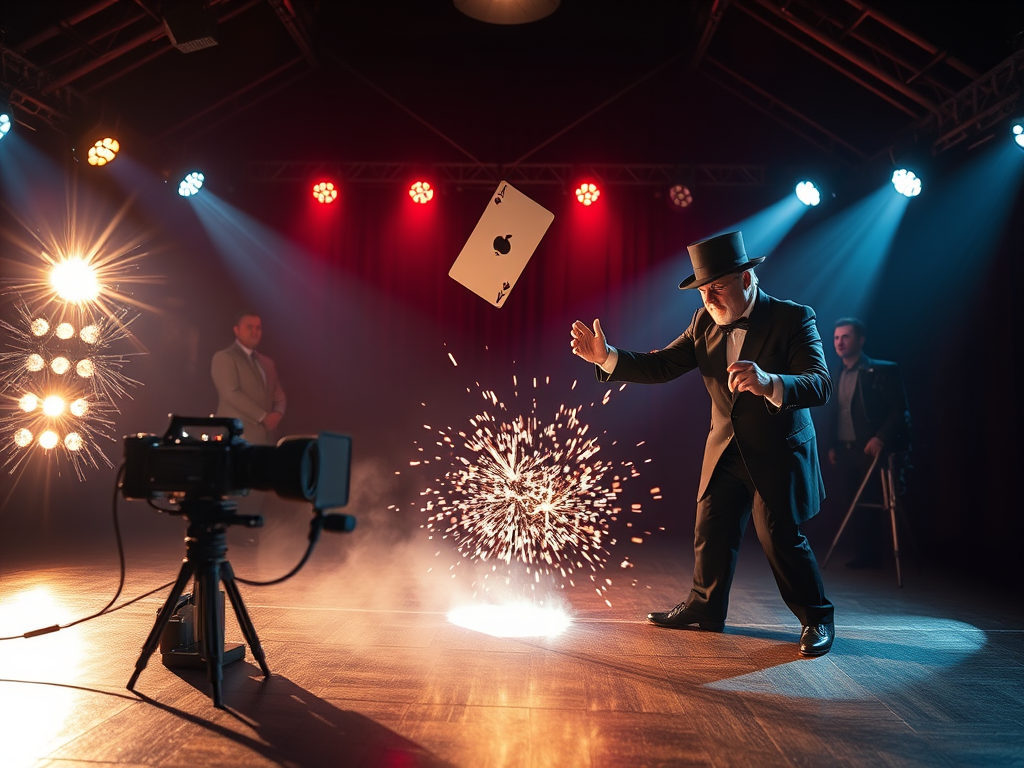

Magic has never been real — at least not in the literal sense. The rabbit appears only because it was hidden under the table, the chosen card is no coincidence, and the magician’s props are built for deception. Films operate with similar sleight of hand: digital effects, A.I. tools, and careful camera work make the impossible appear effortless. Combining magic with cinema should, in theory, produce an illusion twice removed from reality.
Yet audiences welcomed it anyway. The 2013 film “Now You See Me,” a curious blend of action, heist, and stage illusion, became a surprise box-office hit, followed by its 2016 sequel. Now, the franchise reappears with a third installment, “Now You See Me: Now You Don’t.” Despite its self-aware cheesiness — as the villain in the new film gleefully declares — viewers evidently wanted more magicians, more impossible escapes, and even a set that flips entirely upside down.
Edward Ricourt, one of the original film’s writers, believes he understands why the formula endures. “People want to be fooled,” he said during a recent video call.
Ricourt grew up in Manhattan, mesmerized by the street performers who made Washington Square Park and Central Park their stage. Years later, as a new screenwriter in the early Occupy Wall Street era, he imagined a script about a group of street magicians pulling off a Robin Hood-style heist. Magic would be both their method and their distraction.
Not being a magician himself, Ricourt and his co-writers Boaz Yakin and Ed Solomon brought in professional consultants to ground the illusions in authentic technique. These specialists later traveled to New Orleans to train the cast, including Jesse Eisenberg, Woody Harrelson, Isla Fisher, and Dave Franco, each portraying a different kind of performer.
Filming their acts came with its own set of challenges. In a live show, the audience watches from a fixed perspective. In film, the camera moves — meaning it can expose secrets typically hidden from spectators. Producer Bobby Cohen, once a child magician, recalled the extensive testing and rehearsal required to preserve the authenticity of each effect.
Although the filmmakers used visual effects, Cohen emphasized that computer graphics served mainly to erase wires or smooth transitions. The principles behind each illusion, he insisted, remained grounded in real stagecraft. Not everyone agreed; critics noted that the tricks seemed too seamless to be purely practical. But the filmmakers understood that digital perfection can undermine believability. “Audiences know when something looks too clean,” Cohen said. Their goal was to make the illusions feel tactile — still fake, but convincingly human.
The franchise’s success — the first movie earned over $350 million worldwide — inevitably demanded escalation. But topping the impossible is no easy assignment. Director Ruben Fleischer, who helmed the new film, said the creative team needed a clear justification for a third installment. Their answer was more spectacle, sharper twists, and an expanded ensemble.
Alongside returning cast members and Lizzy Caplan, the film introduces a younger generation of magicians played by Ariana Greenblatt, Dominic Sessa, and Justice Smith. Fleischer also committed to minimizing digital shortcuts, believing audiences expect “real magic” when they buy a ticket to a magic-themed film.
To raise the bar, Fleischer enlisted Randy Pitchford — long-time magician and owner of Los Angeles’ legendary Magic Castle. Pitchford gathered a team of expert illusionists who coached the actors and helped engineer the film’s most elaborate set pieces. Their contributions included a meticulously constructed chateau featuring rooms that invert themselves, an Escher-inspired chamber, and a full hall of mirrors — all built physically rather than digitally.
Pitchford admitted that their craftsmanship may have been almost too convincing. Some scenes look so astonishing, he said, that the audience might assume they were created entirely in CGI.
According to Cohen, the actors perform many of the tricks seen on screen. Sessa levitates a playing card, Franco executes complex throws, and Eisenberg completes a full vanish. Harrelson is not actually a hypnotist, yet test audiences often selected the same card during one of his character’s scenes. A promotional behind-the-scenes reel shows the cast practicing extensively to master these skills.
The physical demands were significant. During the first film, Fisher trained with both a free diver and magician David Blaine, learning to hold her breath for as long as three minutes. Her tasks in the new movie — palming a jewel or catching a card in motion — appeared simpler but were surprisingly difficult. She practiced for hours every weekend with expert guidance.

Speaking by phone, Fisher reflected on the similarities between acting and magic. Both professions rely on directing the audience’s attention. But magic, she said, feels far more nerve-racking. “There’s a real technical risk to it,” she explained. “But once you get it right, the feeling is incredible.”
That exhilaration — the fleeting moment when the illusion succeeds — is what the films hope to deliver. Audiences can enjoy the deception, marvel at the mechanics behind it, or simply immerse themselves in the spectacle.
Pitchford summarized it with a magician’s flair: for just a moment, these movies let us imagine what the world would feel like if real magic truly existed.




Leave a Reply