
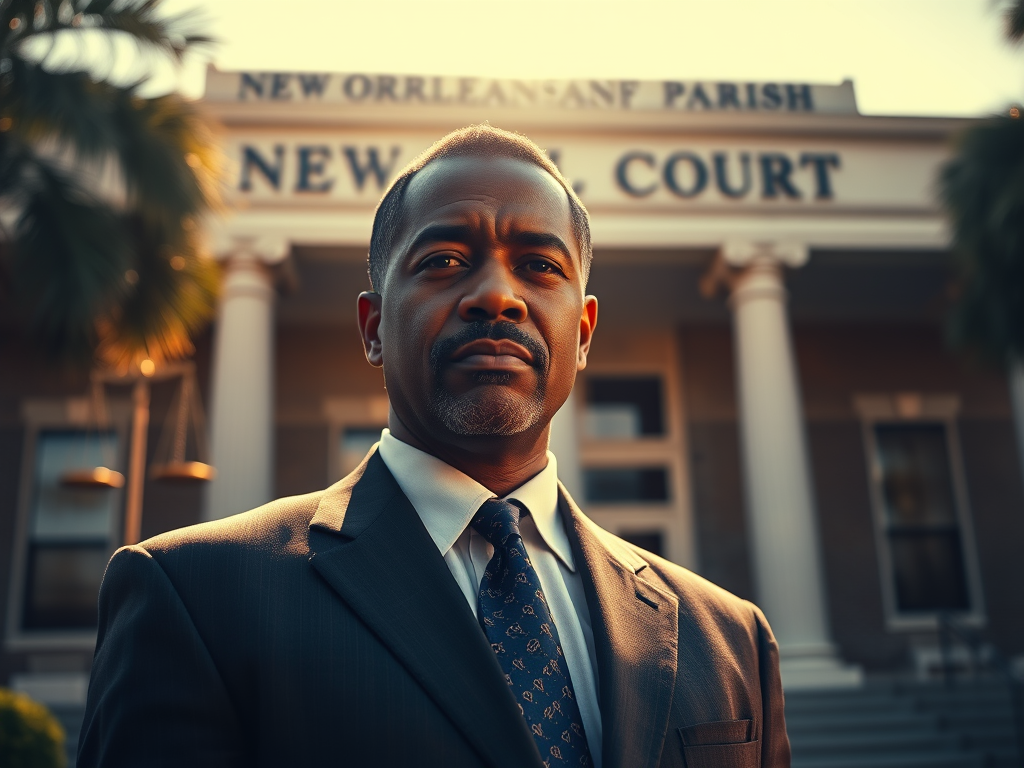

Calvin Duncan’s journey began in one of the most unlikely places: a prison cell in the Louisiana State Penitentiary. Sentenced to life for a 1981 murder he always insisted he did not commit, Duncan gradually forged a reputation as one of the state’s most remarkable jailhouse legal minds. Over nearly three decades behind bars, he taught himself law, guided fellow inmates through their appeals, and built a personal mission around the pursuit of justice. When he was finally released after 28 years, he cleared his name, rebuilt his life, and — at age 60 — earned a law degree.
This extraordinary story took an even more unexpected turn on Saturday, when voters in New Orleans chose Duncan as the new clerk of the parish criminal court. According to preliminary results, he defeated the sitting clerk, a member of a well-established political family, in a race that few initially believed he could win.
Typically, the clerk’s job receives little public attention. The role is administrative and technical, responsible for managing a vast and constantly expanding archive of criminal court documents and evidence. But Duncan’s campaign sought to shift the public’s understanding of the position, arguing that efficient record-keeping is not simply bureaucratic work — it is foundational to a functioning justice system.
Drawing on his own life story, he reminded voters how access to accurate and complete court records can determine whether someone spends decades in prison or walks free. As an advocate, a jailhouse lawyer, and a man whose own freedom depended on those files, he said he was uniquely equipped to modernize an office that has long depended on outdated processes.
On election night, Duncan described the moment as the realization of a dream he had carried for four decades. “I hope the people who died in prison because we could not get their records are looking down on this moment,” he said, addressing supporters. “I hope they are proud. We fought for each other’s rights, and I will keep fighting for yours.”
At the start of the campaign, few observers believed Duncan had a real chance. His candidacy gained unexpected momentum late in the race, however, after incumbent clerk Darren Lombard attempted to undermine Duncan’s record of exoneration. Lombard publicly questioned whether Duncan had ever been officially cleared of the killing and suggested he remained connected to a violent crime.
The claims struck a sensitive nerve in a city where wrongful convictions have long been a painful issue. New Orleans has one of the highest known rates of exonerations in the United States, and Lombard’s remarks did not land the way his campaign intended. Rather than damaging Duncan’s credibility, the accusations highlighted the very flaws in the justice system that Duncan had spent most of his life confronting.
For once, the race for criminal court clerk — a contest usually overshadowed by high-profile mayoral and City Council elections — became one of the most watched races on the ballot.
Lombard, who was first elected in 2021, entered the campaign with strong political backing. He secured endorsements from Helena Moreno, the city’s incoming mayor and a widely popular political figure, and from Representative Troy Carter, New Orleans’s Democratic member of Congress. The editorial board of The Times-Picayune also threw its support behind him, praising his administrative background and experience in managing the office’s varied responsibilities.
In early voting on October 11, Lombard held a modest lead. But that advantage quickly dissolved. By the time all votes were counted, Duncan had overtaken him, pushing both men into a runoff. In that final round, Duncan expanded his lead dramatically, winning about 68 percent of the vote, according to the Louisiana secretary of state’s preliminary numbers. Despite the heightened public interest, turnout remained similar to the runoff four years earlier.
Following the results, Lombard issued a brief statement acknowledging defeat. “This was not the outcome we hoped for,” he said, “but the voters of Orleans Parish have spoken, and I respect their decision.”
For Duncan, now 62, the victory marks the closing of a long and complicated chapter that began with his 1981 conviction. Inside Angola, as the prison is known, he steadfastly maintained that he was innocent of the shooting that had taken a young man’s life during a robbery. Driven by necessity, he immersed himself in criminal law, initially to fight his own case, and later to help countless others.
He became known among incarcerated people and lawyers alike for his deep knowledge of procedural law. Some legal scholars who collaborated with him remarked that his understanding rivaled that of seasoned practitioners. His work contributed to cases that reached the U.S. Supreme Court, and he became a vital resource for inmates searching for errors or overlooked evidence that might reopen their cases.
Those efforts required constant communication with court clerks across Louisiana to obtain documents. In much of the state, Duncan found that records were accessible or could be retrieved with relative ease. But New Orleans was an exception. There, he said, trying to locate case files often felt like a fruitless hunt, filled with delays and dead ends. This experience shaped one of his central campaign promises: speeding up the digitization of court records and making them more accessible to the public.
Duncan’s long fight for justice culminated in 2011, when Innocence Project New Orleans — later renamed Innocence & Justice Louisiana — uncovered evidence that cast serious doubt on the prosecution’s case. Prosecutors agreed to overturn his murder conviction in exchange for his plea to lesser charges, which he accepted. A decade later, a judge ruled that he was factually innocent, clearing his record entirely.
Despite this, Lombard attempted to sow doubt during the campaign by pointing to a letter from Louisiana’s Republican attorney general, Liz Murrill. In that letter, Murrill argued that because Duncan had once pleaded guilty to lesser offenses, referring to him as exonerated was misleading.
But legal scholars and practitioners swiftly pushed back. The National Registry of Exonerations, an independent academic project, had already listed Duncan among its cases. More than 160 attorneys and legal experts also signed a public statement affirming that Duncan met every reasonable standard for exoneration. Their letter emphasized that the facts and procedural history of the case were unequivocal.
For New Orleans voters, the debate ultimately underscored why Duncan’s voice — forged through lived experience and decades of advocacy — resonated so strongly. His victory reflects not only a personal triumph but also a broader public reckoning with a justice system that has too often failed the people caught inside it.




Leave a Reply