
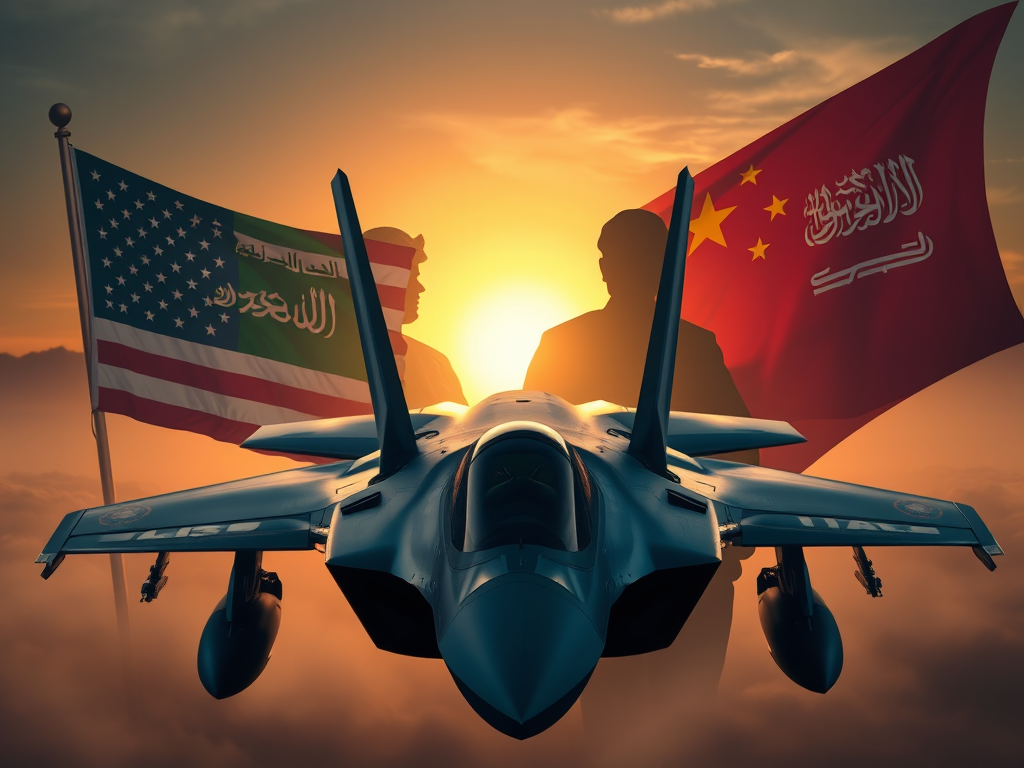

As the Trump administration works to finalize a major arms agreement involving the sale of advanced F-35 fighter jets to Saudi Arabia, a recent Pentagon intelligence assessment has sparked new concerns inside the U.S. defense community. According to individuals familiar with the report, analysts warn that China could gain access to sensitive F-35 technology if the sale is completed.
Officials who have reviewed the potential transaction say the Defense Intelligence Agency has raised the possibility that Beijing could exploit its deepening security relationship with Riyadh—or rely on traditional espionage tactics—to acquire information about America’s most sophisticated stealth aircraft. The assessment, described as broad and comprehensive, outlines a range of risks linked to the proposed deal.
The agreement under discussion would allow U.S. defense contractors to supply 48 F-35 jets to Saudi Arabia, a multibillion-dollar package that Saudi leaders have been pursuing for years. Defense Secretary Pete Hegseth was expected to sign off on the deal before it proceeded to a wider interagency review, according to people familiar with the process.
Crown Prince Mohammed bin Salman, the kingdom’s de facto ruler, is scheduled to meet President Trump at the White House on Tuesday. U.S. officials say the F-35 sale and a potential mutual defense pact will dominate the agenda, reflecting Saudi Arabia’s status as Washington’s largest customer for American-made weapons.
Prince Khalid bin Salman, the Saudi defense minister, said on social media that he recently held discussions with Secretary Hegseth, Secretary of State Marco Rubio and Steve Witkoff, President Trump’s special envoy for the Middle East. He noted that the meetings focused on strengthening bilateral relations and expanding strategic cooperation.
The Defense Intelligence Agency declined to comment on its evaluation of the F-35 proposal, and the Saudi embassy in Washington did not respond to requests for comment. The White House issued a brief statement saying it would not preempt the president on ongoing discussions.
At the same time, Saudi officials have been encouraging Washington to move forward on a separate initiative: assisting the kingdom in developing a civilian nuclear program. That push has raised new debate among U.S. policymakers over whether such technology could eventually enable Saudi Arabia to pursue nuclear weapons capability.
Both the Trump and Biden administrations have tried to persuade Saudi Arabia to normalize relations with Israel. But prospects have dimmed amid high civilian casualties in the Israel-Hamas conflict and continued criticism of the Israeli government’s far-right approach to Palestinian issues.
Beyond the concerns about China, the proposed F-35 sale also raises longstanding questions about preserving Israel’s “qualitative military edge,” a guiding principle of U.S. foreign policy in the Middle East since the 1973 Arab-Israeli war. Israel is currently the only nation in the region equipped with the F-35, which it has used in air operations—including strikes in Iran in 2024 and 2025.
For decades, U.S. administrations have relied on a classified interagency process to determine whether any regional weapons sale might jeopardize Israel’s military advantage. Congress has reinforced this standard, requiring that the United States ensure Israel can defeat any credible conventional threat while sustaining minimal losses.
In 2020, the first Trump administration agreed to sell F-35 jets to the United Arab Emirates after the UAE agreed to establish formal diplomatic ties with Israel under the Abraham Accords. But some U.S. officials voiced strong objections, citing the UAE’s close relationship with China and the potential erosion of Israel’s military edge. When the Biden administration took office, it temporarily froze the agreement to reassess the risks, driven largely by concerns that China could gain access to F-35 technologies through the UAE. Washington eventually issued a list of stringent conditions, including installing kill switches that would allow the United States to disable the aircraft if necessary. Emirati officials rejected the terms, and the deal collapsed.
Similar concerns now cloud the Saudi proposal. U.S. officials are weighing the possibility of imposing security safeguards on any F-35 sale, though it remains unclear how such protections would be implemented or how closely they align with the warnings in the Pentagon’s intelligence report.
Saudi Arabia’s military partnership with China has deepened over the past decade. Beijing has assisted the kingdom in building and upgrading ballistic missile systems, a development that prompted Democratic lawmakers to raise alarms in a letter to President Biden in 2022. For years, Saudi Arabia purchased short-range missiles from China, but it has recently begun acquiring more advanced systems with longer ranges and developing the infrastructure needed to manufacture its own components. Satellite imagery reviewed by U.S. analysts appears to show a Saudi missile testing site modeled on a Chinese facility, according to Jeffrey Lewis, an arms control expert at the Middlebury Institute of International Studies.
Despite these concerns, defense analysts say the F-35 would dramatically enhance Saudi Arabia’s air capabilities if the sale moves forward. Gareth Jennings, aviation editor at Janes, noted that the aircraft’s stealth features, advanced sensors and real-time data integration would allow Saudi pilots to operate with far greater situational awareness. He described the F-35 as the pinnacle of Western combat aviation, combining unmatched technical performance with significant symbolic value.
Israel’s recent operations offer a glimpse of the aircraft’s impact. During the 12-day conflict with Iran in June, Israeli F-35s reportedly helped dismantle segments of Iran’s air defense network, creating openings for older jets to operate with little resistance. Analysts say the aircraft likely played a central role in Israel’s success.
President Trump has repeatedly highlighted his close relationship with Saudi Arabia and the scale of U.S.-Saudi business deals. During his visit to the kingdom in May, the White House announced that the administration had facilitated $600 billion in agreements with Saudi government bodies and companies, including $142 billion in defense sales. However, several of the commercial projects cited during the trip were already in development before Trump took office.
As negotiations continue, the potential F-35 sale has become a focal point of a broader strategic dilemma: how to deepen ties with a key Middle Eastern partner while minimizing the risk that U.S. military technology could be exposed to one of Washington’s chief geopolitical rivals. The ultimate terms of any agreement—if it materializes—will signal how the United States weighs these competing priorities at a moment of shifting global alliances and heightened great-power competition.




Leave a Reply