
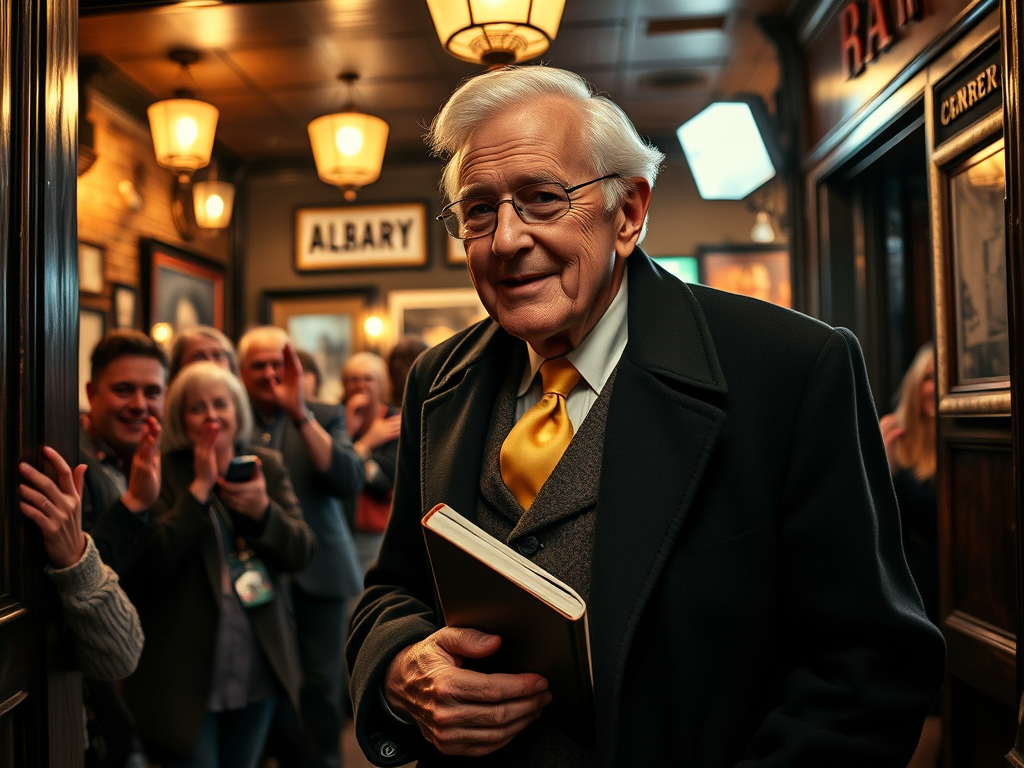

He stepped into the Albany bar with the confidence of someone who had been a legend there for decades. His long black coat, reminiscent of old gangster films, swung slightly as he entered. But instead of a weapon, the only thing he carried was the tool that had shaped his life’s work — a book.
A wave of cheers met him at the entrance. There he is, the crowd called out, voices rising above the hum of conversation. William Kennedy. Bill. Albany’s literary lion.
Kennedy, now approaching 98 and moving with the aid of a walker, still radiates the sharpness and energy that defined his career. Age has softened neither his wit nor his stamina. He remains the unofficial storyteller of Albany — its chronicler, its archivist, and its bard.
The occasion was a marathon public reading of “Legs,” his novel about the impeccably dressed gangster Jack “Legs” Diamond, who met his end in an Albany rooming house in 1931. The event took place at the ADCo Bar & Bottle Shop, a snug, atmospheric space tucked beside the old brick walls of the former National Biscuit Company factory.
Officially, the gathering was a fundraiser for the Sacred Heart of Jesus food pantry, connected to the North Albany parish where Kennedy once served as an altar boy. But the night became something much more: a chance to celebrate a writer whose work elevated Albany from a modest capital city to a place of myth, memory, and literature.
Kennedy still jots down ideas in small notebooks. He still dresses with flair. He still writes fiction. And he is still being recognized for his influence. This coming spring, the Library of America will release a volume containing three of his Albany novels — “Legs,” “Billy Phelan’s Greatest Game,” and “Ironweed.” Novelist Colum McCann, who wrote the volume’s foreword, praised Kennedy’s eight-novel Albany Cycle as one of the most exuberant literary achievements of the last fifty years. The honor places Kennedy in the company of figures such as Saul Bellow, Joan Didion, and Don DeLillo, some of the few authors celebrated by the institution during their lifetimes.

In the bar, Kennedy settled into his seat wearing a sharp brown jacket and a yellow tie that offered just a hint of flash. Volunteers rotated through readings of “Legs” in the adjoining room, and Kennedy would soon read his own section. First, though, he sipped a glass of red wine as people leaned in to recount tales of politicians, crooks, and ordinary Albany characters — tributes expressed in the city’s own vernacular.
Earlier that same day, Kennedy had been sitting in a lounge chair inside his sprawling, nearly two-century-old home on the outskirts of Albany. Thin, relaxed, and elegant, he sipped wine while sharing memories that reached back nearly a century. His shelves and walls were filled with mementos from a remarkable life that began even before Legs Diamond’s demise. Posters, photographs, political memorabilia, an old Royal typewriter — all markers of the years he spent as a journalist in Puerto Rico, Miami, and ultimately Albany.
One wall was covered with photographs of Dana Kennedy, his wife of 66 years, who passed away in 2023. A professional dancer, she swept into his life with grace and energy, raised their three children, and taught dance to support the family while Kennedy pursued his uncertain path as a novelist. She was as much a part of his journey as any of the characters in his books.
That journey led to one of the most unforgettable openings in American literature. “Ironweed,” his 1983 Pulitzer Prize-winning masterpiece, follows Francis Phelan, a drifter haunted by the accidental death of his infant son. Phelan wanders through Albany during the Great Depression, encountering ghosts who embody the weight of his past. In one scene, he enters Saint Agnes Cemetery and sees his deceased parents, his father lighting a pipe with grass roots, his mother weaving crosses from dandelions.
Kennedy is unquestionably proud of his novels. But that afternoon, reclining in his chair, he spoke mostly about life — the details, the humor, the names he never forgot. The childhood haircut that made him resemble actor George Raft. Friends from the Knights of Columbus choir. Old diners and nightclubs frequented by “swells, sports, and bums.”
Reflecting on the most recent Election Day, he remembered his mother waking him after Franklin Roosevelt defeated Alf Landon in 1936, shouting, “Wake up! We won everything!”

He still remembers the lyrics to hundreds of songs, from Irish ballads to forgotten American tunes. His father, a World War I veteran who kept gambling ledgers on the side, used to sing a war-era song titled “Arrah Go On, I’m Gonna Go Back to Oregon.” Now, nearly a century later, his son can still recall every word.
A phone call interrupted the conversation — his older daughter, Dana Nelson, checking in. After a warm chat, he ended the call as he always did: “I’ll see you all of a sudden, kid. Bye-bye.”
With his wine finished, Kennedy prepared for the evening’s reading. He skimmed a few passages from “Legs,” slipped the paperback into his blazer, and headed to the waiting car.
Driving toward Albany, he gazed out at the rain-blurred city lights. His relationship to Albany is often compared to James Joyce’s relationship with Dublin. But unlike Joyce, who left and never returned, Kennedy came back — and found an entire universe inside one small city along the Hudson River.
“It’s mutual,” said Suzanne Roberson, his longtime researcher and archivist. “The city celebrates him, and he gives so much of himself in return.”
Kennedy’s influence is embedded everywhere: in literary festivals, historic preservation, community institutions. One of his biggest contributions, funded in part by his MacArthur Fellowship, was the founding of the New York State Writers Institute at the University at Albany. For forty years, the institute has attracted thousands of writers, turning the city into a hub of literary culture.
“We’ve had the greats come through here, all because of Bill Kennedy,” said Paul Grondahl, the institute’s director and author of several books on Albany. “Everyone wants to spend time with him.”
Following his directions through the rain-soaked streets, the car soon stopped in front of the ADCo Bar, named for the Albany Distilling Company. Inside, a crowd of writers, journalists, friends, admirers, and family waited. Among them were novelist Peter Quinn, historian Terry Golway, State Senator Patricia Fahy, former county comptroller Mike Conners, and Kennedy’s children, Brendan and Kathy. Drinks were shared, stories exchanged.
Outside, figures resembling Francis Phelan seemed to pass by in the rain, grounding Grondahl’s plea to the crowd in the next room: support the food pantry. Many in Albany, including in Kennedy’s old neighborhood, still struggle with hunger.
At last, Kennedy approached the lectern. A bright light illuminated the pages of “Legs.” His glass of red sat close by. His first sentences were quiet, tentative, but he soon found his rhythm. As he read, the audience slipped into the dark woods of the Catskills, watching Jack Diamond interrogate an old man named Streeter about a hidden moonshine still. The tension, the humor, the danger — it all came alive.
When Kennedy finally lifted his head, his face glowed in the warm light. “That’s it,” he said.
From the crowd came the reply, rising like a chorus.
“Keep going!”
And he did.




Leave a Reply