
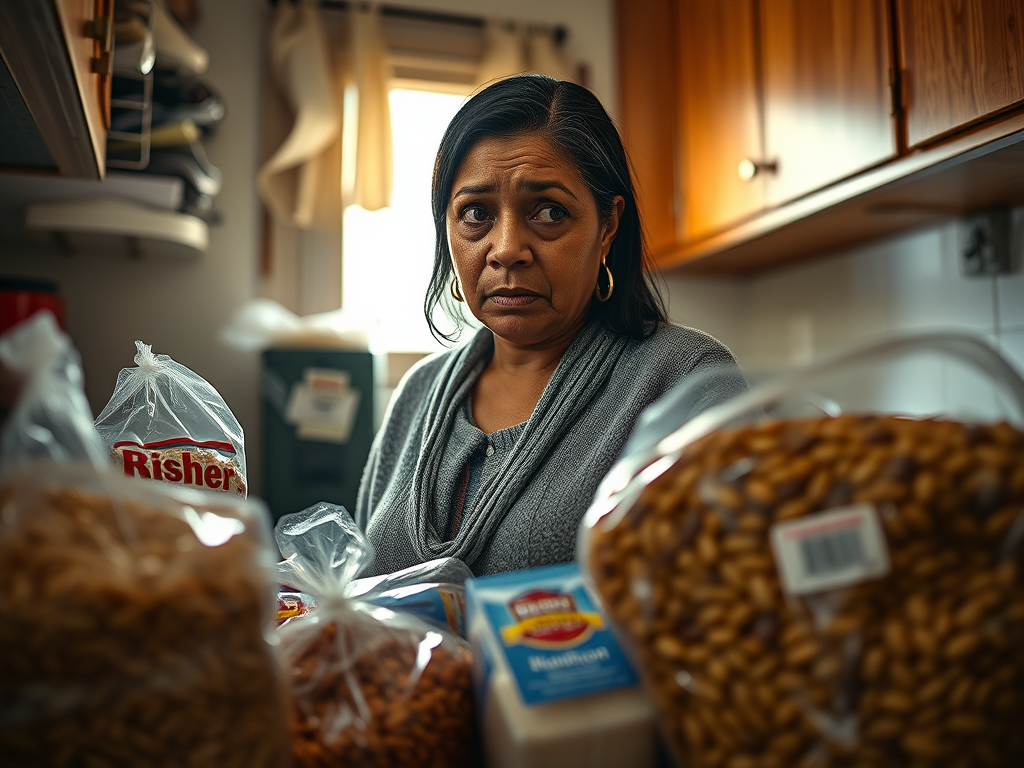

Irene Edwards, who lives in Anchorage, Alaska, began preparing weeks before November arrived. After hearing she might not receive her full food stamp benefits, she filled her pantry with bags of rice, dried beans, and other essentials. Although she lives alone, she also provides home child care and feeds two school-age boys and a toddler using assistance meant for a single adult.
When Nov. 1 came and the expected funds did not appear, Edwards immediately adjusted her routine. She cut back her own meals and skipped buying items that helped support her health needs, including electrolyte supplements she normally relied on because of anemia. “Halfway through October, I already started rationing,” she recalled.
Across the United States, more than 40 million low-income households have spent recent weeks uncertain about whether they would receive full support from the Supplemental Nutrition Assistance Program, or SNAP. That uncertainty has been particularly painful in Alaska and Hawaii, the two most expensive states for groceries.
Some states, including Hawaii, have directed state money to temporarily fill the gap while federal support remains at risk due to the government shutdown standoff in Washington. Negotiations between Democrats and Republicans hinted at progress, but for families already living on tight budgets, reassurance only comes when benefits actually arrive.
Federal data shows how much harder the situation is in Alaska and Hawaii. According to a recent USDA report, a “thrifty” food budget for a family of four in the continental United States requires about $999.50 per month. In Alaska, costs run nearly 28 percent higher. In Hawaii, grocery expenses are nearly 51 percent higher than the national average. At one Honolulu supermarket, a gallon of milk recently sold for $9.19.
Transportation explains much of the price difference. Gov. Mike Dunleavy has noted that 95 percent of Alaska’s food is shipped into the state, often delivered to Anchorage’s port by barge just a few times each week. New tariffs on goods imported from Mexico and Canada have added further strain.
In Southeast Alaska’s isolated towns scattered along fjords and islands, communities often rely on a single store stocked by barges. Dan Parks, executive director of the Southeast Alaska Food Bank, explained that while rural residents still hunt, fish, and harvest berries, imported staples remain essential. “Our emergency food system is fragile because the entire food system here is fragile,” he said.
The state pledged to roll out weekly SNAP support and coordinate with food banks, yet many families still did not know how much assistance they would ultimately receive for November. Edwards estimated she normally receives around $370 to $380 per month, but by the first weekend of November she had only received about half that amount — roughly $193.
Food banks have felt the pressure intensify. Even before the current disruption, Parks’ network had been strained by escalating food and freight prices. Donated goods and emergency supplies simply do not stretch as far.
Hawaii faces a similar challenge. The state imports between 85 and 90 percent of its food, according to its Department of Agriculture. “Grocery costs here are astronomical,” said Joseph Campos II, deputy director of the state’s Department of Human Services. Hawaii created a special fund to make up for missing federal benefits and guaranteed that November payments would be completed. Gov. Josh Green also directed $2 million to food banks.
Even with that support, Campos emphasized that most recipients still struggle by the end of each month. Future months remain uncertain. “The unpredictability is overwhelming,” he said.
On Hawaii’s Big Island, Julia Sativas, 32, has been waiting for her household’s usual $450 monthly SNAP deposit. As soon as the shutdown began in October, she tightened her diet to stretch what she had — sometimes consuming as little as 800 calories per day. She is grateful for assistance, she said, but the cost of living makes it difficult to survive even with help. A bag of chips can cost $8; a loaf of bread may reach $10. Even locally grown produce has become expensive as inflation affects farmers nationwide.
Sativas and her husband are planning to leave Hawaii altogether. “It’s just too expensive to stay,” she said.
The pressure is not limited to younger families. In Juneau, 87-year-old Sylvia Geraghty reported that she still had not received her November benefits. She hoped to delay grocery shopping as long as she could, relying instead on food she had frozen earlier in the season, potatoes from her garden, and eggs from her backyard chickens. Prices in Juneau run even higher than in Anchorage, she said, and a single supermarket trip can quickly drain her budget. “Everything arrives here by barge from Seattle,” she explained. “It adds up fast.”
Back in Anchorage, single mother Katherine du Plessis approached the uncertainty with a practical plan. Du Plessis, who holds a master’s degree in conservation biology, stocked up at Costco on durable foods: sardines, tuna, and seaweed — staples she and her daughter often eat. Though frightened by the situation, she tries to remain positive. She and other local SNAP recipients planned to gather for dinner to share ideas on how to stretch their resources and support one another as the crisis unfolds.
“I feel like change is coming,” she said softly, holding back tears.
The stories from Alaska and Hawaii are a vivid reminder that federal benefits are not just numbers on a budget line — they are meals, stability, and dignity for millions of Americans. For those living far from mainland supply chains, the impact of political gridlock is immediate and severe. Whether fresh support from Washington arrives soon or continues to lag, families across the Pacific and the Arctic are already confronting the consequences every time they open their refrigerator door.




Leave a Reply