
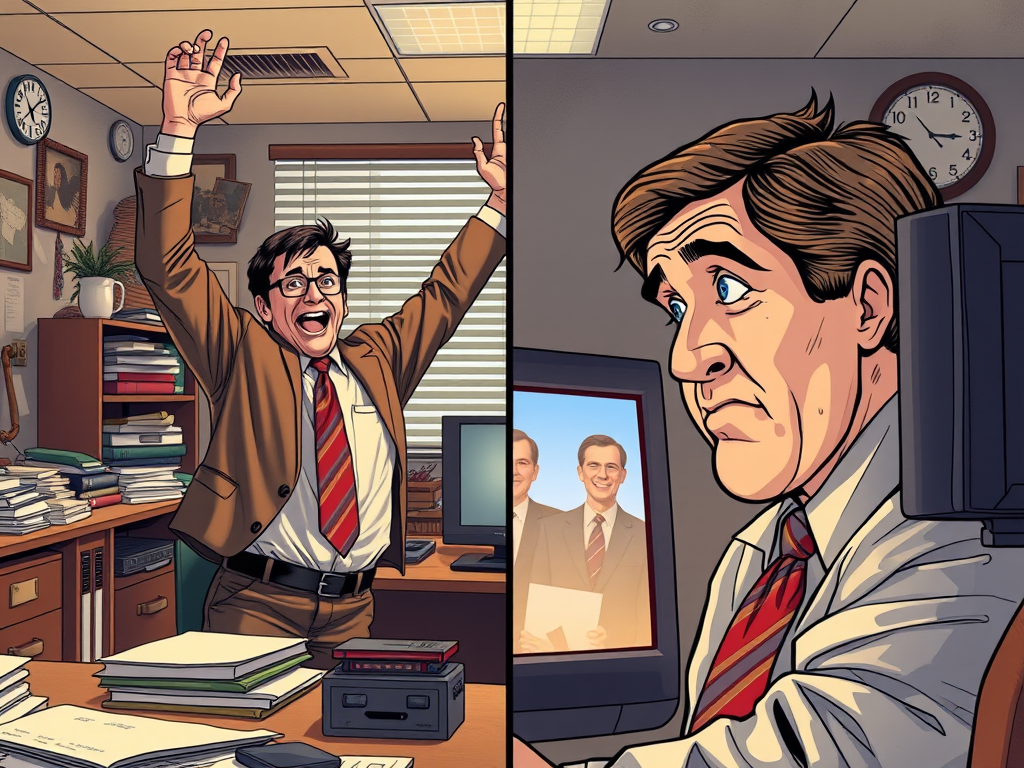
When late-night host Jimmy Kimmel was temporarily pulled off the air, the public conversation largely focused on free-speech debates, viewer backlash, and canceled streaming subscriptions. Yet one surprisingly odd subplot surfaced from the incident — a meme straight out of The Office.
In September, media reporter Brian Stelter asked FCC Chair Brendan Carr for comment on Kimmel’s suspension. Carr had earlier condemned Kimmel’s remarks after the assassination of Charlie Kirk, hinting that local ABC stations should intervene. Soon after, ABC affiliates did respond, and the network decided to pause Jimmy Kimmel Live!
Carr’s public reply? Not a statement or press note, but a GIF of Michael Scott and Dwight Schrute enthusiastically “raising the roof.” It was a strange moment in modern political communication — a government official reacting to a censorship controversy by channeling a famously blundering fictional manager and his overzealous assistant. It was even more peculiar given Carr’s subsequent claim that he never intended to encourage Kimmel’s removal. His earlier threat — “We can do this the easy way or the hard way” — could have easily been mistaken for something Dwight would send in a passive-aggressive office memo.
Still, the meme response felt oddly appropriate for the current political era, in which officials often deploy internet humor as part of their messaging strategy. And it highlighted a larger cultural truth: more than ten years after it ended, The Office remains the social internet’s common language.
Michael Scott’s exaggerated reactions serve as a shorthand emotional dictionary online — whether expressing joy, outrage, or dramatic disbelief. Type almost any feeling into a GIF search, and Steve Carell’s face usually appears somewhere in the results. Jim Halpert pointing to a whiteboard, Pam Beesly insisting two images are the same, Stanley Hudson rolling his eyes — these templates now fuel political commentary, personal jokes, and daily online banter.
Television has always influenced how society expresses itself. Media critic Neil Postman once argued that television became a central way Americans understand their own culture. Yet The Office stands out. It did not dominate ratings like Seinfeld, but its cultural footprint today is far larger, particularly online.
Timing played a role. The show aired between 2005 and 2013, just as social media platforms exploded. It later surged again through streaming — especially during the pandemic, when audiences turned to familiar comfort entertainment and nostalgic depictions of everyday office life.
Importantly, The Office’s mockumentary format gave it a unique edge. Characters acknowledge the camera, react to it, and even perform for it. This direct interaction created countless subtle expressions, glances, and awkward pauses — all perfect raw material for memes. Jim’s smirk feels like a private joke shared with the viewer; his gestures invite audiences to agree silently that the situation is absurd. During the 2024 vice-presidential debate, online observers even thought candidate JD Vance was mimicking the iconic Jim expression — a sign of just how deeply the gesture has embedded itself into the digital psyche.
The documentary-style camerawork also mattered. Quick zooms, sudden pans, and long cringe-filled shots allowed viewers to witness emotional moments up close — a style that seamlessly translates into micro-expressions ideal for reaction posts and short-form media.
One of the most recycled examples is the “Jim Halpert Explains” meme, pulled from a scene where Jim diagrams Michael’s misguided understanding of a pregnancy situation involving sperm donation. Online, the whiteboard became a universal canvas for arguments, punchlines, and sarcastic lessons about grammar, politics, philosophy, and more. The meme format allows users to step into Jim’s role — a clever coworker bursting the bubble of someone who takes themselves too seriously.
What makes all this even more fitting is that The Office was itself shaped by early internet culture. The series premiered the same year YouTube launched and regularly integrated viral trends into storylines — from parkour antics to the cast reenacting a famous viral wedding dance. In essence, The Office didn’t just become part of internet humor; it grew alongside it.
Today, the show’s references function almost like digital shorthand in professional and social settings. Once, office workers traded sitcom catchphrases or late-night monologue jokes. Now, a perfectly chosen Office GIF serves as the new universal language — a simple way to react, respond, or bond across chat apps and group threads.
If Michael Scott worked at a modern tech company, he would likely flood Slack channels with memes of his own face — and everyone would groan, laugh, and share them too. The truth is, many of us have already become a little bit like him — using humor, awkward sincerity, and meme shorthand to navigate the messy realities of work and communication.
In the end, The Office wasn’t just a sitcom. It quietly became the emotional operating system of the internet. And while Jimmy Kimmel’s temporary suspension will fade into news archives, the GIF that accompanied it stands as one more reminder: in the digital era, no press statement lands quite as powerfully as Michael Scott raising the roof.




Leave a Reply