
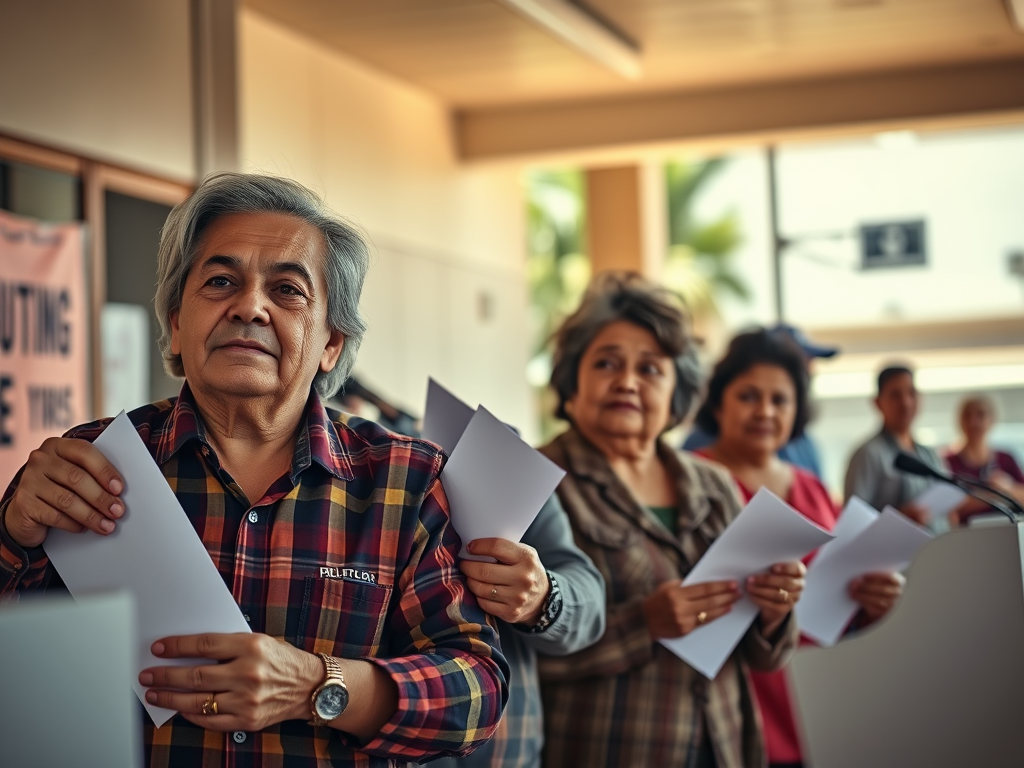
In Bell Gardens, a heavily Latino suburb in Southern California, the last few months have brought a wave of anxiety. Federal immigration raids have become a regular sight — masked agents detaining neighbors, families skipping their usual church services and market visits, and residents carrying passports everywhere, even those long since naturalized.
For 42-year-old Alo Hurtado, these tensions shaped how he approached this year’s special election. Instead of mailing in his ballot — the preferred method for many Californians — he went to a local polling station with his Mexican-born parents to vote early and in person. “Given what’s been happening here,” he said, “we need to make our voices heard.”
Across California, New Jersey, and several other states, elections are unfolding in an atmosphere thick with fear and frustration, especially in Latino neighborhoods targeted by federal immigration enforcement. The Trump administration’s intensified crackdown has injected uncertainty into the political process, with both parties closely watching how Latino voters will respond.
Fear and Determination Intertwined
Democratic organizers and Latino voting-rights advocates warn that immigration raids and the visible presence of federal monitors at polling stations could suppress turnout. The Justice Department’s announcement that it would deploy election observers in select counties of California and New Jersey has raised concerns about voter intimidation.
Yet early turnout data shows Latino participation largely matching historical trends. And in many cases, fear appears to be giving way to determination.
In Virginia, where Republican Lt. Gov. Winsome Earle-Sears is running for governor against Democrat Abigail Spanberger, immigration policy has become a flashpoint. Carlos Castro, a Salvadoran-born grocery store owner and naturalized citizen in Woodbridge, said immigration raids dominate conversations in his community. “We feel it every day,” he said. “It brings sadness — but it also reminds us why we have to vote.”
Elvis Cordova, a 49-year-old policy consultant in Alexandria, said he too planned to vote early for Spanberger. “Many of us came here fleeing authoritarian governments,” he said. “When we see rights eroding, we recognize the signs. That’s why this election matters.”
New Jersey’s Defiance
In New Jersey, where a fiercely contested governor’s race pits Republican Jack Ciattarelli against Democrat Mikie Sherrill, local leaders say federal monitoring won’t deter their communities. Passaic Mayor Hector Lora brushed off fears that Justice Department observers would keep voters away. “We’re Jersey,” he said confidently. “We show up. We vote. Our voices count.”
Nearby in Paterson — a city where Latinos make up more than 60 percent of the population — Mayor André Sayegh echoed that sentiment. “People aren’t scared,” he said. “They’re fired up. Voting feels like a way to push back.”
Federal officials have insisted that Immigration and Customs Enforcement (ICE) is not conducting operations near polling places. “If a dangerous criminal alien happens to be in the vicinity of a polling site, they may be apprehended,” the agency stated, “but enforcement actions are intelligence-driven.”
Despite these assurances, Latino communities remain wary. Memories of intimidation and profiling in previous decades linger, particularly in California, where laws strictly prohibit voter harassment at polling stations.
Political Stakes and Accusations
The Justice Department’s monitoring effort stems from complaints filed by Republican officials in both states. In New Jersey, they accused Democrats in Passaic County of blocking security cameras and refusing to maintain logs for workers handling mail-in ballots. In California, Republicans cited “irregularities” and alleged that local officials were failing to remove duplicate or ineligible voter registrations.
California’s attorney general, Rob Bonta, countered that these complaints lacked merit and said the federal government had no authority to interfere in state-run elections. State officials vowed to send their own monitors to ensure transparency — even monitoring the federal monitors themselves.

Some Latino conservatives dismissed the notion that immigration enforcement could suppress voter turnout. Rudy Melendez, a 57-year-old lighting technician in North Hollywood, said citizens have nothing to fear. “People vote if they want to vote,” he said. “If turnout is low, it’s because these off-year elections don’t grab people’s attention.”
Republican State Senator Suzette Martinez Valladares of Santa Clarita argued that any dip in participation would reflect frustration with state leadership rather than fear of federal action. “Latino voters have been clear — they want affordable living and safe neighborhoods. Sacramento hasn’t delivered,” she said.
The Power of the Latino Vote
Latinos have become one of the fastest-growing voting blocs in the United States, young, diverse, and increasingly influential. In 2024, economic frustration among Latino swing voters helped propel Donald Trump back to the White House. But his aggressive immigration policies — mass deportations, family separations, and high-profile ICE raids — have tested that support, even among naturalized citizens.
Despite repeated claims by the president that undocumented immigrants are voting illegally, no credible evidence has emerged to support those allegations. Advocacy groups say such rhetoric has fueled harassment and distrust.
Héctor Sánchez Barba, president of Mi Familia Vota, one of the country’s largest Latino civic engagement organizations, said his staff have faced growing hostility from right-wing activists. “Our canvassers have been followed, filmed, even harassed,” he said. “Now, with ICE vehicles in our neighborhoods, the intimidation is palpable.” His organization has had to boost spending on security and digital safety measures to protect volunteers.

California’s Ballot Battle
In California, about a quarter of all votes in statewide contests typically come from Latino voters. As of Sunday, roughly 18 percent of ballots counted — including early in-person and mail-in votes — had been cast by Latinos, a normal level given their tendency to vote closer to Election Day.
This year’s ballot also includes Proposition 50, a measure championed by Governor Gavin Newsom that would shift the power to draw congressional districts from the state’s independent commission to the Legislature. The move is widely seen as a response to Republican redistricting maneuvers in states like Texas. If approved, Proposition 50 could give Democrats as many as five additional seats in the U.S. House.
Newsom has openly criticized the Justice Department’s decision to deploy federal monitors in five California counties, calling it a “setup.” He warned that their presence could open the door to intimidation. “Once federal agents are there,” he said, “what’s to stop ICE or Border Patrol from showing up too?”
California has a long history of pushing back against anti-immigrant measures. In 1988, the state’s Republican Party settled a major civil rights lawsuit after uniformed guards were stationed at polling sites to deter Latino voters. That incident cost the party nearly half a million dollars and marked a turning point in California’s political landscape.

A Legacy of Resistance
For many Latino families, the current moment revives memories of earlier struggles. In Bell Gardens, Hurtado’s 65-year-old mother, Josefa Rivera, recalled how she became a U.S. citizen after California voters passed Proposition 187 in 1994 — a controversial measure aimed at denying public services to undocumented immigrants. The courts later struck it down as unconstitutional.
“This feels worse,” Rivera said in Spanish. “But we’ve been through this before. We vote because that’s how we fight back.” She said she cast her ballot for Proposition 50 — not just for herself, but for the undocumented neighbors who can’t vote. “Someone has to speak for them,” she added.
As federal raids continue and the political rhetoric intensifies, one thing has become clear: fear alone will not silence these communities. Across California, New Jersey, and beyond, Latino voters are turning anxiety into activism, showing that even amid intimidation, their voices remain vital — and their votes, decisive.




Leave a Reply