
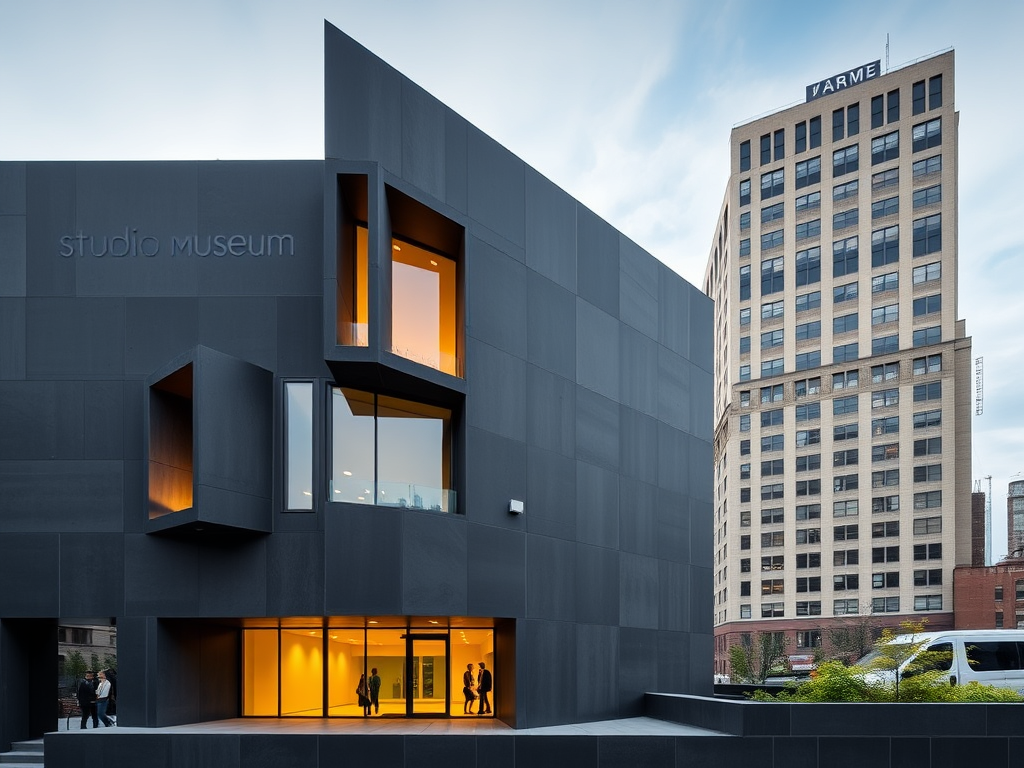

On West 125th Street in Harlem, a striking new landmark now commands attention — the redesigned Studio Museum. Cloaked in rich shades of charcoal and gray, its bold, sculptural façade of layered niches and frames forms a rhythmic composition reminiscent of a Mondrian painting. Against the backdrop of the towering Adam Clayton Powell Jr. State Office Building across the street, the new museum stands firm and confident, its polished and matte surfaces shifting subtly with the changing light.
The building itself is more than an architectural statement — it’s a powerful meditation on the many expressions of Blackness, articulated through the language of concrete and light.
Founded in 1968 by a visionary group of artists and philanthropists, the Studio Museum began humbly, occupying a loft above a liquor store. By the early 1980s, it relocated into a gifted former bank building, a relic of the Depression era that lacked modern wiring and air conditioning. Renowned Black architect J. Max Bond Jr., a Harlem native, transformed the space on a limited budget, creating a home for pioneering exhibitions. Yet, like many Black institutions of its time, the museum had to operate with modest means and great resilience.
The new $160 million Studio Museum marks a historic leap forward. Rising seven stories on the same site where the old bank once stood, the building doubles the museum’s exhibition capacity and finally provides the world-class facilities the institution long deserved.
Inside, there are purpose-built classrooms for school programs, state-of-the-art studios for artists-in-residence, an expansive library, and a dramatic central staircase that connects the building’s floors like a sculptural artery of movement and community. The design also includes versatile meeting rooms for neighborhood groups, reinforcing the museum’s deep ties to Harlem’s civic and cultural life.
From the rooftop garden designed by the Harlem-based landscape firm Studio Zewde, the panoramic view tells a story of two cities: to the north, the South Bronx stretches beyond the YMCA tower on 135th Street; to the south, the gleaming skyscrapers of Midtown rise above Harlem’s historic brownstones. At this vantage point, the museum feels not on the margins of Manhattan, but at its very heart.
The journey to completion was far from easy. The pandemic stalled construction for months, and the project’s total timeline spanned seven years. A separate scandal involving lead architect David Adjaye — who withdrew after allegations of misconduct — left the museum and its design partners navigating a sensitive transition. Despite these hurdles, the institution persevered, a testament to Harlem’s enduring capacity to transform adversity into progress.
The Studio Museum’s director, Thelma Golden — one of the most respected voices in the art world — led a remarkable fundraising campaign that secured $307 million. For a relatively small cultural organization with no endowment at the project’s start, this achievement was unprecedented. The funds not only financed construction but also provided operational support throughout the seven-year build, established a $23 million cash reserve, and seeded a $52 million endowment to ensure long-term stability.

As the museum prepares to open its doors on November 15, it arrives at a Harlem that has changed dramatically since its early days. Across 125th Street, the Urban League Empowerment Center now combines offices, affordable housing, and even a Trader Joe’s and Target. Nearby, the Apollo Theater is undergoing a major renovation and expansion into the former Victoria Theater, while the National Black Theatre has partnered in a new mixed-use tower.
These developments would have seemed unimaginable in the 1960s, when Harlem faced economic decline and mass displacement. At that time, the state government demolished entire blocks of 125th Street, promising jobs and progress that rarely reached local residents. In protest, Harlemites occupied the demolition site, establishing a tent city they called “Reclamation Site No. 1,” complete with a field kitchen and child care — an early echo of the Occupy Wall Street movement decades later. Although the protest was eventually cleared, it ignited a lasting conversation about who controls Harlem’s future.
In the years that followed, Harlem’s leaders envisioned development that would empower the Black community through ownership and opportunity. By the 1990s, organizations like the Abyssinian Baptist Development Corporation — under Reverend Calvin O. Butts III — began leading that charge, developing schools, affordable housing, and community infrastructure along 125th Street. Their efforts redefined gentrification not as an outside invasion, but as a project driven by local visionaries determined to shape their own destiny.
Yet, the results remain complex. Harlem now has big-brand grocery stores and banks, but also rising rents and a shifting demographic landscape. Median rents in Central Harlem have increased by more than 20 percent since 2006, according to the NYU Furman Center. While new opportunities have arrived, long-time residents continue to grapple with fears of displacement.


Darren Walker, who once served as COO of the Abyssinian Development Corporation and later led the Ford Foundation, sees the Studio Museum’s new building as part of a broader movement toward reclaiming Black cultural power. “For too long,” he says, “Black institutions were told to make something out of nothing. Ambitions were minimized, and resource scarcity was treated as normal.” The new museum, he argues, is a defiant answer to that history — an institution refusing to compromise on excellence.
Architecturally, the project represents a collaboration between Adjaye Associates, Cooper Robertson, and structural engineer Guy Nordenson. After Adjaye’s departure, architects Pascale Sablan and Erin Flynn guided the project to completion. Flynn, also the executive architect for the Princeton Art Museum, helped ensure continuity and precision in realizing the museum’s ambitious vision.
The result is a structure that feels rooted in Harlem’s identity yet distinctly global in its sensibility. The concrete lobby, austere at first glance, transforms into an inviting urban living room once filled with visitors and art. The glass-front entrance opens directly onto 125th Street, inviting the public to enter, ascend the sculptural staircase, and linger on the bleacher-like seating that flows into the café — a modern interpretation of Harlem’s stoops and gathering spaces.
The museum’s first exhibition in the new building pays homage to its origins. In 1968, the inaugural show featured Tom Lloyd, a Queens-born artist whose colorful, light-based sculptures challenged the notion that abstraction was “white art.” Lloyd insisted that Black art was defined by Black artists themselves — a philosophy that became the Studio Museum’s guiding principle. The reopening exhibition revisits Lloyd’s work in a dramatic double-height gallery with a barrel-vaulted ceiling that echoes Harlem’s historic churches, reinforcing the connection between spiritual life and artistic creation.


Throughout construction, Golden and her team made a conscious effort to stay connected to their community, regularly informing residents about road closures, crane operations, and building progress. “Why wouldn’t we tell people what’s happening?” Golden remarked when asked about the outreach. “These are our neighbors. We live here.”
As the Studio Museum in Harlem enters this new era, it embodies more than a triumph of architecture or fundraising. It stands as a declaration — that Black creativity, culture, and community deserve spaces as grand and enduring as any in the city. From its luminous staircases to its skyward garden, the museum reclaims its place not just in Harlem’s skyline, but in the story of New York itself.




Leave a Reply