
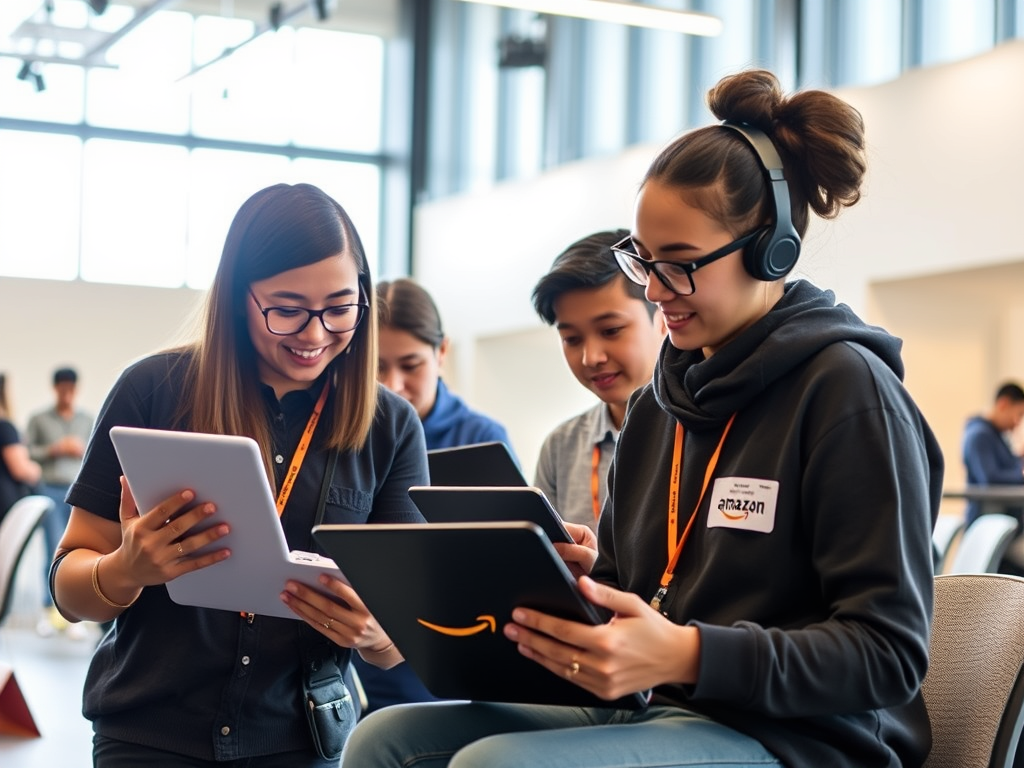

On the opening day of A.I. Camp, a newly launched summer program at California State University, Savannah Bosley was introduced to Amazon Bedrock, a platform for developing artificial intelligence applications.

“I thought it would be useful to add to my résumé and pick up a new, potentially marketable tool,” said Bosley, a recent computer science graduate from California Polytechnic State University in San Luis Obispo.
The five-day program, hosted on the Cal Poly campus and supported by Amazon Web Services, attracted dozens of students. Participants received Amazon-branded notebooks and pens, completed exercises through AWS Jam—a hands-on training app for A.I. skills—and listened to Amazon representatives discuss company principles like “Think Big.”
“I felt like it was a bit like a timeshare presentation,” Bosley, 25, said. “You get the benefits, but also the sales pitch.”
California State, the largest public university system in the U.S. with 460,000 students, has recently launched a public-private initiative involving major tech firms such as Amazon, OpenAI, and Nvidia. The goal is to position the system as the nation’s “first and largest A.I.-enabled” university. This includes providing generative A.I. tools, which can create human-like text and images, across all 22 campuses, integrating chatbots into teaching, and preparing students for increasingly A.I.-driven careers.
As part of the initiative, Cal State is paying OpenAI $16.9 million to offer ChatGPT Edu to over half a million students and staff—described by OpenAI as the world’s largest ChatGPT rollout. An A.I. advisory committee, including representatives from a dozen top tech companies, has been formed to identify the skills California employers need and improve students’ career readiness.
This partnership illustrates a broader trend in the U.S., where universities are inviting tech companies to play an expanded role beyond providing computers and email. These firms are now contributing as educational advisors, curriculum developers, and A.I. instructors.

Critics caution that this growing influence could compromise academic independence. There is limited evidence that widespread A.I. use in education improves learning outcomes, and concerns are rising about chatbots spreading misinformation and weakening critical thinking skills.
Amazon representatives emphasize that their goal is to support students in applying A.I. in diverse ways, rather than merely using chatbots to look up answers. “Students still need to develop problem-solving abilities, strategic thinking, and communication skills,” said Kim Majerus, Amazon Web Services’ vice president for global education.
Cal State’s initiative is part of a wider push. Recently, California Community Colleges partnered with Google to provide advanced A.I. tools and training to 2.1 million students and staff. Microsoft has pledged $4 billion toward teaching A.I. skills in schools, colleges, and adult education programs.
However, some experts warn these efforts resemble a large-scale experiment on young people. Since the 2022 introduction of ChatGPT, students have increasingly relied on chatbots, sometimes for cheating, leaving schools grappling with responsible usage policies.
“Universities are not tech companies,” said Olivia Guest and Iris van Rooij, computational cognitive scientists from Radboud University in the Netherlands. “Our role is to foster critical thinking, not to follow industry trends uncritically.”
The initiative at Cal State was partly driven by feedback from tech companies, which expressed concerns that local students lacked essential A.I. skills. “California’s A.I. leaders complained we weren’t adequately preparing students for the workforce,” said Edmund Clark, Cal State’s chief information officer.

The university launched its comprehensive A.I. plan in February, envisioning a central role for big tech in creating a system that surpasses any existing model in both scale and impact. Some faculty members, however, have raised concerns. They argue that the multimillion-dollar OpenAI deal, which was not opened to competitive bidding, could be wasteful, especially amid budget cuts. Several campus senates have criticized the initiative for overlooking the risks of student misuse of chatbots and ignoring labor and environmental concerns associated with the tech industry.
“This isn’t a true partnership,” said Martha Kenney, a professor of women and gender studies at San Francisco State University. “If you replaced the product, no one would say a photocopier company is collaborating with the university to supply its equipment as a learning tool.”
University officials defend the program. Jason Maymon, a Cal State spokesman, said the institution has a responsibility to equip students and faculty for rapid technological changes. “Like the rise of the internet, artificial intelligence is another technological revolution. Higher education cannot simply observe from the sidelines,” he said. Clark added that the university plans to teach students to critically evaluate A.I., with an external firm assessing the initiative’s effectiveness.
The A.I. camp at Cal Poly, part of Cal State’s broader effort, allowed students from multiple campuses to collaborate on practical challenges. Originating from the Digital Transformation Hub (DxHub), the camp brings together students and Amazon employees to develop apps for nonprofits and government agencies. Projects included streamlining campus administration, such as assigning transfer students to appropriate math courses.

Despite their varied majors—from computer science to zoology—all 80 students, representing 19 campuses, shared a common goal: acquiring A.I. career skills. “Focus on solving real problems for real people, not chasing shiny technology,” advised instructor Matteson.
Student teams applied their learning in competitions, such as designing a video game gatekeeper character using Amazon Nova. “I never built an A.I. before,” said Dianella Sy, 20, a computer science student at Cal State Fullerton. Later, students viewed a futuristic demonstration by A.I. start-up Matter and Space, which envisioned wearable A.I. devices monitoring health and activity, prompting some to draw comparisons to the dystopian series “Black Mirror.”
Other projects focused on concrete campus challenges. One team developed a prototype app to automatically evaluate vendor proposals for procurement processes. Graduate student Arash Peighambari, who previously worked on an A.I. system for power grid monitoring, noted the camp’s practical orientation. “This is much more client- and product-focused,” he said.




Leave a Reply