
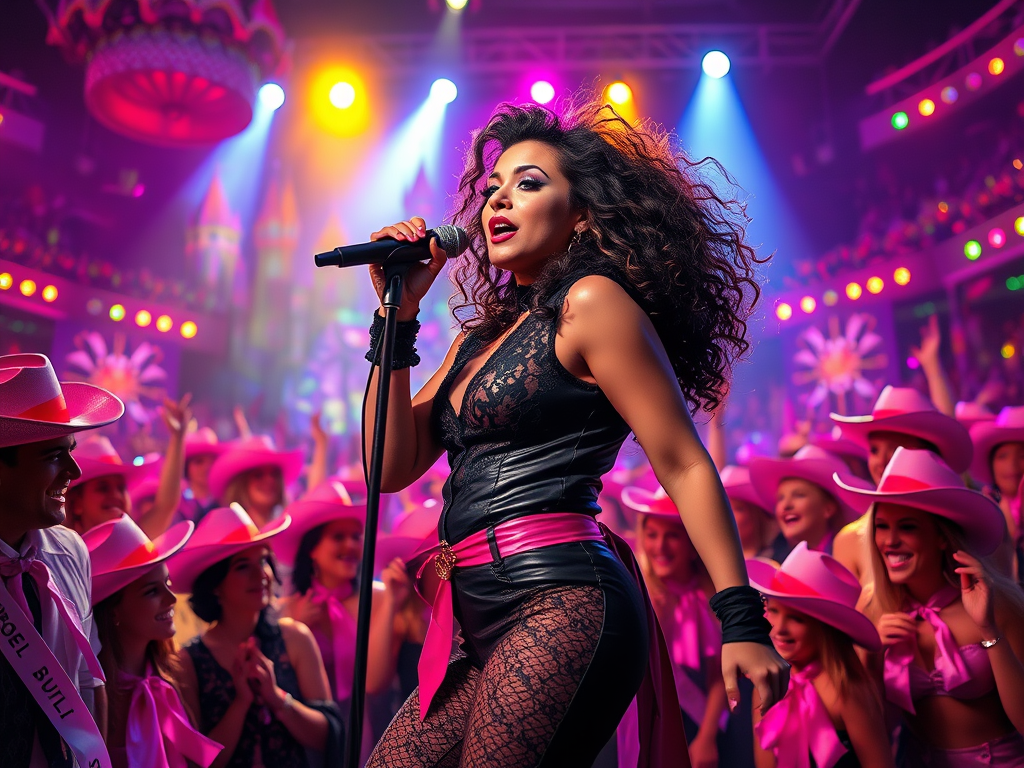

At Forest Hills Stadium in Queens, where more than 13,000 fans packed the venue for the second of four consecutive sold-out nights, Chappell Roan stood before the crowd and admitted something unexpected. The 27-year-old singer, who has become one of pop music’s most magnetic new stars, leaned into the microphone and confessed: “I didn’t ever think I’d get this big.”
For an artist who often performs with commanding flair and a sense of limitless ambition, the remark struck many as surprisingly vulnerable. Yet for longtime fans, it was a familiar glimpse of the honesty and intimacy that Roan has intentionally nurtured throughout her career. She explained that fame comes with pressures to conform, but quickly reminded herself and her audience that she doesn’t have to accept every expectation that comes with success. The roar from her fans—many dressed in pink cowboy hats, satin sashes, and other playful nods to her style—was proof that her authenticity continues to resonate.
A Tour Designed on Her Own Terms
Roan’s four Queens shows marked the launch of the U.S. leg of her Visions of Damsels & Other Dangerous Things tour. Unlike the typical career trajectory of a breakout star, which often involves jumping straight into arenas and international runs, this tour was deliberately smaller and more personal. Rather than booking massive stadiums, she crafted eight “pop-up shows” across just three cities: New York, Kansas City, and Los Angeles. Her explanation was simple—this was a chance to connect deeply with fans before retreating to focus on writing her next album.
The shows felt less like a preview of what comes next and more like a celebratory encore for her 2023 album The Rise and Fall of a Midwest Princess. That record, a vivid narrative of queer identity, self-discovery, and romance, transformed Roan from an underground artist into one of the most closely watched names in modern pop. While the album leaned into glossy synth-pop, her live performance revealed a bolder rock influence, with her all-female band amplifying the intensity of every track.

A Theatrical Stage Presence
On stage, Roan’s presence was unmistakable. Dressed in a lace-printed leather two-piece, dramatic makeup, and voluminous curls, she embodied the energy of an ’80s music video icon. Her sets drew inspiration from Harlequin novels and medieval fantasy, complete with gothic castle backdrops and costume changes. At one show, her cover of Heart’s “Barracuda”—performed alongside Nancy Wilson herself—cemented her as more than a rising pop act. She was declaring herself a rock star in her own right.
Her catalog translated seamlessly to the live stage. Songs like “Hot to Go” built layers of tension before erupting into anthemic choruses, while “My Kink Is Karma” exploded with pounding percussion and raw emotion. During “Pink Pony Club,” the night’s finale, Roan hardly needed to sing at all—the audience’s voices filled the stadium with a collective celebration of freedom and identity.
The Long Road to Breakthrough
What makes Roan’s current moment even more remarkable is how long it took to arrive. When Midwest Princess was first released, it sold modestly, with little industry buzz. But 2024 marked a turning point. Opening for Olivia Rodrigo introduced her to wider audiences, her NPR Tiny Desk performance went viral, and her electrifying set at Coachella became a career-defining moment. By the time she performed “Pink Pony Club” at the Grammys, industry heavyweights who barely knew her name a year earlier were standing, clapping, and singing along.
Her Forest Hills set list underscored her confidence in her debut. While many artists rush to release deluxe editions or expanded reissues, Roan has resisted that temptation. Despite the potential commercial payoff, she hasn’t re-packaged her album with filler tracks. Instead, she’s released only a handful of new singles: “Good Luck, Babe!,” the playful “The Giver,” and the haunting breakup ballad “The Subway.” Each song feels carefully chosen, a reflection of her commitment to quality over quantity.

Protecting Her Mental Health
This measured pace is also strategic. Roan has been outspoken about prioritizing her mental health, even when it means stepping back from high-profile opportunities. Forest Hills, in fact, carried added weight because it was the site of the All Things Go Festival she withdrew from the previous year. That decision, met with both criticism and admiration, showed that she values her well-being above career optics—a rarity in an industry often driven by relentless growth.
Rather than chasing endless momentum, Roan is learning how to scale her career sustainably. She doesn’t seem interested in fame for fame’s sake. Instead, she is building a foundation designed to last, even if it means moving slower than the industry might expect.
A Study in Contrasts
Her approach stands in contrast to fellow pop star Sabrina Carpenter, who has chosen a more accelerated strategy. Carpenter released Man’s Best Friend just a year after her Grammy-winning Short n’ Sweet. While the new album delivered catchy singles like “Manchild,” critics noted it lacked the depth of its predecessor, raising questions about oversaturation. Carpenter benefits from staying top of mind and quickly filling arenas, but the risk is artistic burnout.
Roan, by comparison, is betting on patience. The longer she takes to release her second album, the greater the anticipation grows. Yet judging from her sold-out shows, fans are willing to wait.
Live Highlights That Cement Her Star Power
At Forest Hills, two new songs hit particularly hard. “The Giver” energized the crowd with its playful call-and-response rhythm, while “The Subway” offered a moment of raw vulnerability, highlighting the emotional range of Roan’s voice. Another standout was “California,” a track from Midwest Princess that reflects the uncertainty of chasing a music career. Performed in a packed stadium, the lyrics took on new meaning: Roan had waited years for her breakthrough, and now it was finally here.

Growing at Her Own Pace
Chappell Roan’s journey represents a new blueprint for pop stardom—one that doesn’t depend on instant chart domination or constant content churn. Instead, she is showing that authenticity, careful pacing, and commanding live performances can create just as much impact, if not more.
Her rise proves that in today’s music landscape, success isn’t just about streaming numbers or quick releases. It’s about building a lasting connection with fans, protecting one’s creative spirit, and knowing when to step back in order to move forward.
At Forest Hills, as thousands of voices echoed her lyrics back to her, Roan looked like an artist fully in control—not of the industry’s expectations, but of her own path. She waited for her moment, and now she’s shaping it on her terms. The result is not just a pop star on the rise, but a performer redefining what it means to succeed in modern music.




Leave a Reply