
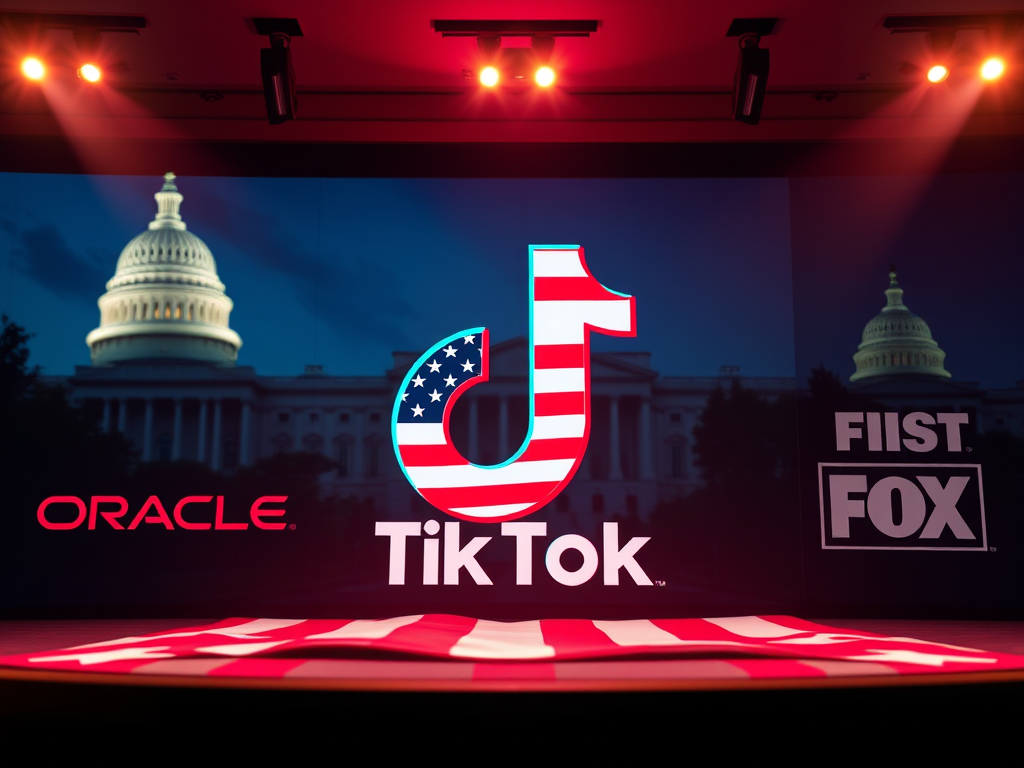

President Donald Trump has taken a decisive step in reshaping the future of TikTok in America. On Thursday, he signed an executive order that paves the way for a coalition of investors to establish a U.S.-controlled version of the popular short-video platform, breaking it away from its Chinese parent company, ByteDance. The move, if completed, would allow TikTok to continue operating in the United States while addressing national security concerns that have surrounded the app for years.
The administration has been negotiating for months to secure non-Chinese investment in TikTok’s American operations. According to Vice President JD Vance, the proposed U.S. entity could be valued at $14 billion, a figure that falls far short of ByteDance’s peak valuation but still represents one of the most high-profile tech restructurings in recent history.
A Response to National Security Law
This deal is designed to bring TikTok into compliance with federal law. In January, the U.S. formally banned the app due to fears that Beijing could use it to access sensitive information about American citizens or influence public opinion through algorithm-driven content distribution. Although Mr. Trump has repeatedly delayed enforcement of the ban, the latest executive order sets a hard deadline: negotiators must finalize a deal by mid-January.
Under the law, the president has the authority to determine whether any arrangement constitutes a “qualified divestiture.” Trump’s order states that the investor coalition’s proposal meets the legal threshold, as ByteDance would be reduced to holding less than 20 percent ownership in the restructured entity.

Who Will Own U.S. TikTok?
The White House has not released an official list of investors, but several names have emerged as central players. Oracle, the software giant founded by billionaire Larry Ellison, is set to take a substantial stake. Media mogul Rupert Murdoch is reportedly involved through Fox Corporation, and other high-profile investors are under consideration, including Michael Dell, chief executive of Dell Technologies.
What surprised many observers is the expected participation of MGX, an Emirati investment firm. Trump had initially emphasized that the coalition would be composed of “American investors, American companies, great ones, great investors.” The inclusion of MGX demonstrates the global scale of the deal, as well as the complex ties between U.S. politics, international finance, and technology.
If the transaction goes through, it would resolve years of uncertainty surrounding TikTok, which has more than 170 million American users. The platform has been a point of contention for both lawmakers and users: policymakers worried about China’s influence, while users feared losing access to one of the most popular apps in the world.
A Lower Valuation but Bigger Stakes
The $14 billion valuation for U.S. TikTok is significantly lower than ByteDance’s estimated $300 billion valuation, according to data from CB Insights. Yet this lower price reflects the political risk surrounding the company and the urgency to secure a solution that satisfies national security concerns.
For MGX, this is just the latest in a string of large-scale investments tied to the Trump administration. The firm previously deposited $2 billion into a cryptocurrency start-up linked to the Trump family. In parallel, the United Arab Emirates pledged to inject $1.4 trillion into the U.S. economy over the next decade.
The Emiratis are also pursuing broader technology ambitions, particularly in artificial intelligence. Earlier this year, Trump’s administration approved the sale of 500,000 AI chips to Abu Dhabi, enabling the construction of one of the world’s largest data center campuses. Oracle, notably, is also involved in building a $20 billion data center in the UAE, with investment firm Silver Lake holding a stake through its ties to G42, an Emirati AI company.
Political and Ethical Concerns
Although the TikTok deal is moving forward, it is not without controversy. Two Democratic senators have called on inspectors general at the Commerce and State Departments to investigate whether Trump officials violated ethics rules during negotiations with Emirati representatives. Critics question whether parallel deals involving AI chips and data center investments influenced the TikTok negotiations.
The executive order stipulates that ByteDance will license its algorithm to the new U.S. entity. Oracle, MGX, and Silver Lake are expected to jointly control roughly 45 percent of the company, while other investors would hold smaller stakes. Oracle, in particular, is positioned to manage and protect U.S. user data, a key priority for the administration.
Despite these safeguards, skepticism remains. John Moolenaar, chairman of the House Select Committee on China, expressed concern that the licensing arrangement could still allow Beijing to exert influence. Similarly, Michael Sobolik of the Hudson Institute questioned the administration’s assurances, noting that the executive order emphasizes “intense monitoring” of software updates, algorithms, and data flows. “Monitoring the algorithm is not the same as controlling it,” Sobolik argued, suggesting that oversight may not eliminate the risk of foreign interference.
China’s Position and the Road Ahead
Interestingly, Trump has claimed that Chinese President Xi Jinping has agreed to the framework of the deal. While a Chinese state-run news agency confirmed discussions, its readout was notably vague, merely signaling support for a “commercial solution.” This leaves open questions about how Beijing views the forced divestiture of one of its most successful global tech exports.
Still, the executive order provides a path forward: TikTok will be majority-owned and controlled by U.S. investors, ByteDance’s stake will fall below 20 percent, and foreign adversaries will no longer have operational control. Whether this framework can fully satisfy both U.S. lawmakers and TikTok’s massive user base remains uncertain.
The Bigger Picture
The unfolding TikTok saga highlights broader issues at the intersection of technology, geopolitics, and economic security. On one hand, it underscores Washington’s determination to reduce dependence on Chinese technology firms. On the other, it illustrates how Middle Eastern capital is increasingly shaping the U.S. tech landscape, often intersecting with sensitive political interests.
TikTok’s future now rests on the ability of investors and policymakers to finalize terms that withstand political scrutiny and public skepticism. The outcome could set a precedent for how the U.S. manages foreign ownership of digital platforms in the future.
For now, what is clear is that TikTok’s American users, numbering over 170 million, are waiting anxiously. The app has become a cultural staple, a marketing engine for small businesses, and a political flashpoint. If Trump’s plan succeeds, TikTok may not only survive in the U.S. but also become a symbol of how political power, financial capital, and digital culture collide in the modern era.


Leave a Reply