
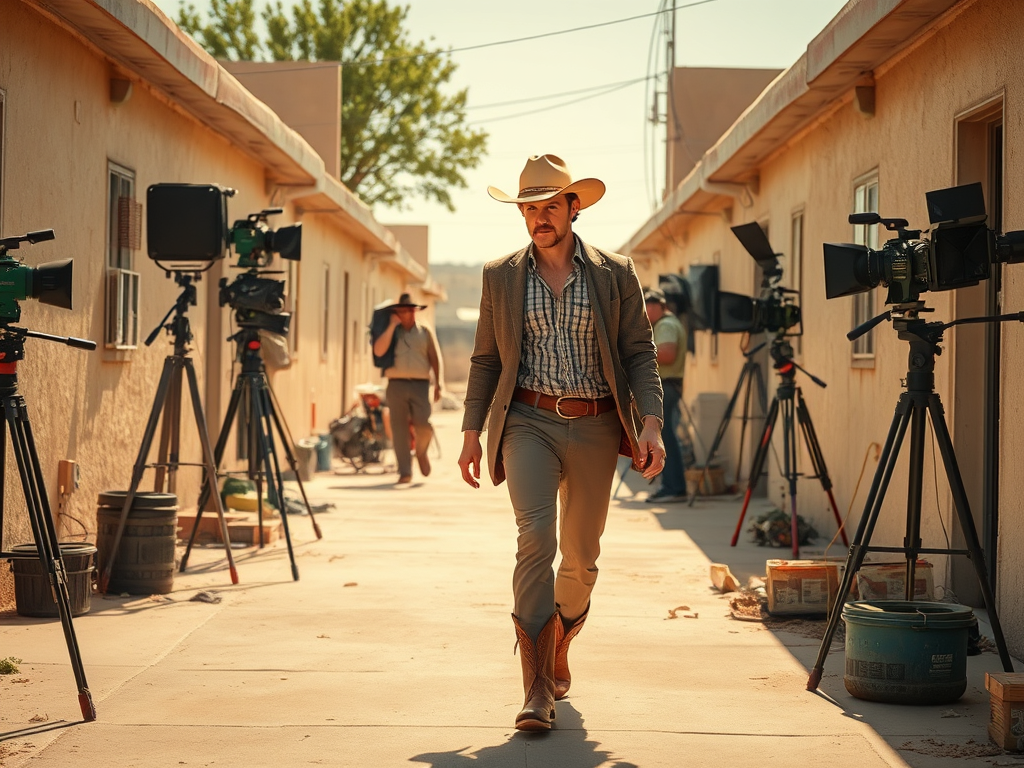

On a sweltering afternoon in Tulsa, Oklahoma, a man in slim-cut trousers and cowboy boots walked briskly through a modest apartment complex transformed into a television set. His wide-brimmed hat carried a rattlesnake band, the tail dangling as he moved with the swagger of someone stepping straight out of a modern-day Western. The figure was none other than Ethan Hawke, who now takes on the role of Lee Raybon, an unrelenting journalist in FX’s new crime series The Lowdown.
Behind him, production crews scurried with cameras, lighting equipment, and radios buzzing in the background. From the outside, it looked like organized chaos, but this scene marked the heart of a highly ambitious project—one that represents not only a new chapter in Hawke’s career but also the creative evolution of showrunner Sterlin Harjo, the acclaimed mind behind Reservation Dogs.
A Crime Drama Set in the Soul of Tulsa
The Lowdown premiered on FX on September 23, followed by streaming availability on Hulu. The eight-episode drama blends hardboiled crime storytelling with Harjo’s personal connection to Tulsa, the city he has called home for nearly two decades.
Hawke’s character, Lee Raybon, is a self-proclaimed “truthstorian”—a relentless muckraker determined to uncover hidden power dynamics and unsolved mysteries, even at the cost of his own safety. His investigation centers on the suspicious death of a figure tied to one of Tulsa’s wealthiest families, pulling him deeper into webs of corruption, betrayal, and long-buried history.
The role gives Hawke a chance to reinvent himself on screen. With scars painted across his face during filming, his physical transformation mirrors the emotional bruises of a man who refuses to stop digging for the truth.
Alongside him is veteran actor Graham Greene, who appears in one of his final roles before his passing. The presence of Greene—beloved for decades across both Native and mainstream cinema—added a layer of poignancy to the production, reminding cast and crew of the legacy Harjo carries forward.

From Reservation Dogs to a Bigger Stage
Sterlin Harjo is no stranger to acclaim. With Reservation Dogs, which aired from 2021 to 2023, he broke new ground by telling deeply authentic Native stories from Oklahoma, co-created with Taika Waititi. While the show never dominated in ratings or awards (it received five Emmy nominations but no wins), it captured the hearts of critics and fans, earning multiple Peabody Awards and cementing Harjo’s reputation as one of television’s most original voices.
That success has now given Harjo the opportunity—and pressure—to follow up with something larger in scope. Whereas Reservation Dogs focused on rural life and the bonds of a close-knit Native community, The Lowdown expands into the urban sprawl of Tulsa. “If Rez Dogs was the rural,” Harjo explains, “this is the city.”
This shift brings new challenges. Unlike his earlier show, where executives had little precedent to offer creative “notes,” The Lowdown is rooted in the crime noir genre—territory where every Hollywood insider has an opinion. Yet Harjo embraces this challenge, infusing the series with his love of Jim Thompson’s gritty storytelling and the languid pacing of Robert Altman’s The Long Goodbye.

A Star-Studded Cast with Oklahoma Roots
FX has invested heavily in the project, securing a lineup of established talent. In addition to Hawke and Greene, the ensemble includes Keith David, Kyle MacLachlan, Jeanne Tripplehorn, Tim Blake Nelson, and Tracy Letts—three of whom hail from Oklahoma themselves.
Tripplehorn, who grew up in Tulsa, described the experience as particularly meaningful: “What’s great about the show is you don’t have to be from Tulsa to appreciate it. But if you are, it feels incredibly personal.”
The series was shot across more than 30 Tulsa locations, turning everyday streets and historic corners into cinematic backdrops. Harjo and his design team filled the set with Easter eggs paying homage to the city’s artistic past. A diner called Sweet Emily’s nods to singer-songwriter Leon Russell, a central figure of the Tulsa Sound. Subtle details reference Reservation Dogs, Francis Ford Coppola’s Rumble Fish, and Larry Clark’s provocative photography book Tulsa.
These layers of intertextuality transform the show into both a noir mystery and a love letter to the city itself.

The Legacy of Lee Roy Chapman
While the show is fictional, its central character draws inspiration from real Tulsa activist and journalist Lee Roy Chapman. Known for calling himself a “history recovery specialist,” Chapman spent years uncovering forgotten or deliberately hidden chapters of the city’s past. His investigations brought renewed attention to the 1921 Tulsa Race Massacre, in which white mobs destroyed the thriving Black community of Greenwood, killing hundreds. Chapman also revealed connections between prominent city founder W. Tate Brady and the Ku Klux Klan, forcing Tulsa to publicly grapple with its historical legacy.
Harjo worked with Chapman during his time at This Land Press, a short-lived but influential Tulsa publication. After Chapman’s death in 2015, his mission continued through the Center for Public Secrets, run by his sister. By channeling Chapman’s spirit into the fictional Lee Raybon, Harjo ensures that the pursuit of truth—and the discomfort it brings—remains at the heart of the narrative.

Confronting History in the Age of Misinformation
The choice to root The Lowdown in Tulsa’s complex past feels timely. As debates over how history is taught and remembered intensify across the United States, the series becomes more than entertainment—it is a cultural statement.
Actor Keith David, who plays a private investigator in the series, sees it as essential storytelling: “The more attempts there are to cover things up, the more the truth demands to be revealed. That’s what makes The Lowdown powerful. It reminds us that truth survives.”
This urgency resonates in an era where misinformation spreads rapidly online and historical narratives are politicized. Harjo uses noir conventions—mystery, corruption, moral ambiguity—not only to entertain but also to highlight the stakes of uncovering truth in any generation.
Balancing Personal and Universal Stories
Although The Lowdown is not exclusively a Native-centered story, Harjo’s personal experiences subtly shape the show. One subplot mirrors his own life as a young father navigating shared custody, grounding the larger-than-life noir atmosphere with intimate emotional stakes.
At the same time, Harjo resists being typecast. “There’s no reason for Sterlin to be boxed in where every piece of art he makes has to be about his heritage,” Hawke said during production. “But because he cares so deeply about his community, it always finds its way in.”
This balance allows The Lowdown to be both universal and specific—a story anyone can connect to, but one that still reflects the texture of Harjo’s Oklahoma roots.

A Noir for Modern Times
Noir has always thrived on shadows—secrets hidden beneath polite society, corruption lurking behind closed doors. In The Lowdown, Harjo uses the genre not only to explore Tulsa’s contradictions but also to ask timeless questions: Who controls history? Who gets to tell the truth? And what happens to those who challenge the official narrative?
Hawke’s Lee Raybon embodies these tensions. He is beaten, scarred, and isolated, but refuses to stop searching for answers. His journey becomes both a gripping mystery and a metaphor for the challenges of truth-telling in a society that often prefers silence.
Conclusion: More Than Just Another Crime Drama
With The Lowdown, FX has delivered a noir drama that is at once stylish, suspenseful, and deeply rooted in its setting. For Sterlin Harjo, it marks both a continuation of his creative vision and a bold expansion into a wider television landscape. For Ethan Hawke, it offers a role that blends grit, vulnerability, and determination in a way audiences haven’t quite seen before.
But above all, The Lowdown is about Tulsa itself—its past and present, its art and scars, its myths and truths. In Harjo’s words: “I want to show my home for what it really is. Not just the pretty picture, but everything beneath it. That’s why noir feels right—it lets you lift the rug and see what’s been hiding underneath.”
As critics respond with praise and audiences discover this layered world, one thing is clear: The Lowdown is more than another detective show. It’s a cultural reckoning wrapped in suspense, humor, and the grit of a city still wrestling with its own history.




Leave a Reply