
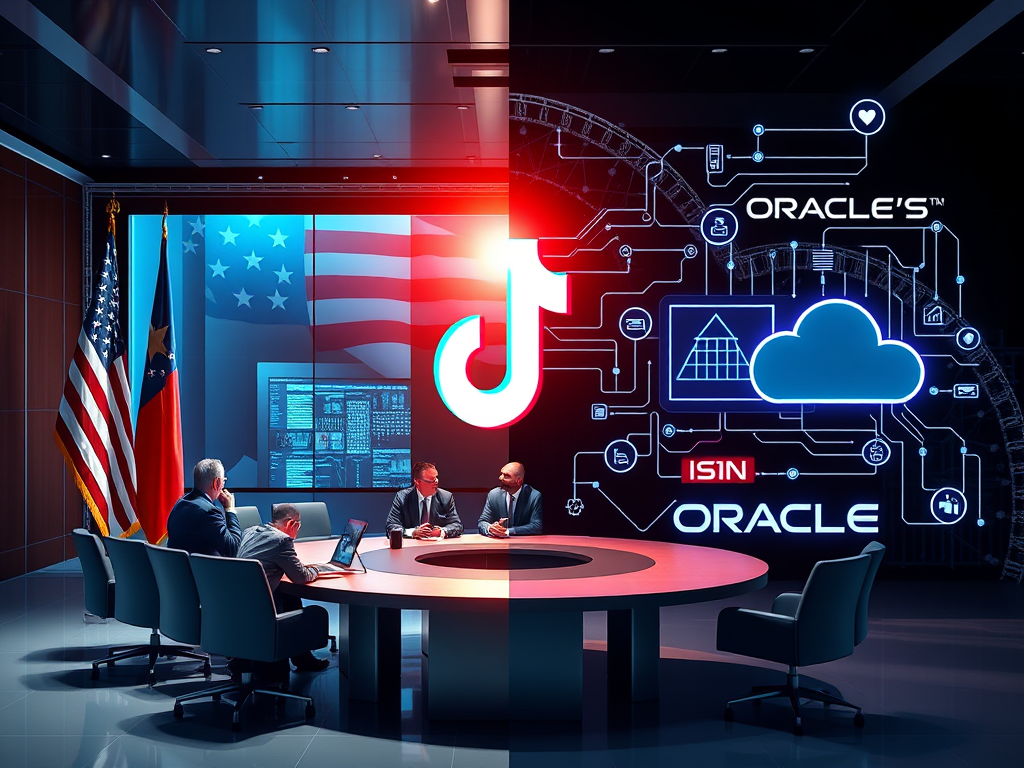

The future of TikTok in the United States appears closer to resolution after the White House offered new details about an agreement that could allow the platform to remain accessible to millions of American users. On Saturday, White House press secretary Karoline Leavitt appeared on Fox News and outlined key elements of a deal designed to safeguard American user data while keeping the popular short-video app operational.
According to Leavitt, the technology company Oracle will play a central role in the proposed framework by overseeing data and privacy management for what she described as a new “American TikTok.” She also noted that the governance structure of the U.S. entity would be reshaped, with a board dominated by American directors.
While Leavitt emphasized that the United States is “100 percent confident that a deal is done,” she acknowledged that the agreement had not yet been formally signed. She suggested the finalization could come in the next few days, adding that momentum is moving in the right direction.
A Bipartisan Push to Restructure TikTok
The debate over TikTok’s future in the United States has been ongoing for several years. Concerns about the Chinese ownership of the platform have united lawmakers across party lines, an increasingly rare occurrence in Washington. Last year, Congress passed legislation requiring TikTok to either divest from its Chinese parent company, ByteDance, or face a nationwide ban.
The law reflects longstanding fears that Beijing could leverage its influence over ByteDance to access sensitive American data or use TikTok as a tool for propaganda. The legislation also sought to address national security risks surrounding foreign access to advanced recommendation algorithms, which are at the heart of TikTok’s influence on digital culture.
President Donald Trump, who has repeatedly called for a resolution to the issue, told reporters on Friday that Chinese President Xi Jinping had already signaled approval of the deal. Similarly, China’s Ministry of Commerce announced over the weekend that both governments had reached a basic framework for moving forward, although their statement lacked the specific details offered by Leavitt.

Structure of the Proposed Deal
Leavitt’s comments confirmed reports that ByteDance has been working for months on a plan to create a separate American entity for TikTok. Under this structure, the company would spin off an independent U.S. TikTok, with a new board consisting of seven seats—six of which would be held by Americans.
In addition, Oracle would take the lead role in safeguarding user data. Oracle already provides cloud computing resources for TikTok, but under the new arrangement, it would be formally responsible for the app’s “data and privacy” operations. This move is intended to address widespread fears that user information could be vulnerable to foreign surveillance.
Another major element of the deal involves reducing ByteDance’s direct ownership. Some of TikTok’s largest current investors would retain their stakes in the American version of the platform, while new U.S. investors would be brought in to bring Chinese ownership below the 20 percent threshold mandated by U.S. law.
Speculation had been growing that Oracle, founded by billionaire Larry Ellison, would be central to the investor consortium. Leavitt’s confirmation reinforced the idea that Oracle’s involvement will go beyond cloud services, giving it a critical role in the governance of TikTok’s American operations.
The Algorithm Question
Perhaps the most sensitive issue in the negotiations has been TikTok’s recommendation algorithm—the technology that powers the platform’s “For You” page and keeps users engaged. Control of this algorithm has been a sticking point, as Chinese export laws require such technology to remain under Chinese oversight, while U.S. law demands that TikTok sever all operational ties with ByteDance.
Leavitt addressed this directly, stating that TikTok’s algorithm would ultimately be “controlled by America.” However, she did not provide clarity on whether the technology would be fully transferred, licensed, or otherwise modified to comply with U.S. requirements.
The question of algorithmic control is not just a legal issue—it strikes at the core of TikTok’s identity. Without the recommendation system that differentiates it from other platforms, TikTok would risk losing the unique appeal that propelled it to global popularity.
A Deal Years in the Making
The announcement represents the closest step yet toward resolving TikTok’s uncertain future in the U.S. The legislation forcing TikTok to divest from ByteDance officially went into effect in January, after the Supreme Court rejected challenges to the law. However, President Trump has delayed enforcement of the shutdown four times, keeping the app alive while negotiations continued.
China has historically been the main obstacle to progress. When U.S. officials first pressed ByteDance to sell TikTok, Beijing swiftly revised its export control rules to cover technologies such as algorithms and source codes. This move gave the Chinese government veto power over any international transfer of TikTok’s core technologies.
Despite this, the latest signals from Beijing suggest a more cooperative stance. While Chinese officials have remained vague in their statements, Trump administration figures appear confident that China is prepared to support the current framework.
Balancing Privacy and Innovation
For millions of American users and creators, the outcome of these negotiations could shape the digital ecosystem for years to come. TikTok has become a cultural powerhouse, influencing music, fashion, politics, and education. A U.S.-based entity with strict privacy safeguards could preserve these creative communities while addressing national security concerns.
Leavitt underscored this balance, noting that President Trump “recognized the need to protect Americans’ privacy and data while also keeping this app open.” She framed the deal as one that “puts Americans first,” aiming to protect both security and innovation.
The involvement of Oracle reflects a broader trend of American tech companies stepping into roles that blend corporate oversight with national security interests. If the deal is finalized, it could serve as a model for how the U.S. manages foreign-owned platforms in the future.
Looking Ahead
Neither ByteDance nor Oracle has issued a formal response to the White House’s announcement. Their silence leaves some questions unanswered, particularly regarding the technical handling of TikTok’s algorithm and the precise ownership structure of the U.S. entity.
Nonetheless, the tone of Leavitt’s remarks suggests that an agreement is imminent. If completed, the deal would mark the end of years of speculation and provide stability for the app’s 150 million American users.
The TikTok saga has highlighted the intersection of global technology, politics, and national security. It has also demonstrated how a single app can become a focal point of international negotiations. For now, all eyes remain on Washington and Beijing as the final details are ironed out.
Whether the U.S.-China TikTok agreement will become a long-term solution or just a temporary compromise remains to be seen. But for users scrolling through their feeds this weekend, the prospect of keeping TikTok alive in the United States looks more promising than ever.




Leave a Reply