
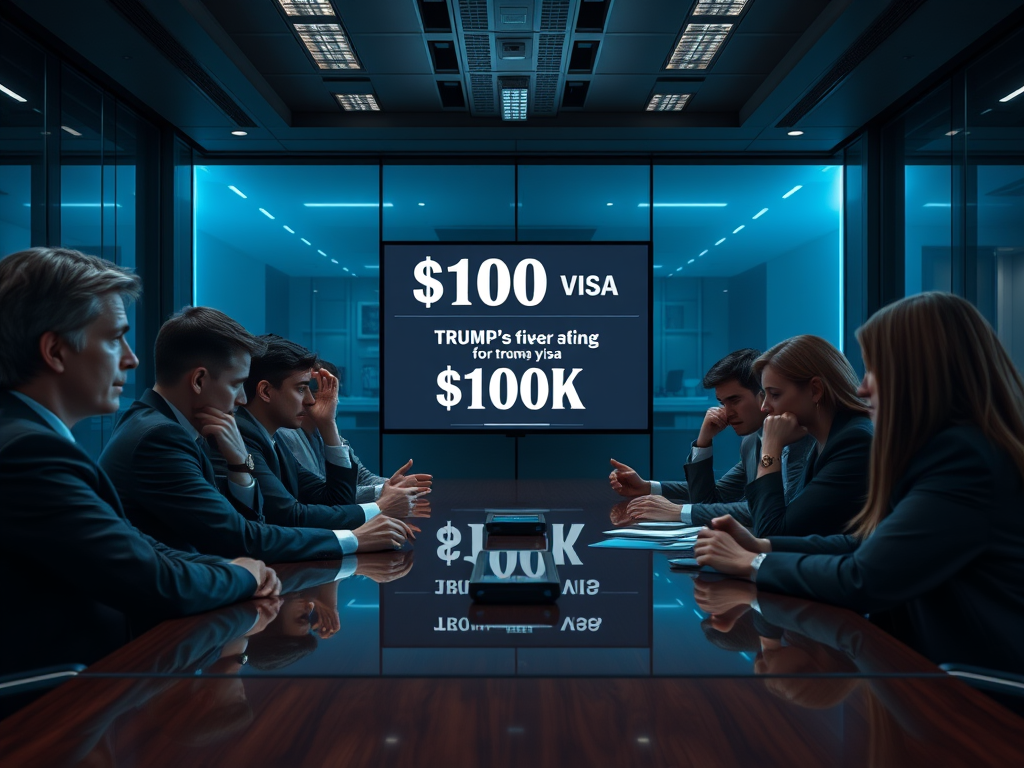

Wall Street banks and Silicon Valley giants were thrown into disarray this weekend as they tried to grasp the full impact of President Trump’s unexpected proclamation imposing a $100,000 fee for skilled foreign worker visas. The order, signed late Friday, triggered widespread anxiety among multinational corporations, immigration lawyers, and thousands of employees working in the United States on H-1B visas.
A Weekend of Uncertainty
Immediately after the announcement, confusion spread about how the new rules would be enforced. Employees at companies such as Microsoft, Amazon, and JPMorgan Chase received urgent internal memos warning H-1B visa holders abroad to return to the U.S. before the rule took effect at 12:01 a.m. Eastern Time on Sunday.
By Saturday, the administration attempted to calm fears, clarifying that the fee would apply only to new H-1B applicants and not to existing visa holders or renewals. The White House posted on social media that the change would “not impact the ability of any current visa holder to travel to or from the United States.”
Even so, corporate legal teams, HR departments, and immigration counsel remained on edge. Many companies still urged their foreign employees to return to the country immediately. For executives, the risk of misinterpreting the order was too high, and for employees, the prospect of being stranded overseas loomed large.
Industry Leaders Voice Concerns
Financial institutions and tech firms, both of which rely heavily on skilled foreign labor, scrambled to reassure staff. Goldman Sachs’ head of human capital management, Jacqueline Arthur, acknowledged the uncertainty in a memo to employees, promising that the bank was reviewing the order with its attorneys and would share updates as details became clearer.
Immigration law firms were inundated with questions. Bernhard Mueller, co-chair of the immigration practice group at Ogletree Deakins, described the atmosphere as “foggy conditions,” noting that board members and executives were desperate for guidance on how to communicate with employees.
Late Saturday, the U.S. Citizenship and Immigration Services (USCIS) issued a memo emphasizing that the order only applied prospectively to petitions not yet filed, but the reassurance did little to quell widespread unease.
The Broader Debate Over H-1B
The H-1B program has long been at the center of America’s immigration debate. Supporters argue it enables companies to hire top talent from around the world, particularly in fast-growing sectors like artificial intelligence, biotechnology, and cloud computing. Critics claim the system has been abused, allowing firms to hire foreign workers at lower wages, thereby displacing U.S. citizens.
The Trump administration framed the new fee as part of its “America First” agenda, insisting that the policy would encourage companies to prioritize domestic workers. White House spokesperson Taylor Rogers said the move would discourage firms from “spamming the system and driving down wages.”
However, industry leaders and trade groups pushed back, warning that such a steep fee could cripple smaller businesses and hinder innovation. The U.S. Chamber of Commerce quickly began discussions with the administration, stressing concerns about employees, their families, and the competitiveness of American employers in global markets.

Silence From Tech Giants
While the tech sector is one of the largest users of H-1B visas, companies like Amazon, Meta, Google, Apple, and Walmart remained largely silent, declining to comment or not responding to media inquiries. Their reluctance underscored both the sensitivity of the issue and the scale of the potential disruption.
Some policy analysts expressed alarm about long-term implications. Adam Kovacevich, CEO of the Chamber of Progress, warned that the rule could weaken America’s global standing in critical industries. “We’re fighting the AI war with one hand tied behind our back,” he said, emphasizing the scarcity of top-tier AI talent worldwide, much of it foreign-born.
Lawsuits on the Horizon
Legal challenges appeared inevitable. The American Immigration Lawyers Association (AILA) announced it was preparing to file for an emergency restraining order. Jeff Joseph, AILA’s president, confirmed that groups were strategizing throughout the weekend to identify plaintiffs spanning a range of industries.
Benjamin Johnson, AILA’s executive director, said immigration lawyers were “dealing with chaos” as clients scrambled for clarity. Panic was especially high among workers already abroad, uncertain whether they could return to the U.S. without facing financial or legal obstacles.
Personal Stories of Disruption
For many individuals, the policy created immediate turmoil. One 29-year-old Indian software engineer in Munich described feeling “clueless” after learning about the order just weeks before his new H-1B position was due to start in the United States. His employer advised him to stay in Germany until further notice.
Microsoft, which employs more than 5,000 H-1B workers, emailed staff on Friday advising those already in the U.S. to remain there “for the foreseeable future” to avoid denial of reentry. The message highlighted how quickly the proclamation disrupted travel plans and instilled fear among visa holders.
Supporters Praise the Change
Not everyone opposed the decision. Some conservative think tanks applauded the administration for taking action. Lora Ries of the Heritage Foundation called the fee a “good start” toward reform, arguing it would force companies to be more selective about which foreign workers they hired and reduce opportunities for wage suppression.

Economic and Strategic Concerns
Despite this praise, many business leaders worried about the broader economic impact. Venture capitalist Alan Patricof pointed out that startups — often unprofitable for years — would be particularly disadvantaged. “There is not a single company I have invested in the last decade that could afford this fee,” he said, warning that innovation could be stifled.
The annual H-1B visa cap of 85,000 slots is typically oversubscribed, with the majority of visas going to Indian citizens. The Indian government voiced concern that the new policy could disrupt families and create humanitarian consequences. The Ministry of External Affairs said it was still assessing the full implications of the rule.
Mukesh Aghi, CEO of the U.S.-India Strategic Partnership Forum, acknowledged the administration’s desire to prevent misuse of the H-1B system but emphasized the need to avoid penalizing companies that are actively creating jobs in America.
The Road Ahead
The introduction of a $100,000 H-1B visa fee marks a dramatic shift in U.S. immigration and labor policy. While framed as a measure to protect American workers, critics argue it risks undermining the country’s ability to attract global talent, particularly in cutting-edge fields that depend on highly skilled labor.
As lawsuits move forward and industries lobby for exemptions, the coming weeks will determine whether this policy becomes a lasting feature of the American labor market or a short-lived political maneuver. What is certain is that the order has already reshaped corporate strategy, disrupted individual lives, and injected new volatility into the debate over the future of skilled immigration in the United States.




Leave a Reply